
五味子甲素通过 ALOX5 调控 PI3K-AKT 信号通路抑制膀胱癌细胞的增殖、迁移和侵袭。
Deoxyschizandrin Inhibits the Proliferation, Migration, and Invasion of Bladder Cancer Cells through ALOX5 Regulating PI3K-AKT Signaling Pathway.
机构信息
Department of Urology, The First Affiliated Hospital of Jiamusi University, Heilongjiang 154007, China.
Department of Vascular Surgery, The First Affiliated Hospital of Jiamusi University, Heilongjiang 154007, China.
出版信息
J Immunol Res. 2022 May 25;2022:3079823. doi: 10.1155/2022/3079823. eCollection 2022.
OBJECTIVE
Deoxyschizandrin has a significant inhibitory effect on a variety of tumor cells. However, the effect of Deoxyschizandrin on bladder cancer cells and its mechanism are still unclear.
METHODS
Bladder cancer cells were treated with different concentrations of Deoxyschizandrin for 24 h, 48 h, and 72 h. The inhibition rate of cell proliferation was detected by CCK-8 assay. The changes of cell migration and invasion were detected by wound healing and Transwell assay. Based on the structure of Deoxyschizandrin, the protein targets of Deoxyschizandrin were predicted by bioinformatics database and verified by RNA and protein. Then, the expressions of ALOX5 and PI3K-AKT signaling pathway proteins were detected by Western blot in bladder cancer cells treated with Deoxyschizandrin.
RESULT
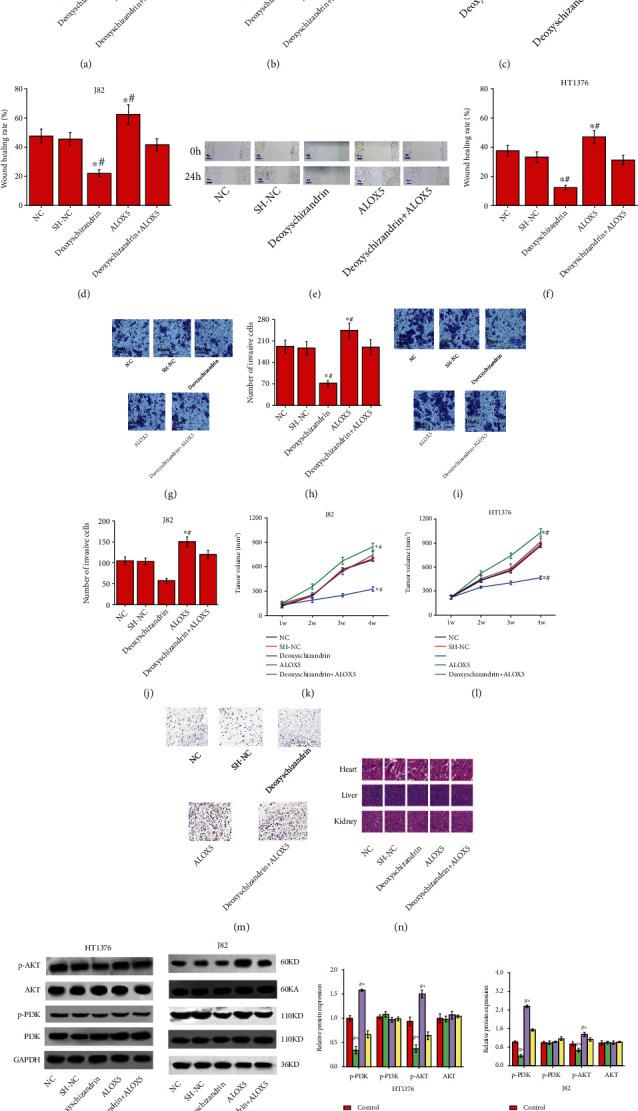
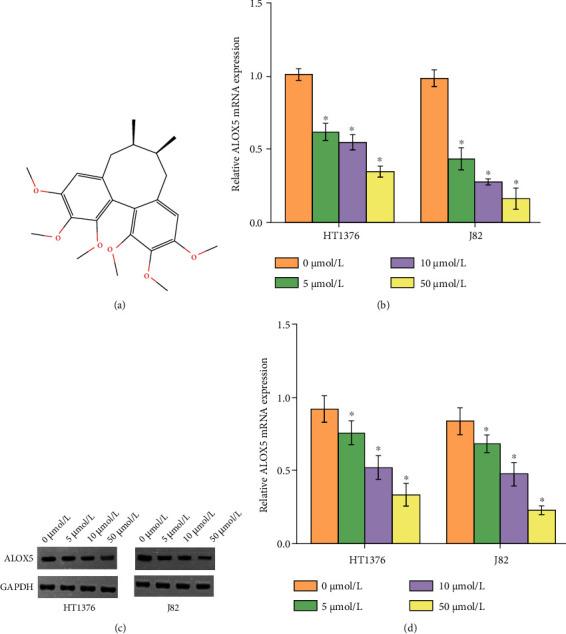
Deoxyschizandrin inhibited the proliferation, migration, and invasion of bladder cancer cells in a time- and concentration-dependent manner. Bioinformatics analysis showed that Deoxyschizandrin had 100 protein targets; among them, the score of ALOX5 was the highest, and the mRNA and protein levels of ALOX5 decreased after treatment with different concentrations of Deoxyschizandrin. Western blot results showed that compared with the control group, Deoxyschizandrin could significantly reduce the expression of p-PI3K and p-AKT, and overexpression of ALOX5 could significantly enhance the expression of p-PI3K and p-AKT. Compared with Deoxyschizandrin or overexpression of ALOX5, the expression of p-PI3K and p-AKT of Deoxyschizandrin combined with overexpression of ALOX5 recovered.
CONCLUSION
Deoxyschizandrin inhibits the proliferation, migration, and invasion of bladder cancer cells through ALOX5 regulating PI3K-AKT signaling pathway.
目的
五味子甲素对多种肿瘤细胞具有显著的抑制作用。然而,五味子甲素对膀胱癌细胞的作用及其机制尚不清楚。
方法
用不同浓度的五味子甲素处理膀胱癌细胞 24、48 和 72 小时。用 CCK-8 法检测细胞增殖抑制率。用划痕愈合和 Transwell 实验检测细胞迁移和侵袭的变化。基于五味子甲素的结构,通过生物信息学数据库预测五味子甲素的蛋白靶点,并通过 RNA 和蛋白进行验证。然后,用 Western blot 检测膀胱癌细胞中五味子甲素处理后 ALOX5 和 PI3K-AKT 信号通路蛋白的表达。
结果
五味子甲素呈时间和浓度依赖性抑制膀胱癌细胞的增殖、迁移和侵袭。生物信息学分析表明,五味子甲素有 100 个蛋白靶点;其中,ALOX5 的分数最高,用不同浓度的五味子甲素处理后,ALOX5 的 mRNA 和蛋白水平降低。Western blot 结果表明,与对照组相比,五味子甲素能显著降低 p-PI3K 和 p-AKT 的表达,而过表达 ALOX5 能显著增强 p-PI3K 和 p-AKT 的表达。与五味子甲素或 ALOX5 过表达相比,五味子甲素与 ALOX5 过表达联合处理后,p-PI3K 和 p-AKT 的表达恢复。
结论
五味子甲素通过 ALOX5 调节 PI3K-AKT 信号通路抑制膀胱癌细胞的增殖、迁移和侵袭。


 Zotero 插件