
基线肌肉量和肌脂肪变性对初治转移性胰腺癌患者一线化疗期间早期毒性反应发生的影响
Impact of Baseline Muscle Mass and Myosteatosis on the Development of Early Toxicity During First-Line Chemotherapy in Patients With Initially Metastatic Pancreatic Cancer.
作者信息
Hong Sun, Kim Kyung Won, Park Hyo Jung, Ko Yousun, Yoo Changhoon, Park Seo Young, Khang Seungwoo, Jeong Heeryeol, Lee Jeongjin
机构信息
Department of Radiology and Research Institute of Radiology, Asan Medical Center, University of Ulsan College of Medicine, Seoul, South Korea.
Biomedical Research Center, Asan Institute for Life Sciences, Asan Medical Center, Seoul, South Korea.
出版信息
Front Oncol. 2022 May 20;12:878472. doi: 10.3389/fonc.2022.878472. eCollection 2022.
OBJECTIVES
Although chemotherapy is the only treatment option for metastatic pancreatic cancer (PDAC), patients frequently encounter adverse events during chemotherapy leading deterioration of patients' quality of life and treatment interruption. We evaluated the role of baseline CT-assessed body composition in predicting early toxicity during first cycle of the first-line chemotherapy in patients with metastatic PDAC.
METHODS
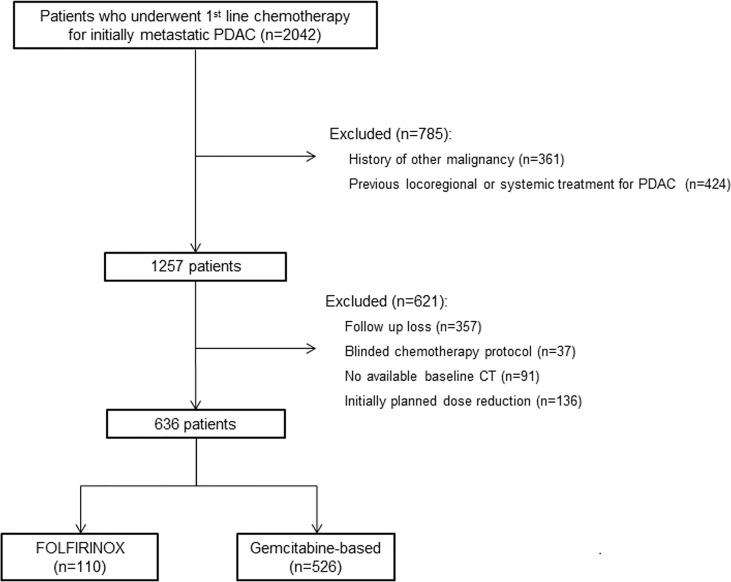
This retrospective study included 636 patients with initially metastatic PDAC who underwent first-line chemotherapy from January 2009 to December 2019. Chemotherapy regimen, baseline laboratory data, and body composition parameters acquired from baseline CT were obtained. The skeletal muscle index (SMI) was used to identify patients with a low muscle mass (SMI < 41 cm/m for women, and < 43 cm/m [body mass index < 25 cm/kg] or < 53 cm/m [body mass index ≥ 25 cm/kg] for men), and myosteatosis was defined as low-attenuated muscle area divided by skeletal muscle area (LAMA/SMA index) ≥ 20%. Univariate and multivariable binary logistic regression analyses were performed using bootstrapping with 500 interactions to identify predictors of grade 3-4 toxicity and any treatment-modifying toxicity which led to a dose reduction, delayed administration, drug skip or discontinuation.
RESULTS
During the first cycle of the first-line chemotherapy, grade 3-4 toxicity and treatment-modifying toxicity occurred in 160 patients (25.2%) and in 247 patients (38.8%), respectively. The presence of both low muscle mass and myosteatosis was significantly associated with the occurrence of both grade 3-4 toxicity (odd ratio [OR], 1.73; 95% confidence interval [CI], 1.14-2.63) and treatment-modifying toxicity (OR, 1.83; 95% CI, 1.26-2.66) whereas low muscle mass alone did not.
CONCLUSIONS
The presence of both low muscle mass and myosteatosis assessed on baseline CT may be used to predict early chemotherapy-related toxicity in patients with metastatic PDAC.
目的
尽管化疗是转移性胰腺癌(PDAC)的唯一治疗选择,但患者在化疗期间经常遭遇不良事件,导致生活质量下降和治疗中断。我们评估了基线CT评估的身体组成在预测转移性PDAC患者一线化疗第一周期早期毒性中的作用。
方法
这项回顾性研究纳入了2009年1月至2019年12月接受一线化疗的636例初诊转移性PDAC患者。获取化疗方案、基线实验室数据以及从基线CT获得的身体组成参数。骨骼肌指数(SMI)用于识别肌肉量低的患者(女性SMI<41cm/m,男性体重指数<25cm/kg时SMI<43cm/m,体重指数≥25cm/kg时SMI<53cm/m),肌脂变定义为低衰减肌肉面积除以骨骼肌面积(LAMA/SMA指数)≥20%。使用500次交互的自抽样进行单变量和多变量二元逻辑回归分析,以确定3-4级毒性和导致剂量减少、延迟给药、药物漏用或停药的任何治疗调整毒性的预测因素。
结果
在一线化疗的第一周期,160例患者(25.2%)发生了3-4级毒性,247例患者(38.8%)发生了治疗调整毒性。低肌肉量和肌脂变同时存在与3-4级毒性(比值比[OR],1.73;95%置信区间[CI],1.14-2.63)和治疗调整毒性(OR,1.83;95%CI,1.26-2.66)的发生均显著相关,而单独低肌肉量则不然。
结论
基线CT评估的低肌肉量和肌脂变同时存在可用于预测转移性PDAC患者早期化疗相关毒性。


 Zotero 插件