
三种易获取的口罩消毒方法的微生物有效性评估及其对过滤性能、空气透气性和物理化学性能的影响。
Evaluation of the Microbiological Effectiveness of Three Accessible Mask Decontamination Methods and Their Impact on Filtration, Air Permeability and Physicochemical Properties.
机构信息
Centre for Mechanical Engineering, Materials and Processes (CEMMPRE), Department of Life Sciences, University of Coimbra, 3000-456 Coimbra, Portugal.
Chemical Process Engineering and Forest Products Research Centre (CIEPQPF), Department of Chemical Engineering, University of Coimbra, Rua Sílvio Lima, Pólo II-Pinhal de Marrocos, 3030-790 Coimbra, Portugal.
出版信息
Int J Environ Res Public Health. 2022 May 27;19(11):6567. doi: 10.3390/ijerph19116567.
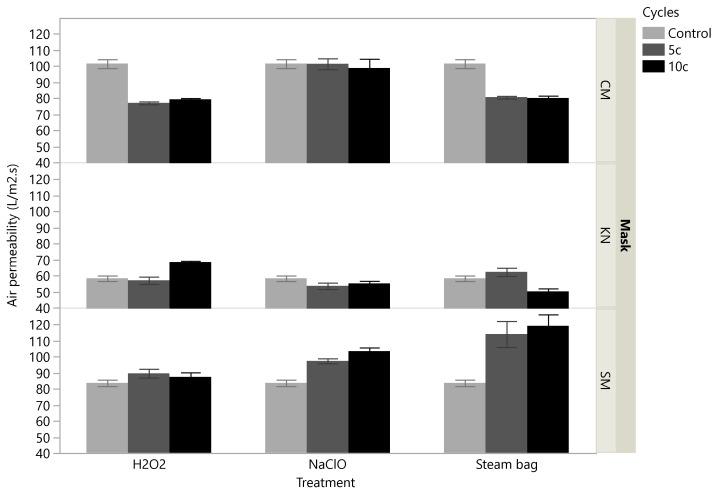
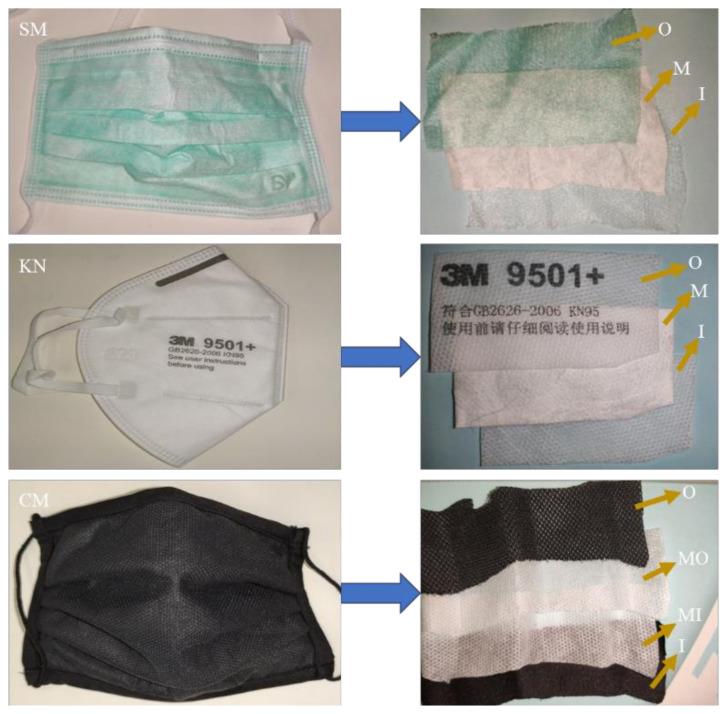
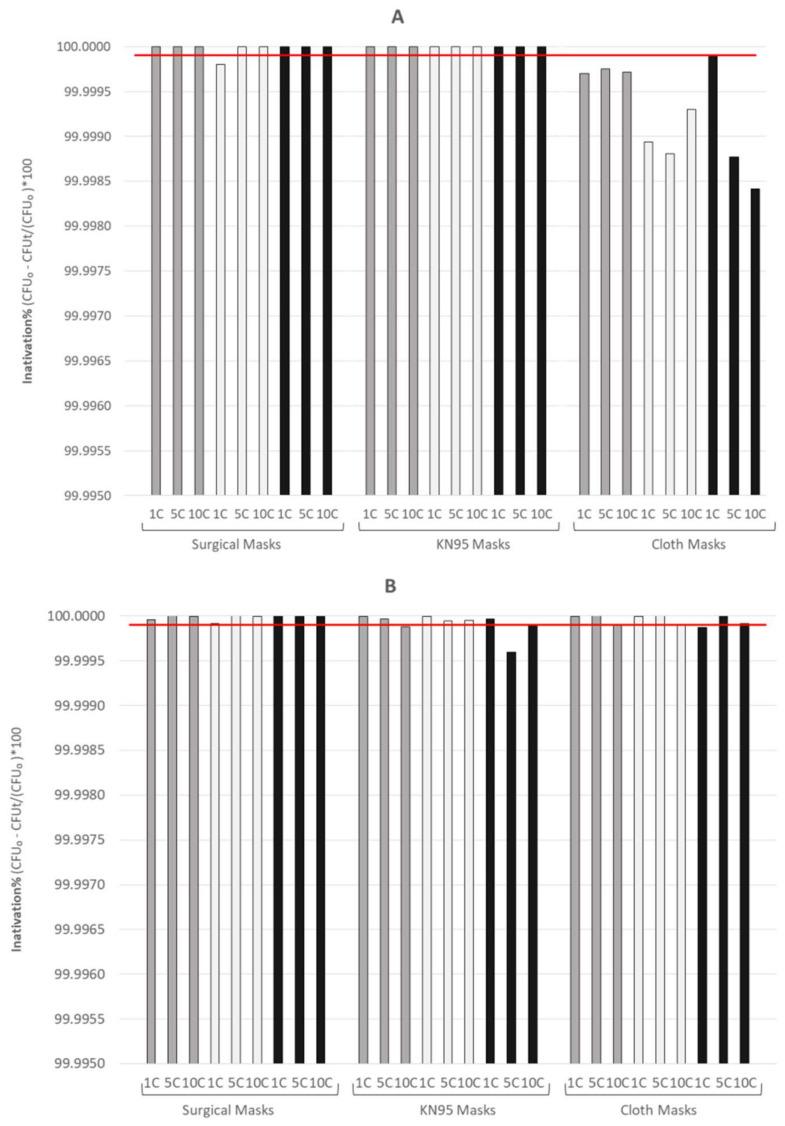
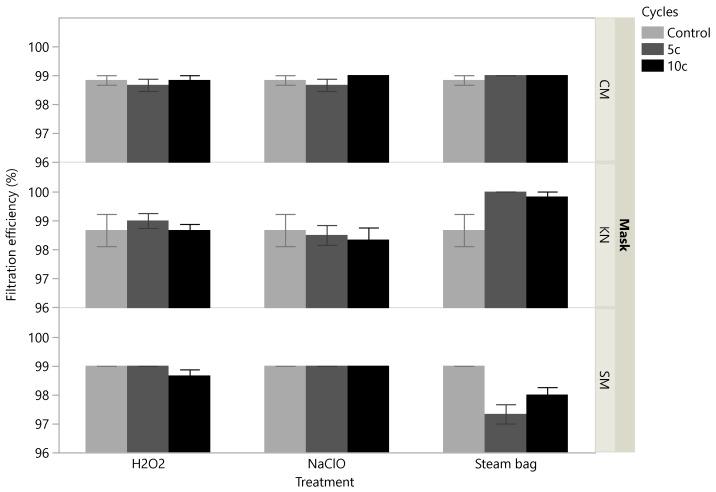
The need to secure public health and mitigate the environmental impact associated with the massified use of respiratory protective devices (RPD) has been raising awareness for the safe reuse of decontaminated masks by individuals and organizations. Among the decontamination treatments proposed, in this work, three methods with the potential to be adopted by households and organizations of different sizes were analysed: contact with nebulized hydrogen peroxide (H2O2); immersion in commercial bleach (NaClO) (sodium hypochlorite, 0.1% p/v); and contact with steam in microwave steam-sanitizing bags (steam bag). Their decontamination effectiveness was assessed using reference microorganisms following international standards (issued by ISO and FDA). Furthermore, the impact on filtration efficiency, air permeability and several physicochemical and structural characteristics of the masks, were evaluated for untreated masks and after 1, 5 and 10 cycles of treatment. Three types of RPD were analysed: surgical, KN95, and cloth masks. Results demonstrated that the H2O2 protocol sterilized KN95 and surgical masks (reduction of >6 log10 CFUs) and disinfected cloth masks (reduction of >3 log10 CFUs). The NaClO protocol sterilized surgical masks, and disinfected KN95 and cloth masks. Steam bags sterilized KN95 and disinfected surgical and cloth masks. No relevant impact was observed on filtration efficiency.
安全保障公众健康和减轻与大量使用呼吸防护设备(RPD)相关的环境影响的需求,促使个人和组织提高对经消毒处理的口罩安全再利用的认识。在提出的消毒处理方法中,本工作分析了三种具有被不同规模的家庭和组织采用潜力的方法:与雾化过氧化氢(H2O2)接触;浸泡在商业漂白剂(NaClO)(次氯酸钠,0.1%p/v)中;以及在微波蒸汽消毒袋(蒸汽袋)中与蒸汽接触。根据国际标准(由 ISO 和 FDA 发布),使用参考微生物评估了它们的消毒效果。此外,还评估了未经处理的口罩和经过 1、5 和 10 次处理循环后的口罩的过滤效率、透气性以及几种物理化学和结构特性的变化。分析了三种类型的 RPD:手术口罩、KN95 和布口罩。结果表明,H2O2 方案对 KN95 和手术口罩进行了灭菌(减少>6 log10 CFU),并对布口罩进行了消毒(减少>3 log10 CFU)。NaClO 方案对手术口罩进行了灭菌,并对 KN95 和布口罩进行了消毒。蒸汽袋对 KN95 进行了灭菌,并对手术口罩和布口罩进行了消毒。过滤效率没有观察到明显的变化。

 Zotero 插件