
福雷替尼可克服 MET 外显子 14 跳跃突变的 NSCLC 患者接受卡马替尼/替泊替尼治疗后的常见靶标耐药突变。
Foretinib can overcome common on-target resistance mutations after capmatinib/tepotinib treatment in NSCLCs with MET exon 14 skipping mutation.
机构信息
Division of Thoracic Surgery, Department of Surgery, Kindai University Faculty of Medicine, 377-2 Ohno-Higashi, Osaka-Sayama, 589-8511, Japan.
出版信息
J Hematol Oncol. 2022 Jun 11;15(1):79. doi: 10.1186/s13045-022-01299-z.
BACKGROUND
Capmatinib and tepotinib are guideline-recommended front-line treatments for non-small-cell lung cancer (NSCLC) patients with MET exon 14 skipping mutations (METex14). However, the emergence of acquired resistance to capmatinib/tepotinib is almost inevitable partially due to D1228X or Y1230X secondary mutations of the MET. In this study, we explored agents that are active against both D1228X and Y1230X MET to propose an ideal sequential treatment after capmatinib/tepotinib treatment failure in NSCLC patients with METex14.
METHODS
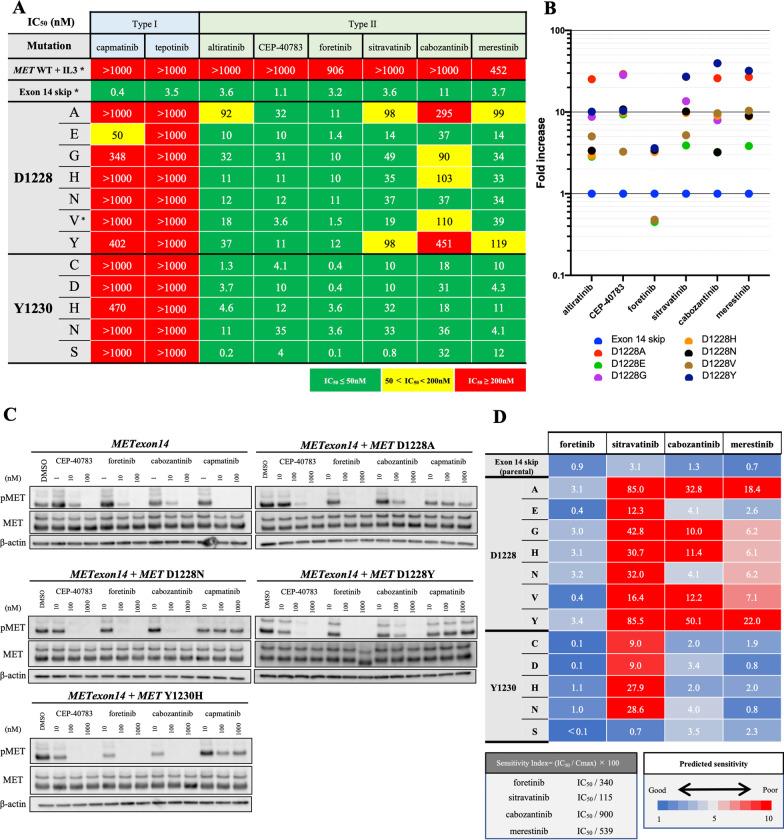
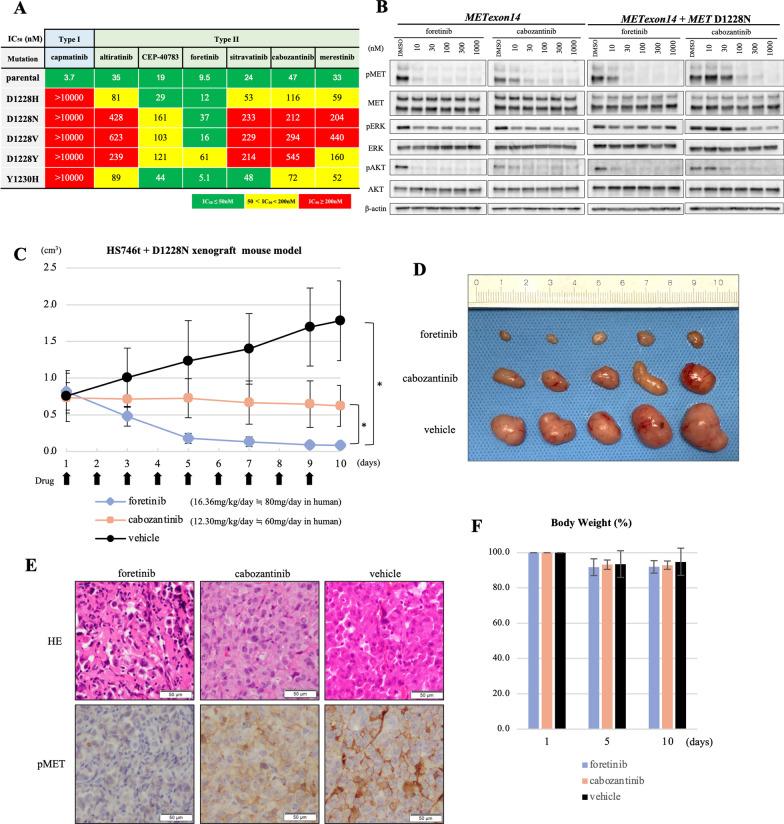
The inhibitory effects of 300 drugs, including 33 MET-TKIs, were screened in Ba/F3 cells carrying METex14 plus MET D1228A/Y secondary mutations. The screen revealed four-candidate type II MET-TKIs (altiratinib, CEP-40783, foretinib and sitravatinib). Therefore, we performed further growth inhibitory assays using these four MET-TKIs plus cabozantinib and merestinib in Ba/F3 cells carrying MET D1228A/E/G/H/N/V/Y or Y1230C/D/H/N/S secondary mutations. We also performed analyses using Hs746t cell models carrying METex14 (with mutant allele amplification) with/without D1228X or Y1230X in vitro and in vivo to confirm the findings. Furthermore, molecular dynamics (MD) simulations were carried out to examine differences in binding between type II MET-TKIs.
RESULTS
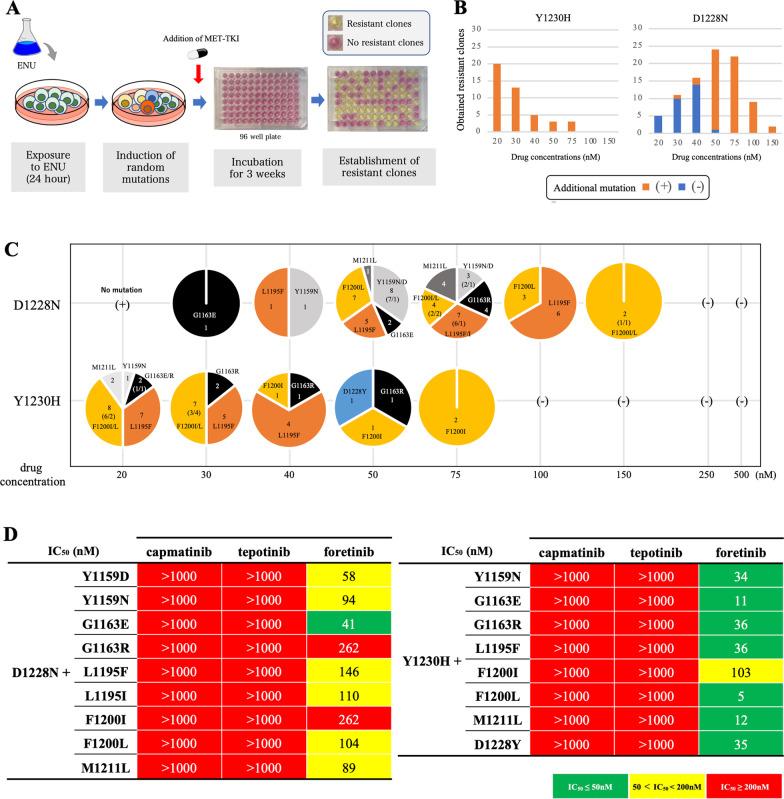
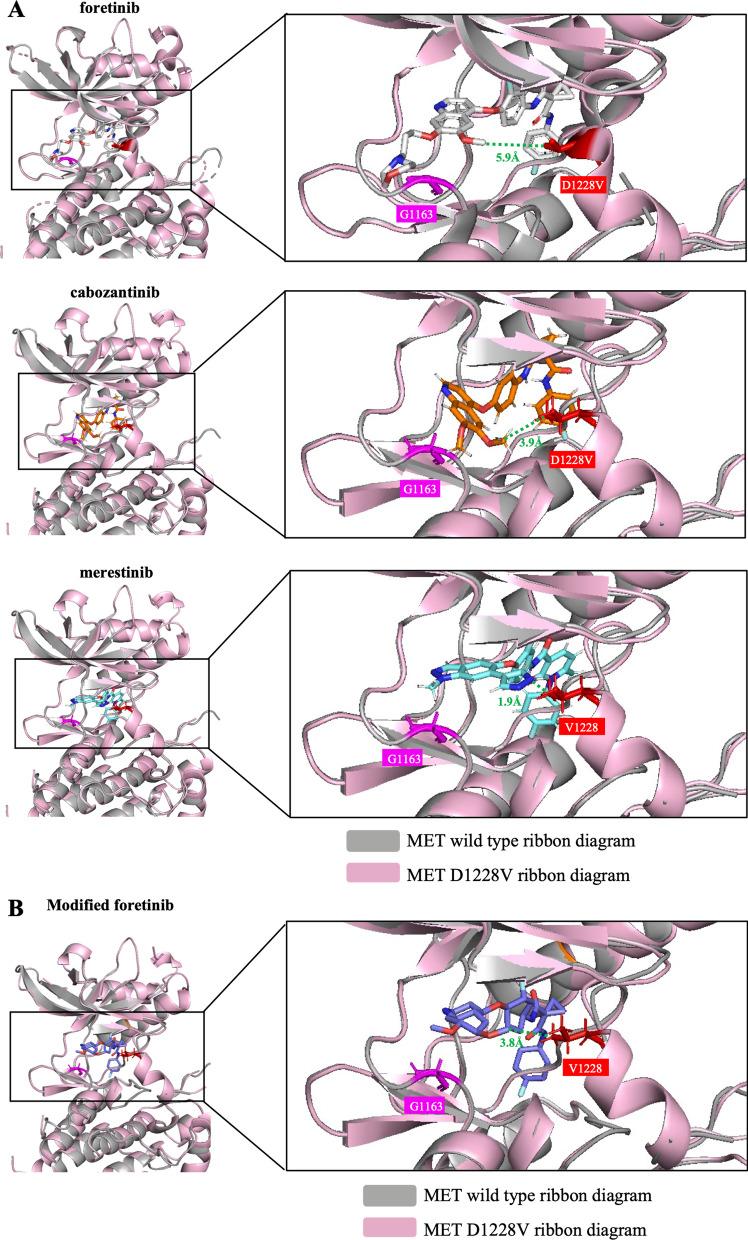
All 6 type II MET-TKIs were active against Y1230X secondary mutations. However, among these 6 agents, only foretinib showed potent activity against D1228X secondary mutations of the MET in the Ba/F3 cell and Hs746t in vitro model and Hs746t in vivo model, and CEP-40783 and altiratinib demonstrated some activity. MD analysis suggested that the long tail of foretinib plays an important role in binding D1228X MET through interaction with a residue at the solvent front (G1163). Tertiary G1163X mutations, together with L1195F/I and F1200I/L, occurred as acquired resistance mechanisms to the second-line treatment foretinib in Ba/F3 cell models.
CONCLUSIONS
The type II MET-TKI foretinib may be an appropriate second-line treatment for NSCLCs carrying METex14 after campatinib/tepotinib treatment failure by secondary mutations at residue D1228 or Y1230.
背景
卡马替尼和特泊替尼是指南推荐的用于治疗非小细胞肺癌(NSCLC)患者 MET 外显子 14 跳跃突变(METex14)的一线治疗药物。然而,卡马替尼/特泊替尼的获得性耐药几乎是不可避免的,部分原因是 MET 的 D1228X 或 Y1230X 继发突变。在这项研究中,我们探索了对 D1228X 和 Y1230X MET 均有活性的药物,以提出 METex14 NSCLC 患者在卡马替尼/特泊替尼治疗失败后的理想序贯治疗方案。
方法
在携带 METex14 加 MET D1228A/Y 继发突变的 Ba/F3 细胞中筛选了 300 种药物(包括 33 种 MET-TKIs)的抑制作用。筛选发现了四种 II 型 MET-TKIs(altiratinib、CEP-40783、foretinib 和 sitravatinib)。因此,我们使用这四种 MET-TKIs 加 cabozantinib 和 merestinib 在携带 MET D1228A/E/G/H/N/V/Y 或 Y1230C/D/H/N/S 继发突变的 Ba/F3 细胞中进一步进行了生长抑制试验。我们还使用携带 METex14(带有突变等位基因扩增)的 Hs746t 细胞模型进行了体外和体内分析,以确认这些发现。此外,进行了分子动力学(MD)模拟,以检查 II 型 MET-TKIs 之间的结合差异。
结果
所有 6 种 II 型 MET-TKIs 对 Y1230X 继发突变均有活性。然而,在这 6 种药物中,只有 foretinib 在 Ba/F3 细胞和 Hs746t 的体外和体内模型中对 MET 的 D1228X 继发突变表现出强大的活性,而 CEP-40783 和 altiratinib 则表现出一定的活性。MD 分析表明,foretinib 的长尾通过与溶剂前沿(G1163)上的残基相互作用,在与 D1228X MET 结合中发挥重要作用。三级 G1163X 突变与 L1195F/I 和 F1200I/L 一起,是 Ba/F3 细胞模型中对二线治疗药物 foretinib 产生获得性耐药的机制。
结论
II 型 MET-TKI foretinib 可能是 METex14 NSCLC 患者在卡马替尼/特泊替尼治疗失败后,通过 D1228 或 Y1230 残基继发突变的二线治疗的合适选择。

 Zotero 插件