
根据剂量绘制膀胱癌放疗后局部失败图谱。
Mapping Local Failure Following Bladder Radiotherapy According to Dose.
机构信息
Division of Radiotherapy and Imaging, The Institute of Cancer Research, London, UK; Department of Radiotherapy, The Royal Marsden NHS Foundation Trust, London, UK.
Joint Department of Physics, The Institute of Cancer Research and The Royal Marsden NHS Foundation Trust, London, UK.
出版信息
Clin Oncol (R Coll Radiol). 2022 Oct;34(10):e421-e429. doi: 10.1016/j.clon.2022.05.003. Epub 2022 Jun 9.
AIMS
To determine the relationship between local relapse following radical radiotherapy for muscle-invasive bladder cancer (MIBC) and radiation dose.
MATERIALS AND METHODS
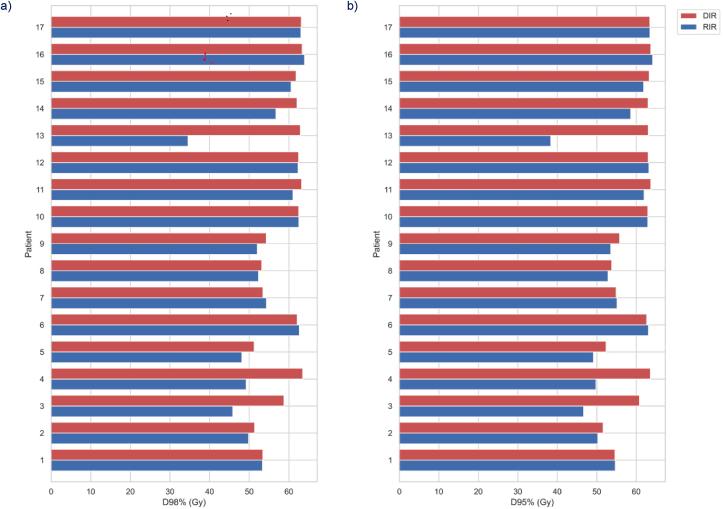
Patients with T2-4N0-3M0 MIBC were recruited to a phase II study assessing the feasibility of intensity-modulated radiotherapy to the bladder and pelvic lymph nodes. Patients were planned to receive 64 Gy/32 fractions to the bladder tumour, 60 Gy/32 fractions to the involved pelvic nodes and 52 Gy/32 fractions to the uninvolved bladder and pelvic nodes. Pre-treatment set-up was informed by cone-beam CT. For patients who experienced local relapse, cystoscopy and imaging (CT/MRI) was used to reconstruct the relapse gross tumour volume (GTV) on the original planning CT . GTV D98% and D95% was determined by co-registering the relapse image to the planning CT utilising deformable image registration (DIR) and rigid image registration (RIR). Failure was classified into five types based on spatial and dosimetric criteria as follows: A (central high-dose failure), B (peripheral high-dose failure), C (central elective dose failure), D (peripheral elective dose failure) and E (extraneous dose failure).
RESULTS
Between June 2009 and November 2012, 38 patients were recruited. Following treatment, 18/38 (47%) patients experienced local relapse within the bladder. The median time to local relapse was 9.0 months (95% confidence interval 6.3-11.7). Seventeen of 18 patients were evaluable based on the availability of cross-sectional relapse imaging. A significant difference between DIR and RIR methods was seen. With the DIR approach, the median GTV D98% and D95% was 97% and 98% of prescribed dose, respectively. Eleven of 17 (65%) patients experienced type A failure and 6/17 (35%) patients type B failure. No patients had type C, D or E failure. MIBC failure occurred in 10/17 (59%) relapsed patients; of those, 7/11 (64%) had type A failure and 3/6 (50%) had type B failure. Non-MIBC failure occurred in 7/17 (41%) patients; 4/11 (36%) with type A failure and 3/6 (50%) with type B failure.
CONCLUSION
Relapse following radiotherapy occurred within close proximity to the original bladder tumour volume and within the planned high-dose region, suggesting possible biological causes for failure. We advise caution when considering margin reduction for future reduced high-dose radiation volume or partial bladder radiotherapy protocols.
目的
确定根治性放疗治疗肌层浸润性膀胱癌(MIBC)后局部复发与放疗剂量之间的关系。
材料和方法
招募了 T2-4N0-3M0 期 MIBC 患者参加一项评估膀胱和盆腔淋巴结调强放疗可行性的 II 期研究。患者计划接受 64 Gy/32 次的膀胱肿瘤 64 Gy/32 次、受累盆腔淋巴结 60 Gy/32 次和未受累膀胱和盆腔淋巴结 52 Gy/32 次。锥形束 CT 指导治疗前设置。对于经历局部复发的患者,采用膀胱镜和影像学(CT/MRI)在原始计划 CT 上重建复发的大体肿瘤体积(GTV)。通过共配准复发图像到计划 CT 利用形变图像配准(DIR)和刚性图像配准(RIR)来确定 GTV D98%和 D95%。根据空间和剂量学标准,将失败分为以下五种类型:A(中央高剂量失败)、B(外周高剂量失败)、C(中央选择剂量失败)、D(外周选择剂量失败)和 E(额外剂量失败)。
结果
2009 年 6 月至 2012 年 11 月期间,共招募了 38 名患者。治疗后,38 名患者中有 18 名(47%)出现膀胱内局部复发。局部复发的中位时间为 9.0 个月(95%置信区间 6.3-11.7)。18 名患者中,有 17 名(94%)根据横断面上的复发影像学评估进行评估。观察到 DIR 和 RIR 方法之间存在显著差异。使用 DIR 方法,GTV D98%和 D95%的中位数分别为规定剂量的 97%和 98%。17 名患者中有 11 名(65%)发生 A 型失败,6 名(35%)发生 B 型失败。没有患者发生 C、D 或 E 型失败。17 名复发病例中有 10 名(59%)发生 MIBC 失败;其中,7 名(64%)发生 A 型失败,3 名(50%)发生 B 型失败。17 名患者中有 7 名(41%)发生非 MIBC 失败;其中,4 名(36%)发生 A 型失败,3 名(50%)发生 B 型失败。
结论
放疗后复发发生在与原始膀胱肿瘤体积非常接近的位置,并在计划的高剂量区域内,这表明失败可能存在生物学原因。在考虑减少未来高剂量放疗体积或部分膀胱放疗方案的边界时,应谨慎。


 Zotero 插件