
循环多不饱和脂肪酸在心血管疾病风险中的作用:基于英国生物库超过 114000 名参与者的孟德尔随机化和脂肪酸遗传关联数据的分析。
Role of circulating polyunsaturated fatty acids on cardiovascular diseases risk: analysis using Mendelian randomization and fatty acid genetic association data from over 114,000 UK Biobank participants.
机构信息
MRC Integrative Epidemiology Unit, University of Bristol, Oakfield House, Oakfield Grove, Bristol, BS8 2BN, UK.
Population Health Sciences, Bristol Medical School, University of Bristol, Bristol, UK.
出版信息
BMC Med. 2022 Jun 13;20(1):210. doi: 10.1186/s12916-022-02399-w.
BACKGROUND
Despite early interest in the health effects of polyunsaturated fatty acids (PUFA), there is still substantial controversy and uncertainty on the evidence linking PUFA to cardiovascular diseases (CVDs). We investigated the effect of plasma concentration of omega-3 PUFA (i.e. docosahexaenoic acid (DHA) and total omega-3 PUFA) and omega-6 PUFA (i.e. linoleic acid and total omega-6 PUFA) on the risk of CVDs using Mendelian randomization.
METHODS
We conducted the largest genome-wide association study (GWAS) of circulating PUFA to date including a sample of 114,999 individuals and incorporated these data in a two-sample Mendelian randomization framework to investigate the involvement of circulating PUFA on a wide range of CVDs in up to 1,153,768 individuals of European ancestry (i.e. coronary artery disease, ischemic stroke, haemorrhagic stroke, heart failure, atrial fibrillation, peripheral arterial disease, aortic aneurysm, venous thromboembolism and aortic valve stenosis).
RESULTS
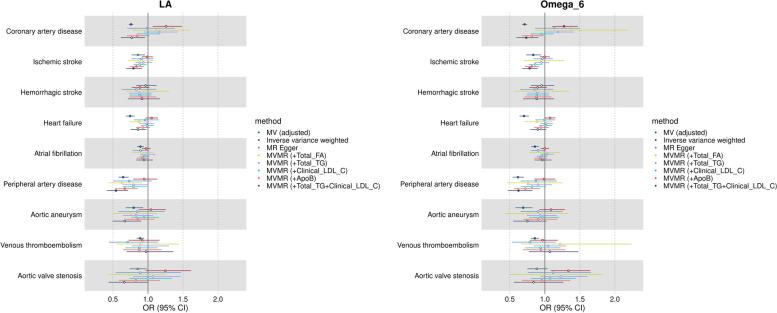
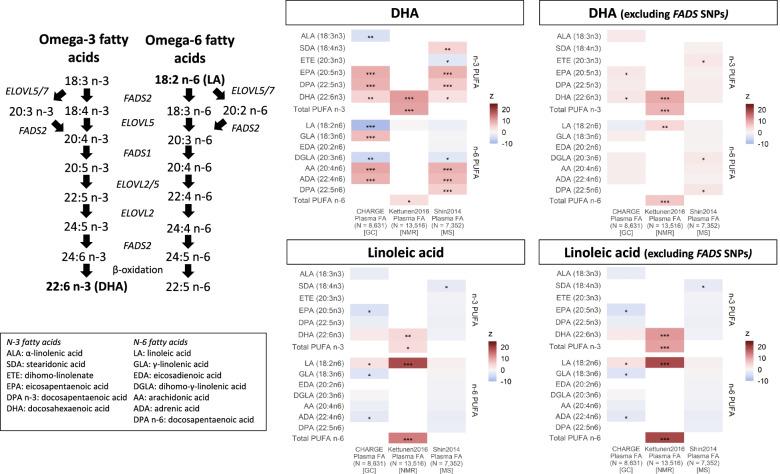
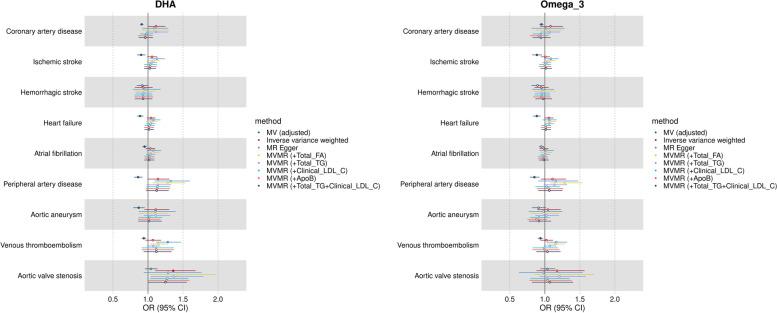
GWAS identified between 46 and 64 SNPs for the four PUFA traits, explaining 4.8-7.9% of circulating PUFA variance and with mean F statistics >100. Higher genetically predicted DHA (and total omega-3 fatty acids) concentration was related to higher risk of some cardiovascular endpoints; however, these findings did not pass our criteria for multiple testing correction and were attenuated when accounting for LDL-cholesterol through multivariable Mendelian randomization or excluding SNPs in the vicinity of the FADS locus. Estimates for the relation between higher genetically predicted linoleic acid (and total omega-6) concentration were inconsistent across different cardiovascular endpoints and Mendelian randomization methods. There was weak evidence of higher genetically predicted linoleic acid being related to lower risk of ischemic stroke and peripheral artery disease when accounting by LDL-cholesterol.
CONCLUSIONS
We have conducted the largest GWAS of circulating PUFA to date and the most comprehensive Mendelian randomization analyses. Overall, our Mendelian randomization findings do not support a protective role of circulating PUFA concentration on the risk of CVDs. However, horizontal pleiotropy via lipoprotein-related traits could be a key source of bias in our analyses.
背景
尽管人们很早就对多不饱和脂肪酸(PUFA)的健康影响产生了兴趣,但目前对于将 PUFA 与心血管疾病(CVD)联系起来的证据仍存在大量争议和不确定性。我们使用孟德尔随机化研究了血浆中 ω-3 PUFA(即二十二碳六烯酸(DHA)和总 ω-3 PUFA)和 ω-6 PUFA(即亚油酸和总 ω-6 PUFA)浓度对 CVD 风险的影响。
方法
我们进行了迄今为止最大的循环 PUFA 全基因组关联研究(GWAS),包括 114999 个人的样本,并将这些数据纳入两样本孟德尔随机化框架,以调查循环 PUFA 在欧洲血统的 1153768 个人中对广泛的 CVD 的影响(即冠状动脉疾病、缺血性中风、出血性中风、心力衰竭、心房颤动、外周动脉疾病、主动脉瘤、静脉血栓栓塞和主动脉瓣狭窄)。
结果
GWAS 确定了 46 到 64 个与四种 PUFA 特征相关的 SNP,解释了 4.8-7.9%的循环 PUFA 变异,平均 F 统计值>100。较高的遗传预测 DHA(和总 ω-3 脂肪酸)浓度与某些心血管终点的较高风险相关;然而,这些发现没有通过我们的多重测试校正标准,并且当通过多变量孟德尔随机化考虑 LDL-胆固醇或排除 FADS 基因座附近的 SNP 时,这些发现会减弱。不同心血管终点和孟德尔随机化方法之间,较高的遗传预测亚油酸(和总 ω-6)浓度与关系的估计值不一致。当考虑到 LDL-胆固醇时,遗传预测的亚油酸浓度较高与缺血性中风和外周动脉疾病的较低风险之间存在较弱的证据。
结论
我们进行了迄今为止最大的循环 PUFA GWAS 和最全面的孟德尔随机化分析。总体而言,我们的孟德尔随机化研究结果不支持循环 PUFA 浓度对 CVD 风险的保护作用。然而,脂蛋白相关特征的水平性平行可能是我们分析中偏倚的一个关键来源。
 Zotero 插件