
用于去除甲基橙的胺化多孔聚丙烯腈纳米纤维吸附剂的制备。
Preparation of aminated porous polyacrylonitrile nanofibers as adsorbent for methyl orange removal.
作者信息
Wu Qinghua, Ling Xionghui, Huang Weigeng, Zeng Xianhua, Fan Longfei, Lin Junyu, Yu Wenhui, Yao Jiaen, Wen Wu
机构信息
School of Textile Materials and Engineering, Wuyi University 22# Dongcheng Village Jiangmen Guangdong Province People's Republic of China
Guangdong Provincial Key Laboratory of Industrial Surfactant, Institute of Chemical Engineering, Guangdong Academy of Sciences China.
出版信息
RSC Adv. 2022 May 19;12(24):15337-15347. doi: 10.1039/d2ra00780k. eCollection 2022 May 17.
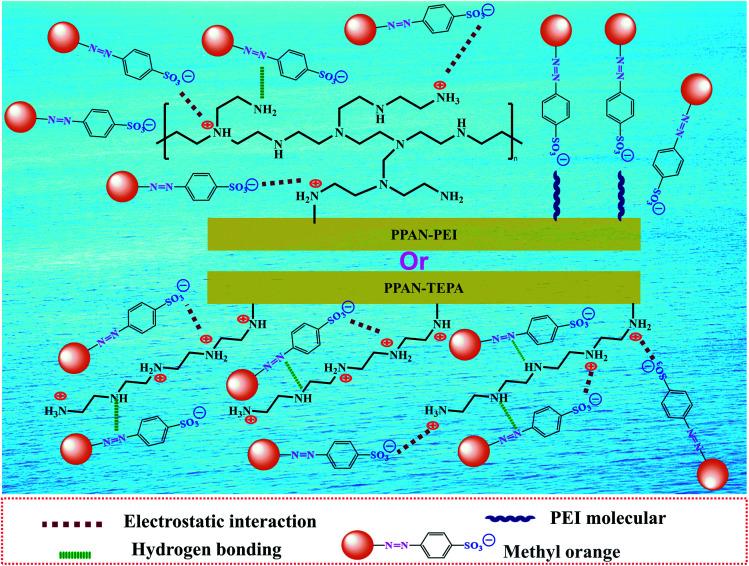
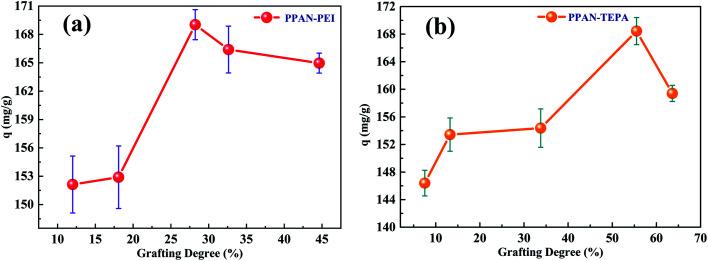
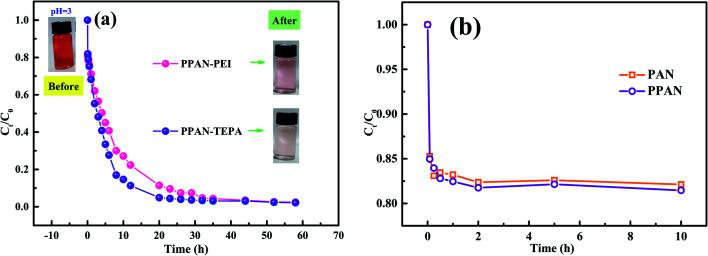
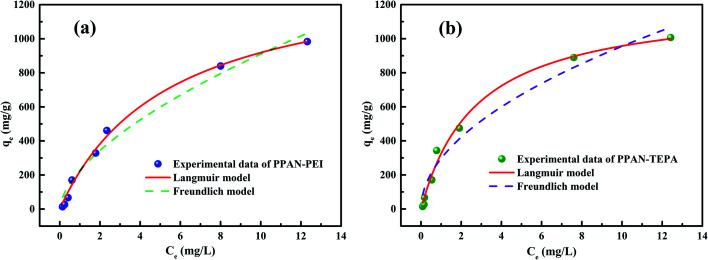
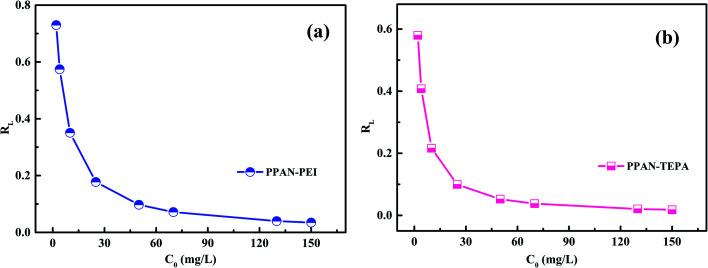
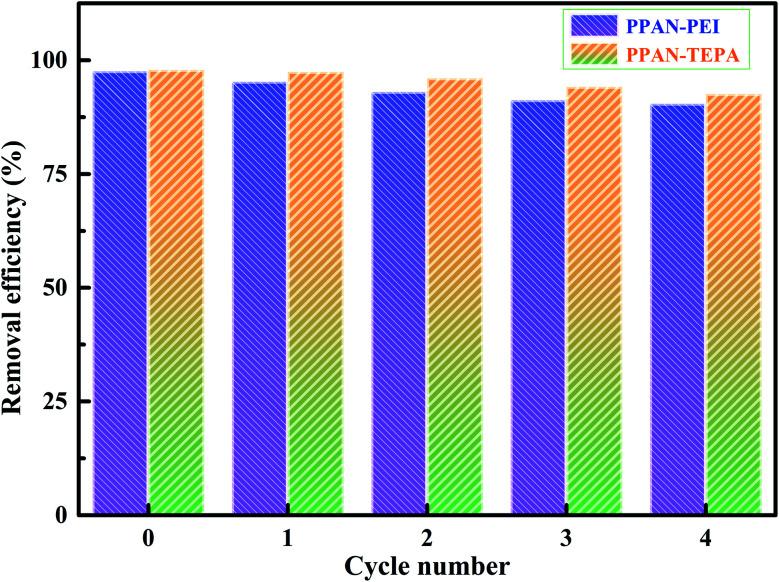
In this study, porous electrospinning polyacrylonitrile nanofiber (PPAN) surface functionalization with amine groups is studied for methyl orange (MO) dye removal from aqueous solution. A series of adsorption experiments were carried out to investigate the influence of initial solution pH value, contact time, initial solution concentration, and adsorption temperature on the adsorption performance. The experimental results showed that the removal of MO on these PPAN-PEI and PPAN-TEPA nanofibrous mats was a pH-dependent process with the maximum adsorption capacity at the initial solution pH of 3, and that the PPAN-PEI and PPAN-TEPA nanofibrous mats could be regenerated successfully after 4 recycling processes. The adsorption equilibrium data were all fitted well to the Langmuir isotherm equation, with maximum adsorption capacity of 1414.52 mg g and 1221.09 mg g for PPAN-PEI and PPAN-TEPA, respectively. The kinetic study indicated that the adsorption of MO could be well fitted by the pseudo-second-order equation and Weber-Morris model. Thermodynamic parameters such as free energy, enthalpy, and entropy of adsorption of the MO were also evaluated, and the results showed that the adsorption was a spontaneous exothermic adsorption process.
在本研究中,对用于从水溶液中去除甲基橙(MO)染料的胺基官能化多孔静电纺丝聚丙烯腈纳米纤维(PPAN)进行了研究。进行了一系列吸附实验,以研究初始溶液pH值、接触时间、初始溶液浓度和吸附温度对吸附性能的影响。实验结果表明,在这些PPAN-PEI和PPAN-TEPA纳米纤维垫上对MO的去除是一个pH依赖过程,在初始溶液pH为3时吸附容量最大,并且PPAN-PEI和PPAN-TEPA纳米纤维垫在4次循环过程后可以成功再生。吸附平衡数据均能很好地拟合Langmuir等温方程,PPAN-PEI和PPAN-TEPA的最大吸附容量分别为1414.52 mg/g和1221.09 mg/g。动力学研究表明,MO的吸附可以用准二级方程和Weber-Morris模型很好地拟合。还评估了MO吸附的自由能、焓和熵等热力学参数,结果表明吸附是一个自发的放热吸附过程。



 Zotero 插件