
现代机器学习预测模型在传染病诊断中的应用。
Modern Machine-Learning Predictive Models for Diagnosing Infectious Diseases.
机构信息
Information Systems, Faculty of Computing and Information Technology, King Abdulaziz University, Jeddah, Saudi Arabia.
Information Systems, King Khalid University, Abha, Saudi Arabia.
出版信息
Comput Math Methods Med. 2022 Jun 9;2022:6902321. doi: 10.1155/2022/6902321. eCollection 2022.
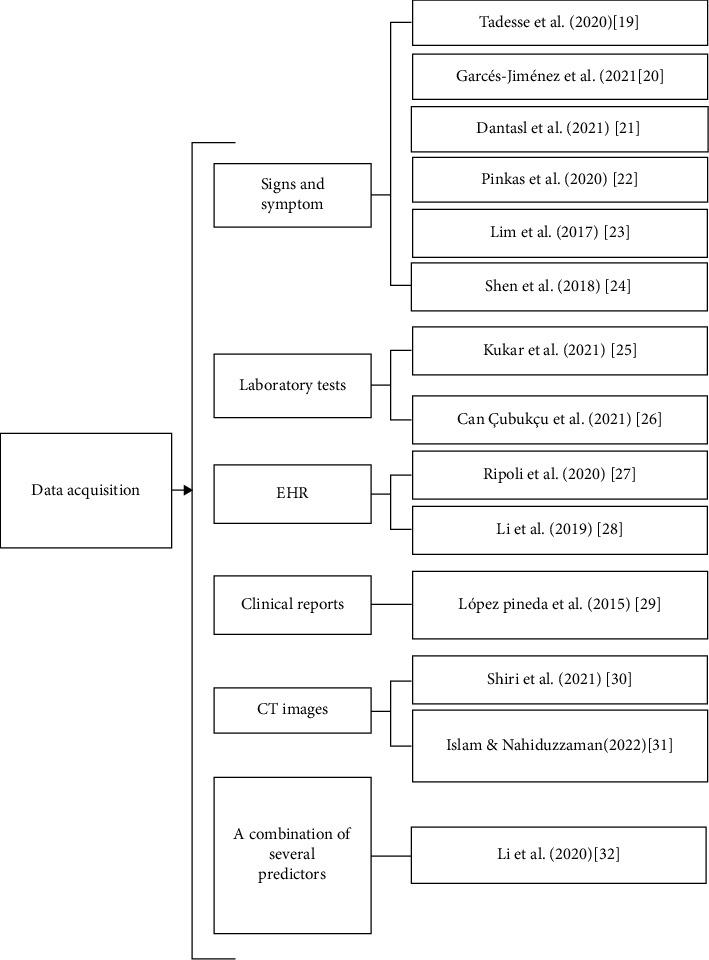
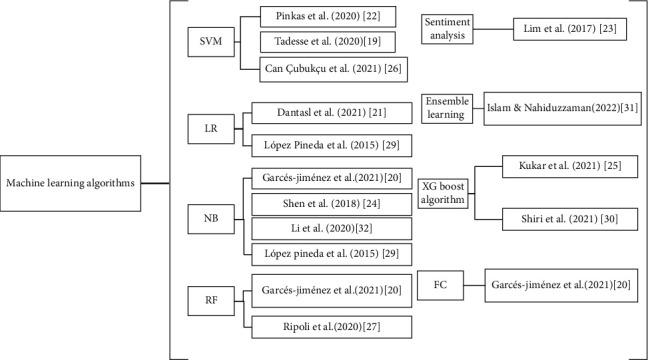
Controlling infectious diseases is a major health priority because they can spread and infect humans, thus evolving into epidemics or pandemics. Therefore, early detection of infectious diseases is a significant need, and many researchers have developed models to diagnose them in the early stages. This paper reviewed research articles for recent machine-learning (ML) algorithms applied to infectious disease diagnosis. We searched the Web of Science, ScienceDirect, PubMed, Springer, and IEEE databases from 2015 to 2022, identified the pros and cons of the reviewed ML models, and discussed the possible recommendations to advance the studies in this field. We found that most of the articles used small datasets, and few of them used real-time data. Our results demonstrated that a suitable ML technique depends on the nature of the dataset and the desired goal. Moreover, heterogeneous data could ensure the model's generalization, while big data, many features, and a hybrid model will increase the resulting performance. Furthermore, using other techniques such as deep learning and NLP to extract vast features from unstructured data is a powerful approach to enhancing the performance of ML diagnostic models.
控制传染病是一项主要的健康优先事项,因为它们可以传播并感染人类,从而演变成流行病或大流行病。因此,早期发现传染病是一个重大需求,许多研究人员已经开发出模型来在早期诊断它们。本文综述了最近应用于传染病诊断的机器学习 (ML) 算法的研究文章。我们从 2015 年到 2022 年在 Web of Science、ScienceDirect、PubMed、Springer 和 IEEE 数据库中进行了搜索,确定了所审查的 ML 模型的优缺点,并讨论了可能的建议,以推动该领域的研究。我们发现,大多数文章使用的是小数据集,很少有文章使用实时数据。我们的结果表明,合适的 ML 技术取决于数据集的性质和预期的目标。此外,异构数据可以确保模型的泛化能力,而大数据、多特征和混合模型将提高最终的性能。此外,使用深度学习和 NLP 等其他技术从非结构化数据中提取大量特征是增强 ML 诊断模型性能的一种强大方法。


 Zotero 插件