
宏基因组和靶向下一代测序工作流程评估用于检测支气管肺泡灌洗液标本中的呼吸道病原体。
Evaluation of Metagenomic and Targeted Next-Generation Sequencing Workflows for Detection of Respiratory Pathogens from Bronchoalveolar Lavage Fluid Specimens.
机构信息
Department of Pathology, grid.471401.7grid.21107.35Johns Hopkins University School of Medicinegrid.471401.7, Baltimore, Maryland, USA.
Department of International Health, Human Nutrition Program, Johns Hopkins Bloomberg School of Public Health, Baltimore, Maryland, USA.
出版信息
J Clin Microbiol. 2022 Jul 20;60(7):e0052622. doi: 10.1128/jcm.00526-22. Epub 2022 Jun 13.
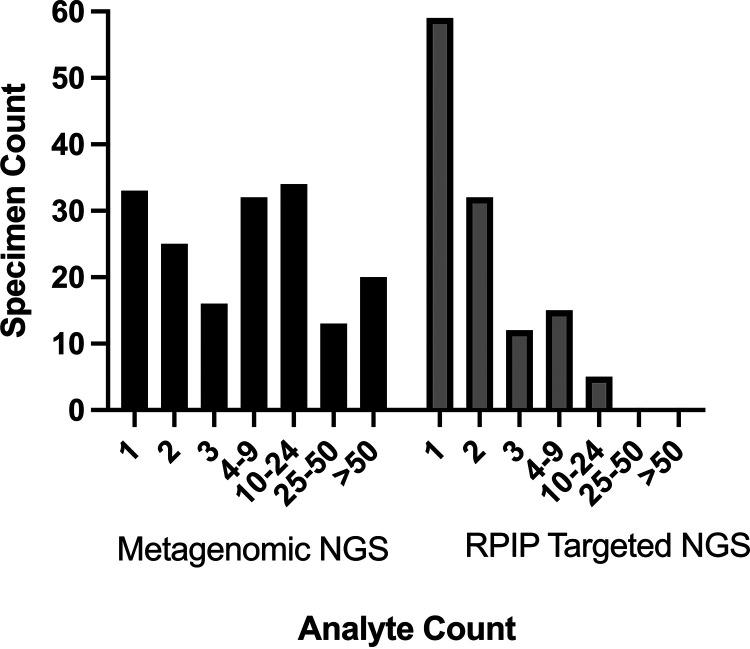
Next-generation sequencing (NGS) workflows applied to bronchoalveolar lavage (BAL) fluid specimens could enhance the detection of respiratory pathogens, although optimal approaches are not defined. This study evaluated the performance of the Respiratory Pathogen ID/AMR (RPIP) kit (Illumina, Inc.) with automated Explify bioinformatic analysis (IDbyDNA, Inc.), a targeted NGS workflow enriching specific pathogen sequences and antimicrobial resistance (AMR) markers, and a complementary untargeted metagenomic workflow with in-house bioinformatic analysis. Compared to a composite clinical standard consisting of provider-ordered microbiology testing, chart review, and orthogonal testing, both workflows demonstrated similar performances. The overall agreement for the RPIP targeted workflow was 65.6% (95% confidence interval, 59.2 to 71.5%), with a positive percent agreement (PPA) of 45.9% (36.8 to 55.2%) and a negative percent agreement (NPA) of 85.7% (78.1 to 91.5%). The overall accuracy for the metagenomic workflow was 67.1% (60.9 to 72.9%), with a PPA of 56.6% (47.3 to 65.5%) and an NPA of 77.2% (68.9 to 84.1%). The approaches revealed pathogens undetected by provider-ordered testing (Ureaplasma parvum, Tropheryma whipplei, severe acute respiratory syndrome coronavirus 2 [SARS-CoV-2], rhinovirus, and cytomegalovirus [CMV]), although not all pathogens detected by provider-ordered testing were identified by the NGS workflows. The RPIP targeted workflow required more time and reagents for library preparation but streamlined bioinformatic analysis, whereas the metagenomic assay was less demanding technically but required complex bioinformatic analysis. The results from both workflows were interpreted utilizing standardized criteria, which is necessary to avoid reporting nonpathogenic organisms. The RPIP targeted workflow identified AMR markers associated with phenotypic resistance in some bacteria but incorrectly identified genes in Pseudomonas aeruginosa as being associated with carbapenem resistance. These workflows could serve as adjunctive testing with, but not as a replacement for, standard microbiology techniques.
下一代测序 (NGS) 工作流程应用于支气管肺泡灌洗液 (BAL) 标本可以提高呼吸道病原体的检测率,尽管目前还没有明确的最佳方法。本研究评估了 Respiratory Pathogen ID/AMR (RPIP) 试剂盒(Illumina,Inc.)与自动化 Explify 生物信息学分析(IDbyDNA,Inc.)、靶向 NGS 工作流程富集特定病原体序列和抗菌药物耐药性 (AMR) 标志物以及互补的非靶向宏基因组学工作流程与内部生物信息学分析的性能。与由提供者指令的微生物学检测、图表审查和正交检测组成的综合临床标准相比,两种工作流程均表现出相似的性能。RPIP 靶向工作流程的总体一致性为 65.6%(95%置信区间,59.2 至 71.5%),阳性百分一致率 (PPA) 为 45.9%(36.8 至 55.2%),阴性百分一致率 (NPA) 为 85.7%(78.1 至 91.5%)。宏基因组学工作流程的总体准确性为 67.1%(60.9 至 72.9%),阳性百分一致率为 56.6%(47.3 至 65.5%),阴性百分一致率为 77.2%(68.9 至 84.1%)。这两种方法均揭示了提供者指令的检测方法未检测到的病原体(解脲脲原体、嗜肺军团菌、严重急性呼吸综合征冠状病毒 2 [SARS-CoV-2]、鼻病毒和巨细胞病毒 [CMV]),尽管并非所有由提供者指令的检测方法检测到的病原体都可通过 NGS 工作流程识别。RPIP 靶向工作流程的文库制备需要更多的时间和试剂,但简化了生物信息学分析,而宏基因组学检测在技术上要求较低,但需要复杂的生物信息学分析。两种工作流程的结果均利用标准化标准进行解释,这是避免报告非致病性生物所必需的。RPIP 靶向工作流程识别了与某些细菌表型耐药性相关的 AMR 标志物,但错误地将铜绿假单胞菌中的基因识别为与碳青霉烯类耐药性相关。这些工作流程可作为标准微生物学技术的辅助检测方法,但不能替代标准微生物学技术。


 Zotero 插件