
第二代(44 通道)脉络膜上视网膜假体:电极-组织界面的长期观察。
A Second-Generation (44-Channel) Suprachoroidal Retinal Prosthesis: Long-Term Observation of the Electrode-Tissue Interface.
机构信息
Bionics Institute, East Melbourne, Victoria, Australia.
Medical Bionics Department, University of Melbourne, Melbourne, Victoria, Australia.
出版信息
Transl Vis Sci Technol. 2022 Jun 1;11(6):12. doi: 10.1167/tvst.11.6.12.
PURPOSE
To report the long-term observations of the electrode-tissue interface and perceptual stability in humans after chronic stimulation with a 44-channel suprachoroidal retinal implant.
METHODS
Four subjects (S1-4) with end-stage retinitis pigmentosa received the implant unilaterally (NCT03406416). Electrode impedances, electrode-retina distance (measured using optical coherence tomography imaging), and perceptual thresholds were monitored up to 181 weeks after implantation as the subjects used the prosthesis in the laboratory and in daily life. Stimulation charge density was limited to 32 µC/cm2 per phase.
RESULTS
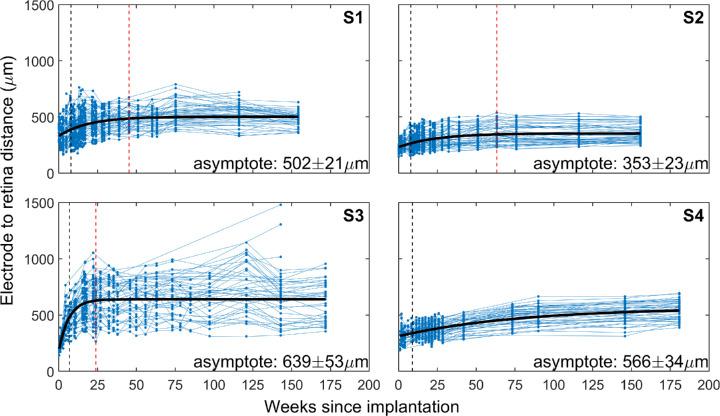
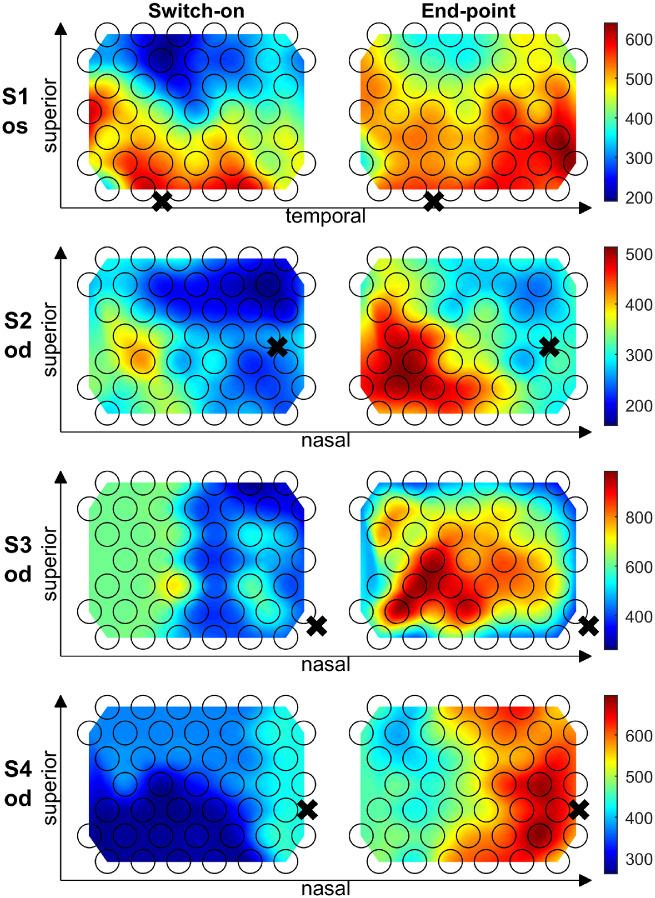
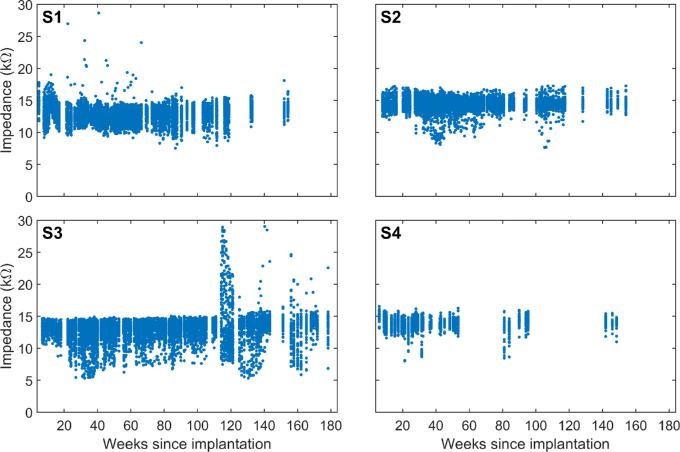
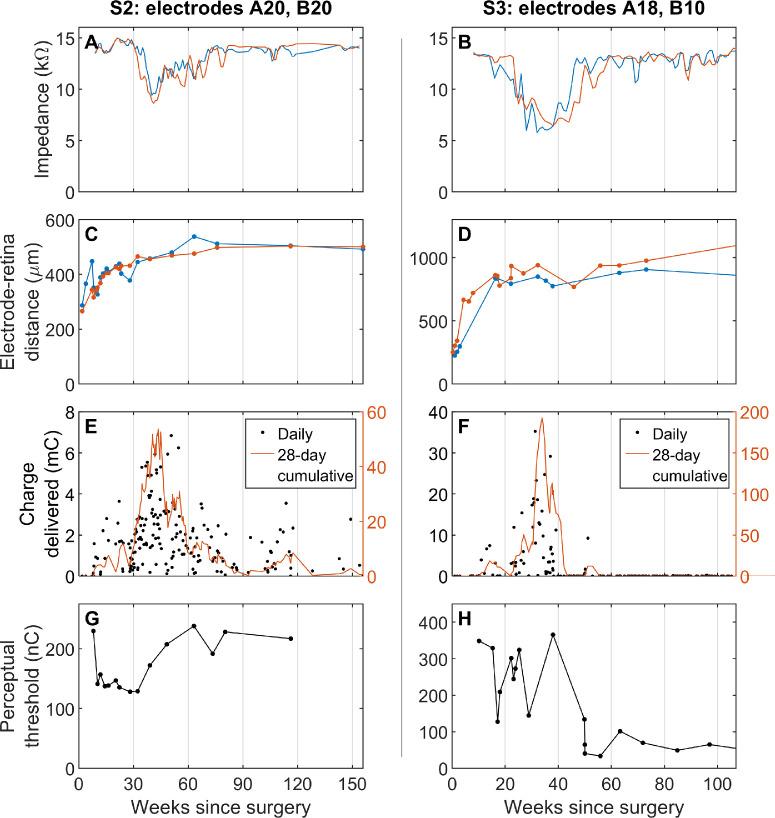
Electrode impedances were stable longitudinally. The electrode-retina distances increased after surgery and then stabilized, and were well-described by an asymptotic exponential model. The stabilization of electrode-retina distances was variable between subjects, stabilizing after 45 weeks for S1, 63 weeks for S2, and 24 weeks for S3 (linear regression; Pgradient > 0.05). For S4, a statistically significant increase in electrode-retina distance persisted (P < 0.05), but by the study end point the rate of increase was clinically insignificant (exponential model: 0.33 µm/wk). Perceptual electrical thresholds were stable in one subject, decreased over time in two subjects (linear model; P < 0.05), and increased slightly in one subject but remained within the predefined charge limits (P = 0.02).
CONCLUSIONS
Chronic stimulation with the suprachoroidal retinal prosthesis over 3 years resulted in stable impedances, small individual changes in perceptual electrical thresholds, and no clinically significant increase in electrode-retina distances after a period of settling after surgery.
TRANSLATIONAL RELEVANCE
Chronic stimulation with the 44-channel suprachoroidal retinal implant with a charge density of up to 32 µC/cm2 per phase is suitable for long-term use in humans.
目的
报告在慢性刺激 44 通道脉络膜上视网膜植入物后,人类电极-组织界面和感知稳定性的长期观察结果。
方法
4 名晚期色素性视网膜炎患者(S1-4)接受单侧植入(NCT03406416)。在植入后长达 181 周的时间里,当受试者在实验室和日常生活中使用假体时,监测电极阻抗、电极-视网膜距离(使用光学相干断层扫描成像测量)和感知阈值。每个相位的刺激电荷密度限制在 32 µC/cm2 以内。
结果
电极阻抗呈纵向稳定。手术后电极-视网膜距离增加,然后稳定,由渐近指数模型很好地描述。电极-视网膜距离的稳定在受试者之间是可变的,S1 稳定在 45 周,S2 稳定在 63 周,S3 稳定在 24 周(线性回归;Pgradient > 0.05)。对于 S4,电极-视网膜距离的增加仍然具有统计学意义(P < 0.05),但在研究终点时增加率在临床意义上并不显著(指数模型:0.33 µm/wk)。一个受试者的感知电阈值稳定,两个受试者的阈值随时间降低(线性模型;P < 0.05),一个受试者的阈值略有升高但仍在预定的电荷限制内(P = 0.02)。
结论
在 3 年多的时间里,对脉络膜上视网膜假体进行慢性刺激,导致阻抗稳定,感知电阈值有较小的个体变化,手术后一段时间稳定后,电极-视网膜距离没有临床意义上的增加。
翻译
杨婧



 Zotero 插件