
微生物对微尺度多轴皱纹表面的响应。
Microbial Response to Micrometer-Scale Multiaxial Wrinkled Surfaces.
机构信息
Department of Chemical Engineering, Imperial College London, London SW7 2AZ, United Kingdom.
Fraunhofer Institute for Interfacial Engineering and Biotechnology IGB, Nobelstrasse 12, 70569 Stuttgart, Germany.
出版信息
ACS Appl Mater Interfaces. 2022 Jul 13;14(27):31463-31473. doi: 10.1021/acsami.2c08768. Epub 2022 Jun 14.
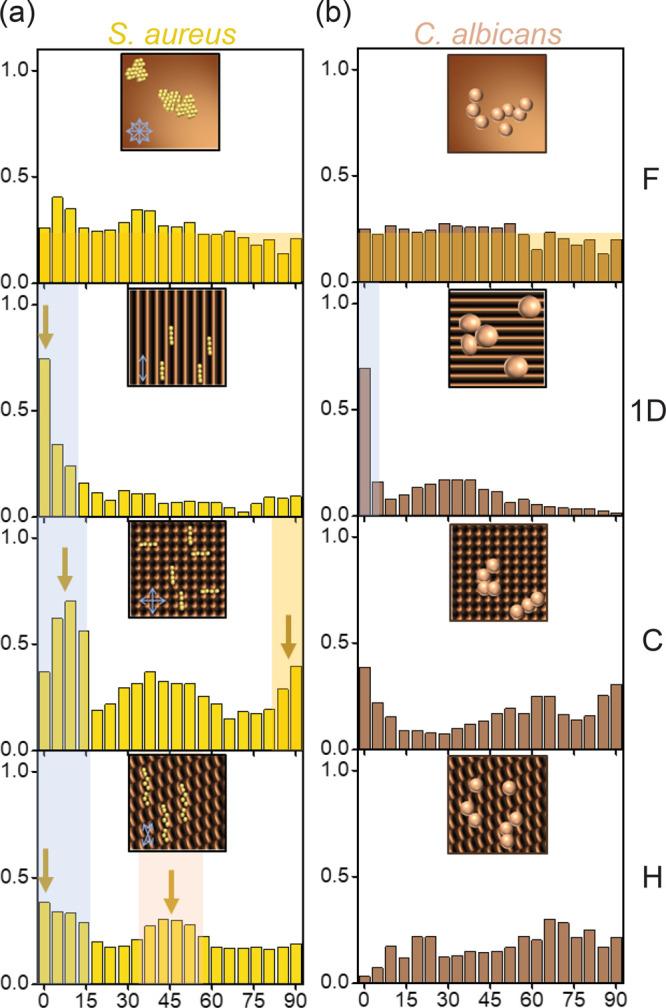
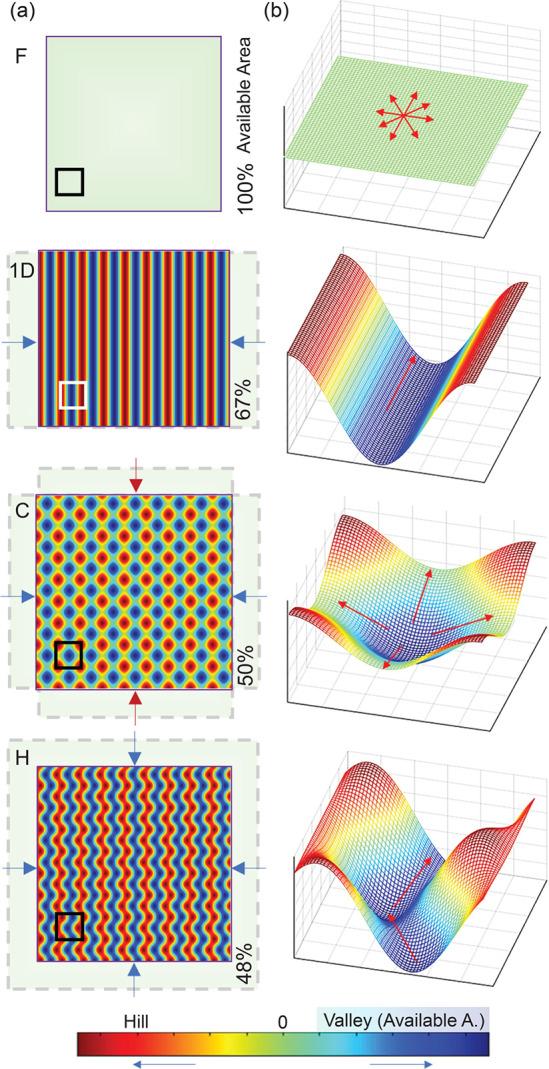
We investigate the effect of micrometer-scale surface wrinkling on the attachment and proliferation of model bacteria (, , and K12) and fungi (). Specifically, sinusoidal (1D), checkerboard (C), and herringbone (H) patterns were fabricated by mechanical wrinkling of plasma-oxidized polydimethylsiloxane (PDMS) bilayers and contrasted with flat (F) surfaces. Microbial deformation and orientation were found to correlate with the aspect ratio and commensurably with surface pattern dimensions and local pattern order. Significantly, the proliferation of could be described by a linear scaling between bacterial area coverage and available surface area, defined as a fraction of the line integral along each profile with negative curvature. However, in the early stages of proliferation (up to 6 h examined), that C and H patterns disrupt the spatial arrangement of bacteria, impeding proliferation for several hours and reducing it (by ∼50%) thereafter. Our findings suggest a simple framework to rationalize the impact of micrometer-scale topography on microbial action and demonstrate that multiaxial patterning order provides an effective strategy to delay and frustrate the early stages of bacterial proliferation.
我们研究了微尺度表面皱折对模型细菌(、、和 K12)和真菌()附着和增殖的影响。具体而言,通过机械褶皱等离子氧化聚二甲基硅氧烷(PDMS)双层来制造正弦形(1D)、棋盘形(C)和人字形(H)图案,并与平面(F)表面进行对比。发现微生物的变形和取向与纵横比相关,与表面图案尺寸和局部图案顺序相称。重要的是,细菌面积覆盖率与可用表面积之间呈线性比例关系,可以描述 增殖情况,可用表面积定义为每条轮廓线积分的负值部分与总积分的比值。然而,在增殖的早期阶段(检查至 6 小时),C 和 H 图案会破坏细菌的空间排列,阻碍增殖数小时,并在此后减少增殖(约 50%)。我们的研究结果提供了一个简单的框架来合理推断微尺度形貌对微生物作用的影响,并表明多轴图案有序性提供了一种有效的策略来延迟和挫败细菌增殖的早期阶段。


 Zotero 插件