
停药后血浆 HIV-1 反弹人群与外周血单个核细胞中储存前病毒人群的不吻合。
Discordance between HIV-1 Population in Plasma at Rebound after Structured Treatment Interruption and Archived Provirus Population in Peripheral Blood Mononuclear Cells.
机构信息
Department of Microbiology and Immunology, University of Miami, Miller School of Medicine, Miami, Florida, USA.
Emerging Pathogens Institute, University of Floridagrid.15276.37, Gainesville, Florida, USA.
出版信息
Microbiol Spectr. 2022 Aug 31;10(4):e0135322. doi: 10.1128/spectrum.01353-22. Epub 2022 Jun 14.
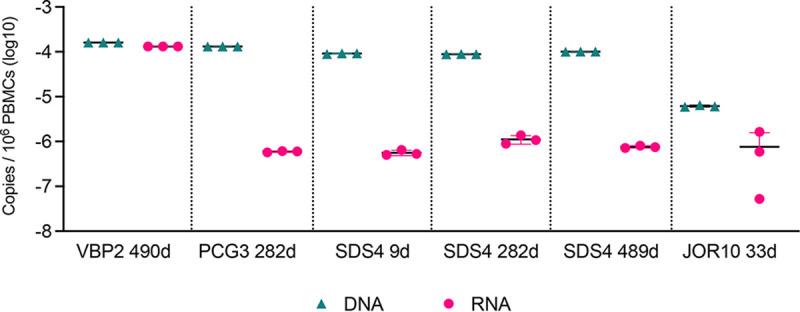
Antiretroviral therapy (ART) can sustain the suppression of plasma viremia to below detection levels. Infected individuals undergoing a treatment interruption exhibit rapid viral rebound in plasma viremia which is fueled by cellular reservoirs such as CD4 T cells, myeloid cells, and potentially uncharacterized cellular sources. Interrogating the populations of viruses found during analytical treatment interruption (ATI) can give insights into the biologically competent reservoirs that persist under effective ART as well as the nature of the cellular reservoirs that enable viral persistence under ART. We interrogated plasma viremia from four rare cases of individuals undergoing sequential ATIs. We performed next-generation sequencing (NGS) on cell-associated viral DNA and cell-free virus to understand the interrelationship between sequential ATIs as well as the relationship between viral genomes in circulating peripheral blood mononuclear cells (PBMCs) and RNA from rebound plasma. We observed population differences between viral populations recrudescing at sequential ATIs as well as divergence between viral sequences in plasma and those in PBMCs. This indicated that viruses in PBMCs were not a major source of post-ATI viremia and highlights the role of anatomic reservoirs in post-ATI viremia and viral persistence. Even with effective ART, HIV-1 persists at undetectable levels and rebounds in individuals who stop treatment. Cellular and anatomical reservoirs ignite viral rebound upon treatment interruption, remaining one of the key obstacles for HIV-1 cure. To further examine HIV-1 persistence, a better understanding of the distinct populations that fuel viral rebound is necessary to identify and target reservoirs and the eradication of HIV-1. This study investigates the populations of viruses found from proviral genomes from PBMCs and plasma at rebound from a unique cohort of individuals who underwent multiple rounds of treatment interruption. Using NGS, we characterized the subtypes of viral sequences and found divergence in viral populations between plasma and PBMCs at each rebound, suggesting that distinct viral populations appear at each treatment interruption.
抗逆转录病毒疗法 (ART) 可以将血浆病毒载量抑制到检测不到的水平。接受治疗中断的感染者会在血浆病毒载量中迅速出现病毒反弹,这是由 CD4 T 细胞、髓样细胞和潜在未被描述的细胞来源等细胞储库所驱动的。分析治疗中断 (ATI) 期间发现的病毒种群可以深入了解在有效的 ART 下持续存在的具有生物学能力的储库,以及在 ART 下使病毒持续存在的细胞储库的性质。我们对四名接受连续 ATI 的个体的血浆病毒载量进行了检测。我们对细胞相关病毒 DNA 和无细胞病毒进行了下一代测序 (NGS),以了解连续 ATI 之间的相互关系,以及循环外周血单核细胞 (PBMC) 中病毒基因组与反弹血浆 RNA 之间的关系。我们观察到在连续 ATI 中重新出现的病毒种群之间存在种群差异,以及血浆中和 PBMC 中的病毒序列之间的差异。这表明 PBMC 中的病毒不是 ATI 后病毒血症的主要来源,并强调了解剖储库在 ATI 后病毒血症和病毒持续存在中的作用。即使接受有效的 ART,HIV-1 也会在停止治疗的个体中保持不可检测的水平并反弹。细胞和解剖储库在治疗中断时引发病毒反弹,仍然是 HIV-1 治愈的关键障碍之一。为了进一步研究 HIV-1 的持续存在,需要更好地了解引发病毒反弹的不同种群,以确定和靶向储库并消除 HIV-1。本研究调查了从经历多轮治疗中断的个体的 PBMC 和反弹血浆中发现的病毒种群。使用 NGS,我们对病毒序列的亚型进行了特征描述,并在每次反弹时发现了血浆和 PBMC 中病毒种群的差异,表明在每次治疗中断时都会出现不同的病毒种群。

 Zotero 插件