
DHA 氧化产物对细胞外基质的修饰改变了巨噬细胞的黏附模式,并促进了慢性炎症期间巨噬细胞的留存。
Modification of Extracellular Matrix by the Product of DHA Oxidation Switches Macrophage Adhesion Patterns and Promotes Retention of Macrophages During Chronic Inflammation.
机构信息
Department of Biomedical Sciences, Quillen College of Medicine, East Tennessee State University, Johnson City, TN, United States.
Center of Excellence in Inflammation, Infectious Disease and Immunity, Quillen College of Medicine, East Tennessee State University, Johnson City, TN, United States.
出版信息
Front Immunol. 2022 May 26;13:867082. doi: 10.3389/fimmu.2022.867082. eCollection 2022.
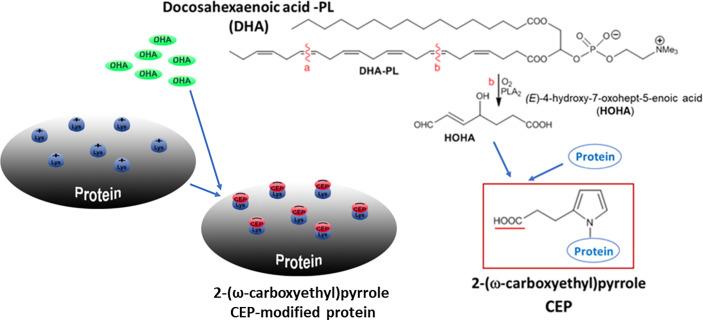
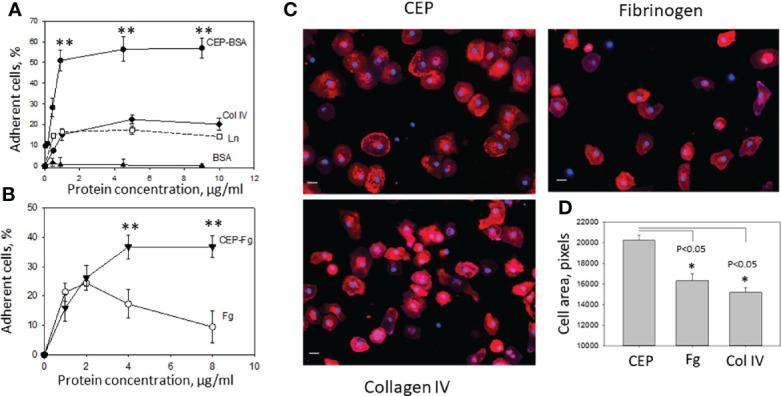
Oxidation of polyunsaturated fatty acids contributes to different aspects of the inflammatory response due to the variety of products generated. Specifically, the oxidation of DHA produces the end-product, carboxyethylpyrrole (CEP), which forms a covalent adduct with proteins an ϵ-amino group of lysines. Previously, we found that CEP formation is dramatically increased in inflamed tissue and CEP-modified albumin and fibrinogen became ligands for αβ (CD11d/CD18) and αβ (CD11b/CD18) integrins. In this study, we evaluated the effect of extracellular matrix (ECM) modification with CEP on the adhesive properties of M1-polarized macrophages, particularly during chronic inflammation. Using digested atherosclerotic lesions and oxidation assays, we demonstrated the ability of ECM proteins to form adducts with CEP, particularly, DHA oxidation leads to the formation of CEP adducts with collagen IV and laminin, but not with collagen I. Using integrin αβ-transfected HEK293 cells, WT and mouse M1-polarized macrophages, we revealed that CEP-modified proteins support stronger cell adhesion and spreading when compared with natural ECM ligands such as collagen IV, laminin, and fibrinogen. Integrin αβ is critical for M1 macrophage adhesion to CEP. Based on biolayer interferometry results, the isolated α I-domain demonstrates markedly higher binding affinity to CEP compared to the "natural" αβ ligand fibrinogen. Finally, the presence of CEP-modified proteins in a 3D fibrin matrix significantly increased M1 macrophage retention. Therefore, CEP modification converts ECM proteins to αβ-recognition ligands by changing a positively charged lysine to negatively charged CEP, which increases M1 macrophage adhesion to ECM and promotes macrophage retention during detrimental inflammation, autoimmunity, and chronic inflammation.
多不饱和脂肪酸的氧化由于产生的各种产物而导致炎症反应的多个方面。具体来说,DHA 的氧化产生终产物羧乙基吡咯(CEP),它与蛋白质形成共价加合物 - 赖氨酸的ε-氨基。以前,我们发现炎症组织中 CEP 的形成显著增加,CEP 修饰的白蛋白和纤维蛋白原成为 αβ(CD11d/CD18)和 αβ(CD11b/CD18)整合素的配体。在这项研究中,我们评估了 CEP 对 M1 极化巨噬细胞黏附特性的细胞外基质(ECM)修饰的影响,特别是在慢性炎症期间。使用消化的动脉粥样硬化病变和氧化测定,我们证明了 ECM 蛋白与 CEP 形成加合物的能力,特别是 DHA 氧化导致 CEP 与胶原蛋白 IV 和层粘连蛋白形成加合物,但不与胶原蛋白 I 形成加合物。使用整合素 αβ 转染的 HEK293 细胞、WT 和 小鼠 M1 极化巨噬细胞,我们揭示了与天然 ECM 配体(如胶原蛋白 IV、层粘连蛋白和纤维蛋白原)相比,CEP 修饰的蛋白质支持更强的细胞黏附和铺展。整合素 αβ 对于 M1 巨噬细胞黏附到 CEP 是至关重要的。基于生物层干涉测量结果,分离的 α I 结构域与“天然”αβ 配体纤维蛋白原相比表现出明显更高的结合亲和力到 CEP。最后,在 3D 纤维蛋白基质中存在 CEP 修饰的蛋白质显著增加了 M1 巨噬细胞的保留。因此,CEP 修饰通过将带正电荷的赖氨酸改变为带负电荷的 CEP,将 ECM 蛋白转化为 αβ 识别配体,从而增加 M1 巨噬细胞对 ECM 的黏附,并在有害炎症、自身免疫和慢性炎症期间促进巨噬细胞的保留。




 Zotero 插件