
伊维菌素预防和治疗 COVID-19。
Ivermectin for preventing and treating COVID-19.
机构信息
Department of Anaesthesiology, Intensive Care, Emergency and Pain Medicine, University Hospital Wuerzburg, Wuerzburg, Germany.
Department of Nephrology, Klinikum Rechts der Isar, Technical University of Munich, Munich, Germany.
出版信息
Cochrane Database Syst Rev. 2022 Jun 21;6(6):CD015017. doi: 10.1002/14651858.CD015017.pub3.
BACKGROUND
Ivermectin, an antiparasitic agent, inhibits the replication of viruses in vitro. The molecular hypothesis of ivermectin's antiviral mode of action suggests an inhibitory effect on severe acute respiratory syndrome coronavirus 2 (SARS-CoV-2) replication in early stages of infection. Currently, evidence on ivermectin for prevention of SARS-CoV-2 infection and COVID-19 treatment is conflicting.
OBJECTIVES
To assess the efficacy and safety of ivermectin plus standard of care compared to standard of care plus/minus placebo, or any other proven intervention for people with COVID-19 receiving treatment as inpatients or outpatients, and for prevention of an infection with SARS-CoV-2 (postexposure prophylaxis).
SEARCH METHODS
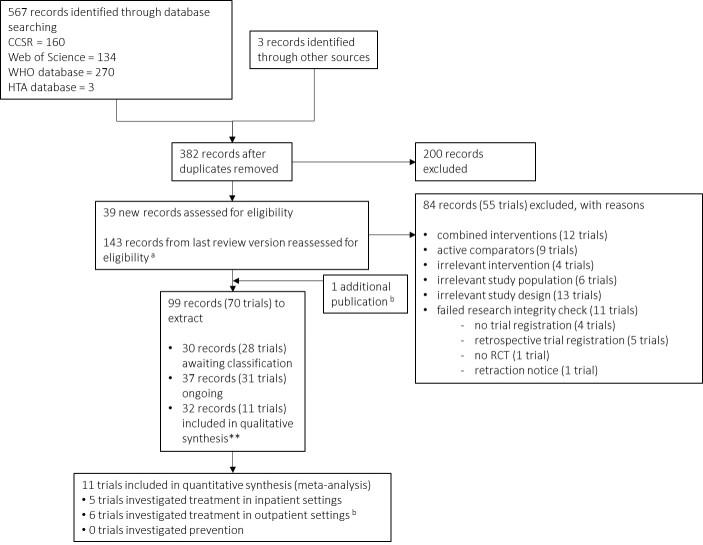
We searched the Cochrane COVID-19 Study Register, Web of Science (Emerging Citation Index and Science Citation Index), WHO COVID-19 Global literature on coronavirus disease, and HTA database weekly to identify completed and ongoing trials without language restrictions to 16 December 2021. Additionally, we included trials with > 1000 participants up to April 2022.
SELECTION CRITERIA
We included randomized controlled trials (RCTs) comparing ivermectin to standard of care, placebo, or another proven intervention for treatment of people with confirmed COVID-19 diagnosis, irrespective of disease severity or treatment setting, and for prevention of SARS-CoV-2 infection. Co-interventions had to be the same in both study arms. For this review update, we reappraised eligible trials for research integrity: only RCTs prospectively registered in a trial registry according to WHO guidelines for clinical trial registration were eligible for inclusion.
DATA COLLECTION AND ANALYSIS
We assessed RCTs for bias, using the Cochrane RoB 2 tool. We used GRADE to rate the certainty of evidence for outcomes in the following settings and populations: 1) to treat inpatients with moderate-to-severe COVID-19, 2) to treat outpatients with mild COVID-19 (outcomes: mortality, clinical worsening or improvement, (serious) adverse events, quality of life, and viral clearance), and 3) to prevent SARS-CoV-2 infection (outcomes: SARS-CoV-2 infection, development of COVID-19 symptoms, admission to hospital, mortality, adverse events and quality of life).
MAIN RESULTS
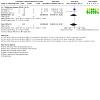
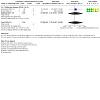
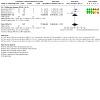
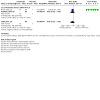
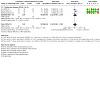
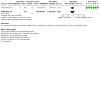
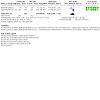
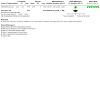
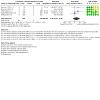
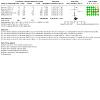
We excluded seven of the 14 trials included in the previous review version; six were not prospectively registered and one was non-randomized. This updated review includes 11 trials with 3409 participants investigating ivermectin plus standard of care compared to standard of care plus/minus placebo. No trial investigated ivermectin for prevention of infection or compared ivermectin to an intervention with proven efficacy. Five trials treated participants with moderate COVID-19 (inpatient settings); six treated mild COVID-19 (outpatient settings). Eight trials were double-blind and placebo-controlled, and three were open-label. We assessed around 50% of the trial results as low risk of bias. We identified 31 ongoing trials. In addition, there are 28 potentially eligible trials without publication of results, or with disparities in the reporting of the methods and results, held in 'awaiting classification' until the trial authors clarify questions upon request. Ivermectin for treating COVID-19 in inpatient settings with moderate-to-severe disease We are uncertain whether ivermectin plus standard of care compared to standard of care plus/minus placebo reduces or increases all-cause mortality at 28 days (risk ratio (RR) 0.60, 95% confidence interval (CI) 0.14 to 2.51; 3 trials, 230 participants; very low-certainty evidence); or clinical worsening, assessed by participants with new need for invasive mechanical ventilation or death at day 28 (RR 0.82, 95% CI 0.33 to 2.04; 2 trials, 118 participants; very low-certainty evidence); or serious adverse events during the trial period (RR 1.55, 95% CI 0.07 to 35.89; 2 trials, 197 participants; very low-certainty evidence). Ivermectin plus standard of care compared to standard of care plus placebo may have little or no effect on clinical improvement, assessed by the number of participants discharged alive at day 28 (RR 1.03, 95% CI 0.78 to 1.35; 1 trial, 73 participants; low-certainty evidence); on any adverse events during the trial period (RR 1.04, 95% CI 0.61 to 1.79; 3 trials, 228 participants; low-certainty evidence); and on viral clearance at 7 days (RR 1.12, 95% CI 0.80 to 1.58; 3 trials, 231 participants; low-certainty evidence). No trial investigated quality of life at any time point. Ivermectin for treating COVID-19 in outpatient settings with asymptomatic or mild disease Ivermectin plus standard of care compared to standard of care plus/minus placebo probably has little or no effect on all-cause mortality at day 28 (RR 0.77, 95% CI 0.47 to 1.25; 6 trials, 2860 participants; moderate-certainty evidence) and little or no effect on quality of life, measured with the PROMIS Global-10 scale (physical component mean difference (MD) 0.00, 95% CI -0.98 to 0.98; and mental component MD 0.00, 95% CI -1.08 to 1.08; 1358 participants; high-certainty evidence). Ivermectin may have little or no effect on clinical worsening, assessed by admission to hospital or death within 28 days (RR 1.09, 95% CI 0.20 to 6.02; 2 trials, 590 participants; low-certainty evidence); on clinical improvement, assessed by the number of participants with all initial symptoms resolved up to 14 days (RR 0.90, 95% CI 0.60 to 1.36; 2 trials, 478 participants; low-certainty evidence); on serious adverse events (RR 2.27, 95% CI 0.62 to 8.31; 5 trials, 1502 participants; low-certainty evidence); on any adverse events during the trial period (RR 1.24, 95% CI 0.87 to 1.76; 5 trials, 1502 participants; low-certainty evidence); and on viral clearance at day 7 compared to placebo (RR 1.01, 95% CI 0.69 to 1.48; 2 trials, 331 participants; low-certainty evidence). None of the trials reporting duration of symptoms were eligible for meta-analysis.
AUTHORS' CONCLUSIONS: For outpatients, there is currently low- to high-certainty evidence that ivermectin has no beneficial effect for people with COVID-19. Based on the very low-certainty evidence for inpatients, we are still uncertain whether ivermectin prevents death or clinical worsening or increases serious adverse events, while there is low-certainty evidence that it has no beneficial effect regarding clinical improvement, viral clearance and adverse events. No evidence is available on ivermectin to prevent SARS-CoV-2 infection. In this update, certainty of evidence increased through higher quality trials including more participants. According to this review's living approach, we will continually update our search.
背景
伊维菌素是一种抗寄生虫药物,可抑制病毒在体外的复制。伊维菌素抗病毒作用的分子假说表明,它可能对严重急性呼吸综合征冠状病毒 2(SARS-CoV-2)感染的早期阶段具有抑制作用。目前,关于伊维菌素预防 SARS-CoV-2 感染和 COVID-19 治疗的证据相互矛盾。
目的
评估伊维菌素联合标准治疗与标准治疗加/不加安慰剂或任何其他已证实的干预措施相比,对住院或门诊接受治疗的 COVID-19 患者的疗效和安全性,以及对 SARS-CoV-2 (暴露后预防)感染的预防作用。
检索方法
我们检索了 Cochrane COVID-19 研究注册库、Web of Science(新兴引文索引和科学引文索引)、世界卫生组织 COVID-19 全球冠状病毒疾病文献以及 HTA 数据库,每周检索一次,直到 2021 年 12 月 16 日,以确定已完成和正在进行的试验,不限制语言。此外,我们还纳入了截至 2022 年 4 月有超过 1000 名参与者的试验。
入选标准
我们纳入了比较伊维菌素与标准治疗、安慰剂或任何其他已证实的干预措施治疗确诊 COVID-19 患者的随机对照试验(RCTs),无论疾病严重程度或治疗环境如何,以及预防 SARS-CoV-2 感染。联合干预措施在研究组中必须相同。对于本次综述更新,我们重新评估了合格试验的研究完整性:只有符合世卫组织临床试验注册指南的前瞻性注册的 RCT 才有资格纳入。
数据收集和分析
我们使用 Cochrane RoB 2 工具评估 RCT 的偏倚。我们使用 GRADE 评估以下情况下和人群中结局的证据确定性:1)治疗中重度 COVID-19 的住院患者,2)治疗轻度 COVID-19 的门诊患者(结局:死亡率、临床改善或恶化、(严重)不良事件、生活质量和病毒清除),3)预防 SARS-CoV-2 感染(结局:SARS-CoV-2 感染、出现 COVID-19 症状、住院、死亡率、不良事件和生活质量)。
主要结果
我们排除了之前综述版本中纳入的 14 项试验中的 7 项;其中 6 项未前瞻性注册,1 项为非随机试验。本次更新综述包括 11 项试验,涉及 3409 名参与者,比较了伊维菌素联合标准治疗与标准治疗加/不加安慰剂。没有试验研究伊维菌素预防感染或比较伊维菌素与已证实有效的干预措施。五项试验治疗中度 COVID-19(住院环境);六项治疗轻度 COVID-19(门诊环境)。八项试验为双盲、安慰剂对照,三项为开放标签。我们评估了约 50%的试验结果为低偏倚风险。我们发现了 31 项正在进行的试验。此外,还有 28 项潜在合格的试验没有发表结果,或在报告方法和结果方面存在差异,在请求试验作者澄清问题之前,这些试验被列为“待分类”。
伊维菌素治疗 COVID-19 在住院环境中伴有中重度疾病的患者:我们不确定伊维菌素联合标准治疗与标准治疗加/不加安慰剂是否能降低或增加 28 天内的全因死亡率(风险比(RR)0.60,95%置信区间(CI)0.14 至 2.51;3 项试验,230 名参与者;极低确定性证据);或临床恶化,由新需要有创机械通气或第 28 天死亡的参与者评估(RR 0.82,95%CI 0.33 至 2.04;2 项试验,118 名参与者;极低确定性证据);或试验期间的严重不良事件(RR 1.55,95%CI 0.07 至 35.89;2 项试验,197 名参与者;极低确定性证据)。伊维菌素联合标准治疗与标准治疗加安慰剂相比,可能对第 28 天存活出院的参与者的临床改善(RR 1.03,95%CI 0.78 至 1.35;1 项试验,73 名参与者;低确定性证据)、试验期间任何不良事件(RR 1.04,95%CI 0.61 至 1.79;3 项试验,228 名参与者;低确定性证据)和第 7 天的病毒清除(RR 1.12,95%CI 0.80 至 1.58;3 项试验,231 名参与者;低确定性证据)几乎没有或没有影响。没有试验在任何时间点评估生活质量。
伊维菌素治疗 COVID-19 在门诊环境中伴有无症状或轻度疾病的患者:伊维菌素联合标准治疗与标准治疗加/不加安慰剂相比,在第 28 天的全因死亡率(RR 0.77,95%CI 0.47 至 1.25;6 项试验,2860 名参与者;中度确定性证据)和生活质量(用 PROMIS 全球-10 量表测量)可能几乎没有或没有影响(身体成分平均差(MD)0.00,95%CI -0.98 至 0.98;和心理成分 MD 0.00,95%CI -1.08 至 1.08;1358 名参与者;高确定性证据)。伊维菌素可能对住院或 28 天内死亡的临床恶化(RR 1.09,95%CI 0.20 至 6.02;2 项试验,590 名参与者;低确定性证据)、临床改善(RR 0.90,95%CI 0.60 至 1.36;2 项试验,478 名参与者;低确定性证据)、严重不良事件(RR 2.27,95%CI 0.62 至 8.31;5 项试验,1502 名参与者;低确定性证据)、任何不良事件(RR 1.24,95%CI 0.87 至 1.76;5 项试验,1502 名参与者;低确定性证据)和第 7 天的病毒清除(RR 1.01,95%CI 0.69 至 1.48;2 项试验,331 名参与者;低确定性证据)几乎没有或没有影响。没有报告症状持续时间的试验符合荟萃分析的条件。
作者结论
对于门诊患者,目前有低至高确定性证据表明伊维菌素对 COVID-19 患者没有有益的作用。基于住院患者非常低的确定性证据,我们仍然不确定伊维菌素是否预防死亡或临床恶化或增加严重不良事件,而关于临床改善、病毒清除和不良事件,我们有低确定性证据表明它没有有益的作用。没有证据表明伊维菌素可以预防 SARS-CoV-2 感染。在本次更新中,通过纳入更多参与者的高质量试验,证据确定性有所提高。根据本综述的动态方法,我们将继续更新我们的检索。









 Zotero 插件