
不同视觉和任务条件下肌肉疲劳对静态姿势控制的影响的性别差异。
Sex differences in the effect of muscle fatigue on static postural control under different vision and task conditions.
机构信息
School of Rehabilitation Sciences, Faculty of Health Sciences, University of Ottawa, Ottawa, Ontario, Canada.
Aging and Movement Laboratory, Bruyère Research Institute, Ottawa, Ontario, Canada.
出版信息
PLoS One. 2022 Jun 22;17(6):e0269705. doi: 10.1371/journal.pone.0269705. eCollection 2022.
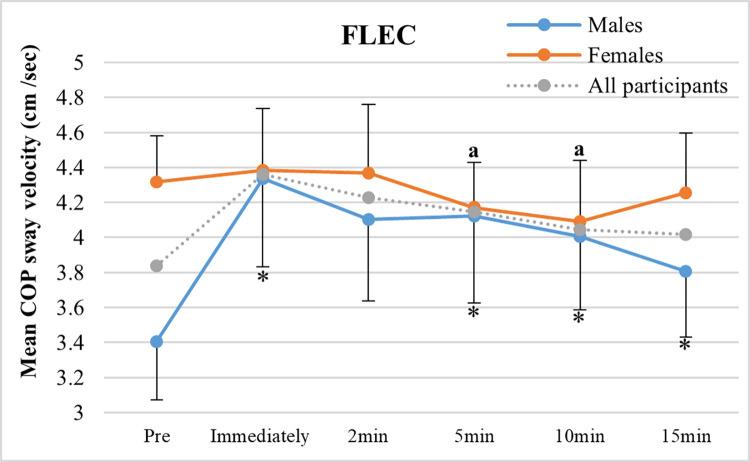
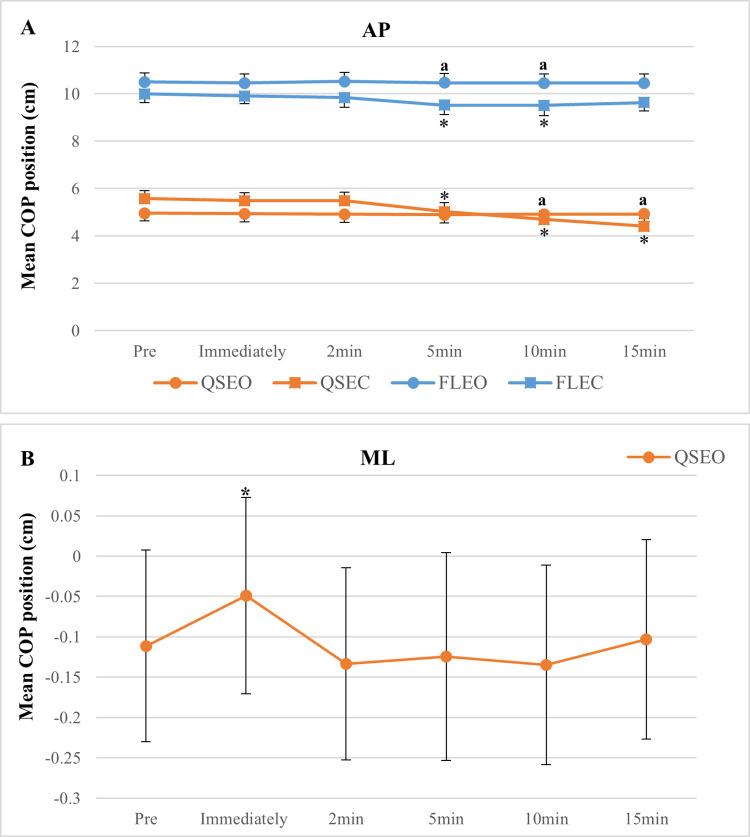
The main aim of this study was to compare the effects of ankle plantar flexors fatigue on postural control between healthy young adult males and females. The secondary aim was to determine the effects of vision on the fatigue-induced postural changes. Ten healthy young males and nine females were asked to perform quiet standing (QS) and standing forward lean (FL) tasks with eyes open (EO) and closed (EC) before and immediately following exercise, and throughout a 15-min recovery period. A sustained isometric exercise of ankle plantar flexors was performed until participants were no longer able to maintain a target torque of 50% of maximal voluntary isometric contraction (MVIC). Mean anteroposterior (AP) and mediolateral (ML) positions of the center of pressure (COP), mean COP sway velocity, and 95% ellipse area of COP sway were measured. Ankle plantar flexors fatigue had significant effects on all dependent variables, except for sway area. A fatigue X sex interaction was found for sway velocity with the most challenging task condition (FL-EC), where males showed a significant increase in sway velocity up to 15 min following exercise, whereas females did not. Fatigue X vision interactions for AP position were also found, with the withdrawal of vision leading to a greater backward shift during recovery for both the QS (5 to 15 min) and FL (5 to 10 min) tasks. Our findings suggest the use of different postural control strategies with ankle fatigue between males and females, and also a contribution of vision to compensate for fatigue-induced instability that is not dependent on task difficulty.
本研究的主要目的是比较健康年轻男性和女性在踝关节跖屈肌疲劳后对姿势控制的影响。次要目的是确定视觉对疲劳引起的姿势变化的影响。十名健康年轻男性和九名女性被要求在闭眼(EC)和睁眼(EO)条件下进行安静站立(QS)和向前倾斜站立(FL)任务,分别在运动前、运动后即刻以及 15 分钟恢复期内进行测量。采用持续等长踝关节跖屈肌运动,直到参与者无法再维持 50%最大自主等长收缩(MVIC)的目标扭矩。测量了中心压力点(COP)的前后(AP)和左右(ML)位置、COP 摆动速度的平均值以及 COP 摆动的 95%椭圆面积。踝关节跖屈肌疲劳对所有依赖变量都有显著影响,除了摆动面积。在最具挑战性的任务条件(FL-EC)中,发现疲劳与性别存在交互作用,男性在运动后 15 分钟内摆动速度显著增加,而女性则没有。还发现了疲劳与视觉的交互作用,AP 位置的摆动速度在恢复期间,男性和女性在 QS(5 到 15 分钟)和 FL(5 到 10 分钟)任务中,视觉缺失导致向后移动幅度更大。我们的研究结果表明,男性和女性在踝关节疲劳时使用不同的姿势控制策略,并且视觉有助于补偿不依赖于任务难度的疲劳引起的不稳定性。


 Zotero 插件