
从 - 内生真菌菌株 AN103 中提取的生物活性次生代谢产物的体外植物生物学研究。
In Vitro Phytobiological Investigation of Bioactive Secondary Metabolites from the -Derived Endophytic Fungus Strain AN103.
机构信息
Colin Ratledge Center for Microbial Lipids, School of Agricultural Engineering and Food Science, Shandong University of Technology, Zibo 255000, China.
Department of Botany and Microbiology, Faculty of Science, Al-Azhar University, Assiut 71524, Egypt.
出版信息
Molecules. 2022 Jun 11;27(12):3762. doi: 10.3390/molecules27123762.
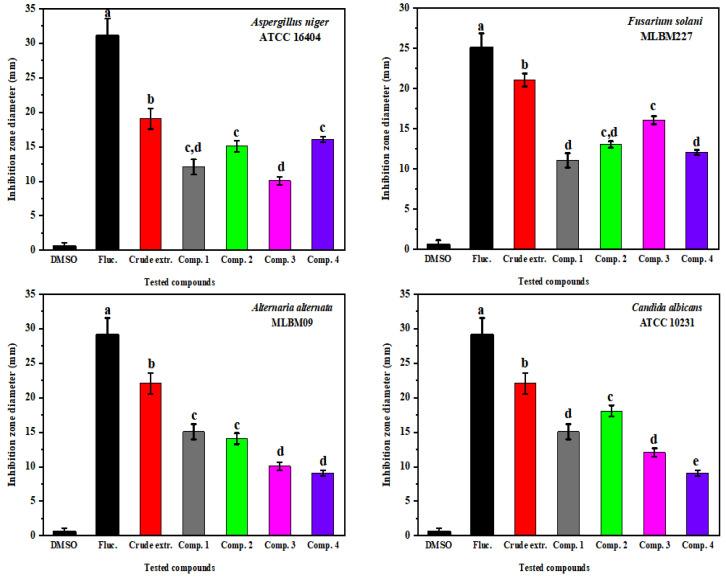
Endophytic fungi including black aspergilli have the potential to synthesize multiple bioactive secondary metabolites. Therefore, the search for active metabolites from endophytic fungi against pathogenic microbes has become a necessity for alternative and promising strategies. In this study, 25 endophytic fungal isolates associated with Malus domestica were isolated, grown, and fermented on a solid rice medium. Subsequently, their ethyl acetate crude extracts were pretested for biological activity. One endophytic fungal isolate demonstrated the highest activity and was chosen for further investigation. Based on its phenotypic, ITS ribosomal gene sequences, and phylogenetic characterization, this isolate was identified as Aspergillus tubingensis strain AN103 with the accession number (KR184138). Chemical investigations of its fermented cultures yielded four compounds: Pyranonigrin A (1), Fonsecin (2), TMC 256 A1 (3), and Asperazine (4). Furthermore, 1H-NMR, HPLC, and LC-MS were performed for the identification and structure elucidation of these metabolites. The isolated pure compounds showed moderate-to-potent antibacterial activities against Pseudomonas aeruginosa and Escherichia coli (MIC value ranged from 31 and 121 to 14.5 and 58.3 μg/mL), respectively; in addition, the time−kill kinetics for the highly sensitive bacteria against isolated compounds was also investigated. The antifungal activity results show that (3) and (4) had the maximum effect against Fusarium solani and A. niger with inhibition zones of 16.40 ± 0.55 and 16.20 ± 0.20 mm, respectively, and (2) had the best effect against Candida albicans, with an inhibition zone of 17.8 ± 1.35 mm. Moreover, in a cytotoxicity assay against mouse lymphoma cell line L5178Y, (4) exhibited moderate cytotoxicity (49% inhibition), whereas (1−3) reported weak cytotoxicity (15, 26, and 19% inhibition), respectively. Our results reveal that these compounds might be useful to develop potential cytotoxic and antimicrobial drugs and an alternative source for various medical and pharmaceutical fields.
内生真菌包括黑曲霉具有合成多种生物活性次生代谢物的潜力。因此,从内生真菌中寻找针对病原微生物的活性代谢物已成为替代和有前途的策略的必要条件。在这项研究中,从与苹果属相关的 25 个内生真菌分离物中分离、生长并在固体大米培养基上发酵。随后,对其乙酸乙酯粗提取物进行了生物活性的预测试。一个内生真菌分离物表现出最高的活性,被选为进一步研究。根据其表型、ITS 核糖体基因序列和系统发育特征,该分离物被鉴定为 Aspergillus tubingensis 菌株 AN103,登录号为(KR184138)。对其发酵培养物的化学研究得到了四个化合物:Pyranonigrin A(1)、Fonsecin(2)、TMC 256 A1(3)和 Asperazine(4)。此外,还进行了 1H-NMR、HPLC 和 LC-MS 以鉴定和结构阐明这些代谢物。分离得到的纯化合物对铜绿假单胞菌和大肠杆菌表现出中等至强的抗菌活性(MIC 值范围为 31 和 121 至 14.5 和 58.3 μg/mL);此外,还研究了对高度敏感细菌的时间杀伤动力学。抗真菌活性结果表明,(3)和(4)对茄病镰刀菌和黑曲霉的抑制作用最大,抑菌圈分别为 16.40 ± 0.55 和 16.20 ± 0.20 mm,(2)对白色念珠菌的抑制作用最好,抑菌圈为 17.8 ± 1.35 mm。此外,在对小鼠淋巴瘤细胞系 L5178Y 的细胞毒性测定中,(4)表现出中等细胞毒性(49%抑制),而(1-3)分别表现出弱细胞毒性(15%、26%和 19%抑制)。我们的结果表明,这些化合物可能有助于开发潜在的细胞毒性和抗菌药物,以及为各种医疗和制药领域提供替代来源。


 Zotero 插件