
对于乙肝相关代偿期肝硬化且肝癌风险评分高的患者,替诺福韦在降低肝癌发生率方面优于恩替卡韦。
Tenofovir is superior to entecavir in reducing HCC for patients with HBV-related compensated cirrhosis at high HCC risk scores.
作者信息
Huang Yan, Chen Lichang, Huang Rui, Zhu Chuanwu, Shang Jia, Qian Yunsong, Lian Jianqi, Liu Longgen, Jiang Jianning, Liu Chenghai, Gui Honglian, Xie Qing
机构信息
Department of Infectious Diseases, Ruijin Hospital, Shanghai Jiao Tong University School of Medicine, Shanghai, China.
Department of Infectious Disease, Nanjing Drum Tower Hospital, Clinical College of Nanjing Medical University, Nanjing, China.
出版信息
Ther Adv Chronic Dis. 2022 Jun 21;13:20406223221102791. doi: 10.1177/20406223221102791. eCollection 2022.
BACKGROUND
Both tenofovir disoproxil fumarate (TDF) and entecavir (ETV) are known to reduce the risk of hepatocellular carcinoma (HCC) in patients with chronic hepatitis B (CHB). This study aimed to compare the difference in HCC risk reduction between TDF and ETV in treatment-naïve patients with CHB-related compensated cirrhosis.
METHODS
Patients with compensated cirrhosis initially treated with TDF or ETV at nine Chinese hospitals between June 2014 and March 2021 were enrolled in this retrospective study. The cumulative HCC incidence rates for the two drugs were compared for the entire cohort, and a subgroup analysis was performed according to the HCC risk scores. Propensity score matching (PSM) was used to control confounding biases.
RESULTS
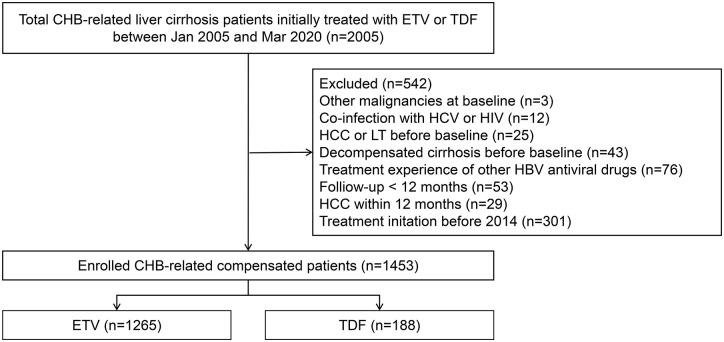
The analysis included 1453 patients (TDF group, = 188; ETV group, = 1265). Ninety-five patients developed HCC, with a median follow-up period of 26.1 months. The 3-year HCC incidence was 2.0% in the TDF group and 7.5% in the ETV group (log-rank = 0.005). TDF treatment was associated with a lower risk of HCC than ETV treatment [hazard ratio (HR) = 0.222, 95% confidence interval (CI), 0.070-0.702, = 0.010] but was similar after PSM (HR = 0.483, 95% CI, 0.144-1.626, = 0.240; log-rank = 0.230). However, subgroup analysis showed that the cumulative HCC incidence was lower in the TDF group than in the ETV group among patients with a modified PAGE-B score (mPAGE-B) ⩾9, either before or after PSM (log-rank = 0.048 and = 0.023, respectively).
CONCLUSION
Among patients with an mPAGE-B score ⩾9, TDF is associated with a lower HCC incidence than ETV in patients with CHB-related compensated cirrhosis.
背景
已知替诺福韦酯(TDF)和恩替卡韦(ETV)均可降低慢性乙型肝炎(CHB)患者发生肝细胞癌(HCC)的风险。本研究旨在比较初治的CHB相关代偿期肝硬化患者中,TDF和ETV在降低HCC风险方面的差异。
方法
本回顾性研究纳入了2014年6月至2021年3月期间在中国9家医院开始接受TDF或ETV治疗的代偿期肝硬化患者。比较了两种药物在整个队列中的累积HCC发病率,并根据HCC风险评分进行了亚组分析。采用倾向评分匹配(PSM)来控制混杂偏倚。
结果
分析纳入了1453例患者(TDF组,n = 188;ETV组,n = 1265)。95例患者发生了HCC,中位随访时间为26.1个月。TDF组3年HCC发病率为2.0%,ETV组为7.5%(对数秩检验P = 0.005)。TDF治疗与ETV治疗相比,HCC风险较低[风险比(HR)= 0.222,95%置信区间(CI)为0.070 - 0.702,P = 0.010],但PSM后两者相似(HR = 0.483,95% CI为0.144 - 1.626,P = 0.240;对数秩检验P = 0.230)。然而,亚组分析显示,在改良PAGE - B评分(mPAGE - B)≥9的患者中,无论PSM前后,TDF组的累积HCC发病率均低于ETV组(对数秩检验P分别为0.048和0.023)。
结论
在mPAGE - B评分≥9的CHB相关代偿期肝硬化患者中,TDF与ETV相比,HCC发病率较低。



 Zotero 插件