
年龄对精子质量的影响:对1500份精液样本的评估。
The effects of age on sperm quality: an evaluation of 1,500 semen samples.
作者信息
Oliveira João Batista A, Petersen Claudia G, Mauri Ana L, Vagnini Laura D, Baruffi Ricardo L R, Franco José G
机构信息
Center for Human Reproduction Prof. Franco Jr., Ribeirao Preto, SP, Brazil.
Paulista Center for Diagnosis Research and Training, Ribeirao Preto, SP, Brazil.
出版信息
JBRA Assist Reprod. 2014 Jun 27;18(2):34-41. doi: 10.5935/1518-0557.20140002.
OBJECTIVE
The aim of this study was to evaluate the effects of aging on semen quality in a population of infertile couples.
METHODS
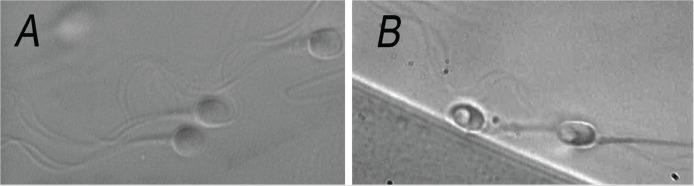
A cross-sectional study of semen samples obtained from 1,500 men randomly selected from couples who attended an infertility clinic was conducted. The analyses were performed using Spearman's correlation and Mann-Whitney tests. The age groups consisted of men ≤ 35 years, from 36-45 years and > 45 years of age. The semen analysis was performed according to the WHO criteria, and morphology was evaluated using the motile sperm organelle morphology examination (MSOME). The percentages of normal spermatozoa and spermatozoa with large nuclear vacuoles (LNV, occupying > 50% nuclear area) were determined. The percentages of DNA fragmentation were assessed using the TUNEL assay.
RESULTS
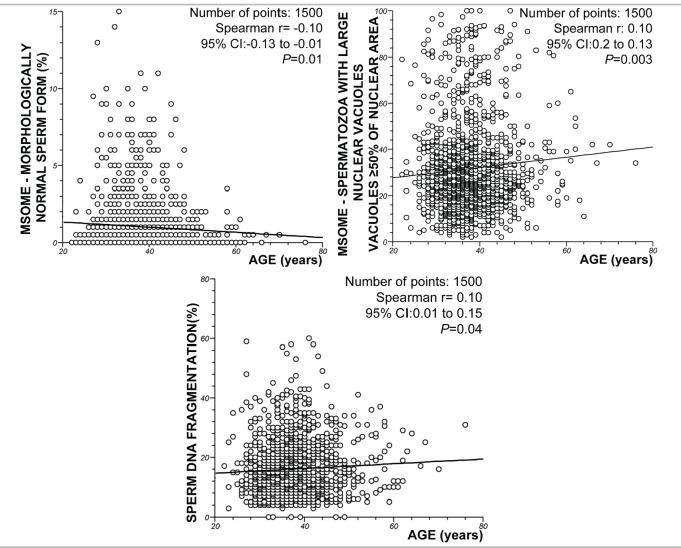
A regression analysis revealed that the percentages of LNV spermatozoa and sperm DNA fragmentation positively correlated with age. Conversely, a regression analysis revealed that the percentage of normal sperm, sperm progressive motility and sperm vitality negatively correlated with age. As in the previous test, the analysis by age group showed that there was a significant reduction (P < 0.05) in the percentage of normal sperm, sperm progressive motility and sperm vitality as age increased. Conversely, the percentage of spermatozoa with LNVs and sperm DNA fragmentation significantly increased (P < 0.05) as age increased.
CONCLUSION
Semen quality seems to be influenced by aging. The age-related decrease in sperm quality suggests that delaying childbearing, not only for women but also for men, may jeopardize reproductive capacity.
目的
本研究旨在评估衰老对不孕夫妇群体精液质量的影响。
方法
对从一家不孕不育诊所就诊的夫妇中随机选取的1500名男性的精液样本进行横断面研究。采用Spearman相关性分析和Mann-Whitney检验进行分析。年龄组包括年龄≤35岁、36 - 45岁和>45岁的男性。精液分析按照世界卫生组织标准进行,使用活动精子细胞器形态学检查(MSOME)评估精子形态。测定正常精子和有大核空泡(LNV,占据>50%核面积)精子的百分比。使用TUNEL检测法评估DNA碎片化百分比。
结果
回归分析显示,LNV精子百分比和精子DNA碎片化与年龄呈正相关。相反,回归分析显示,正常精子百分比、精子前向运动能力和精子活力与年龄呈负相关。与之前的测试一样,按年龄组分析显示,随着年龄增加,正常精子百分比、精子前向运动能力和精子活力显著降低(P<0.05)。相反,随着年龄增加,有LNV的精子百分比和精子DNA碎片化显著增加(P<0.05)。
结论
精液质量似乎受衰老影响。与年龄相关的精子质量下降表明,不仅女性,男性推迟生育也可能危及生殖能力。

 Zotero 插件