
固有淋巴细胞、记忆与生殖的新兴概念
Emerging Concepts in Innate Lymphoid Cells, Memory, and Reproduction.
机构信息
Placenta Lab, Department of Obstetrics, Jena University Hospital, Jena, Germany.
出版信息
Front Immunol. 2022 Jun 14;13:824263. doi: 10.3389/fimmu.2022.824263. eCollection 2022.
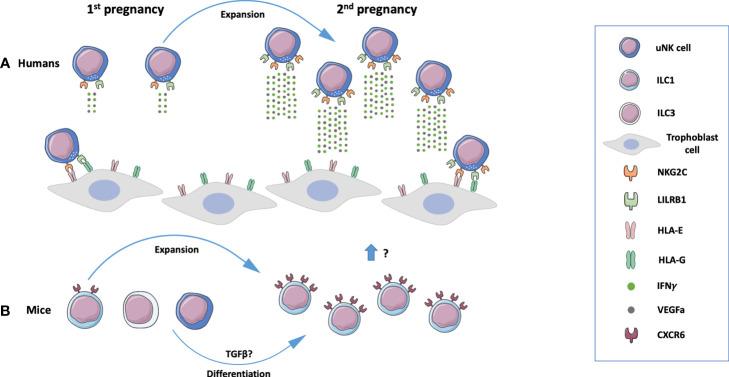
Members of the innate immune system, innate lymphoid cells (ILCs), encompass five major populations (Natural Killer (NK) cells, ILC1s, ILC2s, ILC3s, and lymphoid tissue inducer cells) whose functions include defense against pathogens, surveillance of tumorigenesis, and regulation of tissue homeostasis and remodeling. ILCs are present in the uterine environment of humans and mice and are dynamically regulated during the reproductive cycle and pregnancy. These cells have been repurposed to support pregnancy promoting maternal immune tolerance and placental development. To accomplish their tasks, immune cells employ several cellular and molecular mechanisms. They have the capacity to remember a previously encountered antigen and mount a more effective response to succeeding events. Memory responses are not an exclusive feature of the adaptive immune system, but also occur in innate immune cells. Innate immune memory has already been demonstrated in monocytes/macrophages, neutrophils, dendritic cells, and ILCs. A population of decidual NK cells characterized by elevated expression of NKG2C and LILRB1 as well as a distinctive transcriptional and epigenetic profile was found to expand during subsequent pregnancies in humans. These cells secrete high amounts of interferon-γ and vascular endothelial growth factor likely favoring placentation. Similarly, uterine ILC1s in mice upregulate CXCR6 and expand in second pregnancies. These data provide evidence on the development of immunological memory of pregnancy. In this article, the characteristics, functions, and localization of ILCs are reviewed, emphasizing available data on the uterine environment. Following, the concept of innate immune memory and its mechanisms, which include epigenetic changes and metabolic rewiring, are presented. Finally, the emerging role of innate immune memory on reproduction is discussed. Advances in the comprehension of ILC functions and innate immune memory may contribute to uncovering the immunological mechanisms underlying female fertility/infertility, placental development, and distinct outcomes in second pregnancies related to higher birth weight and lower incidence of complications.
固有免疫系统成员,固有淋巴样细胞(ILCs),包含五个主要群体(自然杀伤(NK)细胞、ILC1、ILC2、ILC3 和淋巴组织诱导细胞),其功能包括防御病原体、监测肿瘤发生以及调节组织稳态和重塑。ILCs 存在于人类和小鼠的子宫环境中,并在生殖周期和妊娠期间动态调节。这些细胞被重新用于支持妊娠促进母体免疫耐受和胎盘发育。为了完成它们的任务,免疫细胞采用了几种细胞和分子机制。它们具有记住以前遇到的抗原的能力,并对后续事件产生更有效的反应。记忆反应不是适应性免疫系统的专有特征,也发生在固有免疫细胞中。固有免疫记忆已经在单核细胞/巨噬细胞、中性粒细胞、树突状细胞和 ILCs 中得到证实。在人类中,发现一种具有高水平表达 NKG2C 和 LILRB1 以及独特转录和表观遗传特征的蜕膜 NK 细胞群体在随后的妊娠中扩张。这些细胞分泌大量的干扰素-γ 和血管内皮生长因子,可能有利于胎盘形成。同样,小鼠的子宫 ILC1 在第二次妊娠时上调 CXCR6 并扩增。这些数据提供了关于妊娠免疫记忆发展的证据。在本文中,回顾了 ILCs 的特征、功能和定位,强调了关于子宫环境的可用数据。其次,介绍了固有免疫记忆及其机制的概念,包括表观遗传变化和代谢重编程。最后,讨论了固有免疫记忆在生殖中的新兴作用。对 ILC 功能和固有免疫记忆的理解的进展可能有助于揭示女性生育/不育、胎盘发育以及与更高出生体重和较低并发症发生率相关的第二次妊娠的不同结果的免疫机制。

 Zotero 插件