
代谢功能障碍相关脂肪性肝病和过量饮酒均为死亡的独立危险因素。
Metabolic dysfunction-associated fatty liver disease and excessive alcohol consumption are both independent risk factors for mortality.
机构信息
Department of Gastroenterology and Hepatology , Erasmus MC University Medical Centre , Rotterdam , The Netherlands.
出版信息
Hepatology. 2023 Mar 1;77(3):942-948. doi: 10.1002/hep.32642. Epub 2023 Feb 17.
BACKGROUND AND AIMS
MAFLD often cooccurs with excessive alcohol consumption, while its prognostic value in this group remains unclear. We aimed to study the mortality risk of MAFLD in relation to excessive alcohol consumption and its potential interactions.
APPROACH AND RESULTS
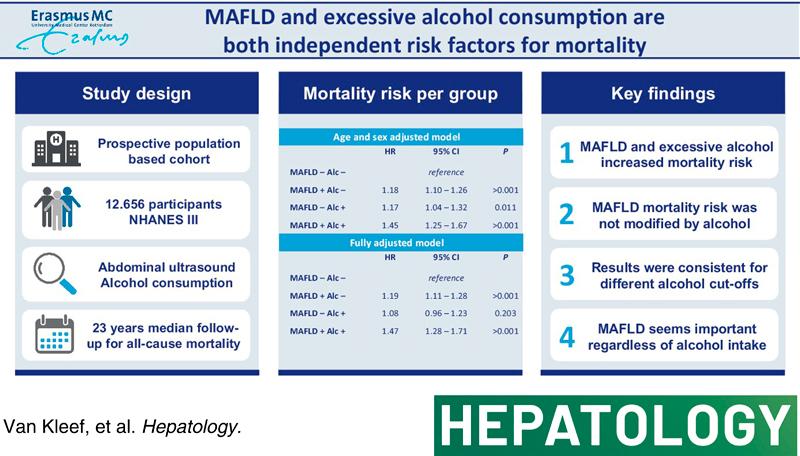
We analyzed persons 25-74 years old enrolled in the National Health and Nutrition Examination Survey III cohort with available steatosis and alcohol data. Participants with viral hepatitis, body mass index < 18.5, and missing data on age or follow-up were excluded, leaving 12,656 participants for analysis with a median follow-up of 22.9 [20.9-24.8] years. MAFLD was defined as steatosis on ultrasound in the presence of metabolic dysfunction. Daily alcohol intake of ≥10 g in females and ≥20 g in males was considered excessive alcohol consumption. We quantified mortality risk with multivariate Cox regression for MAFLD and excessive alcohol consumption. Models were adjusted for age, age squared, sex, race, marital status, education, and smoking. MAFLD was present in 31% and excessive alcohol consumption in 13% and were both independently and simultaneously associated with increased mortality risk in fully adjusted models (adjusted HR [aHR], 1.21; 95% CI, 1.13-1.30 and aHR, 1.14; 95% CI, 1.04-1.26, respectively). Similarly, MAFLD was associated with increased mortality risk in participants with and without excessive alcohol consumption. Participants with both MAFLD and excessive alcohol consumption (4.0%) expressed the highest mortality risk (aHR, 1.47; 95% CI, 1.28-1.71). Results were consistent using the initial 10 years of follow-up, a stringent definition of excessive alcohol, and propensity score weighting.
CONCLUSIONS
MAFLD increases mortality risk independent of excessive alcohol consumption. This underscores the importance of MAFLD, even in patients with excessive alcohol consumption.
背景与目的
MAFLD 常与过量饮酒同时发生,但其在该人群中的预后价值尚不清楚。我们旨在研究 MAFLD 与过量饮酒相关的死亡风险及其潜在的相互作用。
方法和结果
我们分析了参加美国国家健康与营养调查 III 队列的 25-74 岁年龄组人群,这些人有可供分析的脂肪变性和酒精数据。排除了患有病毒性肝炎、体重指数<18.5 和年龄或随访数据缺失的患者,最后有 12656 名参与者可用于分析,中位随访时间为 22.9 [20.9-24.8] 年。MAFLD 的定义为超声检查提示存在脂肪变性且合并代谢功能障碍。女性每日酒精摄入量≥10 g,男性每日酒精摄入量≥20 g 被认为是过量饮酒。我们使用多变量 Cox 回归来量化 MAFLD 和过量饮酒与死亡率之间的关系。模型调整了年龄、年龄平方、性别、种族、婚姻状况、教育程度和吸烟状况。完全调整模型中,MAFLD 的存在(调整后的 HR [aHR],1.21;95%CI,1.13-1.30)和过量饮酒(aHR,1.14;95%CI,1.04-1.26)均与死亡率风险的增加独立相关。类似地,MAFLD 与有或没有过量饮酒的参与者的死亡率风险增加相关。同时患有 MAFLD 和过量饮酒的参与者(4.0%)的死亡率风险最高(aHR,1.47;95%CI,1.28-1.71)。使用最初的 10 年随访、严格的过量饮酒定义和倾向评分加权,结果仍然一致。
结论
MAFLD 独立于过量饮酒增加死亡风险。这突出了 MAFLD 的重要性,即使在过量饮酒的患者中也是如此。
 Zotero 插件