
英国基于人群的队列研究:BMI 与 COVID-19 疫苗接种率、疫苗有效性以及接种后 COVID-19 严重结局风险的关联。
Associations of BMI with COVID-19 vaccine uptake, vaccine effectiveness, and risk of severe COVID-19 outcomes after vaccination in England: a population-based cohort study.
机构信息
Nuffield Department of Primary Care Health Sciences, Radcliffe Observatory Quarter, University of Oxford, Oxford, UK; Department of Biochemistry and Molecular Biology II, Faculty of Pharmacy, Center for Biomedical Research, University of Granada, Granada, Spain.
Nuffield Department of Primary Care Health Sciences, Radcliffe Observatory Quarter, University of Oxford, Oxford, UK.
出版信息
Lancet Diabetes Endocrinol. 2022 Aug;10(8):571-580. doi: 10.1016/S2213-8587(22)00158-9. Epub 2022 Jul 1.
BACKGROUND
A high BMI has been associated with a reduced immune response to vaccination against influenza. We aimed to investigate the association between BMI and COVID-19 vaccine uptake, vaccine effectiveness, and risk of severe COVID-19 outcomes after vaccination by using a large, representative population-based cohort from England.
METHODS
In this population-based cohort study, we used the QResearch database of general practice records and included patients aged 18 years or older who were registered at a practice that was part of the database in England between Dec 8, 2020 (date of the first vaccination in the UK), to Nov 17, 2021, with available data on BMI. Uptake was calculated as the proportion of people with zero, one, two, or three doses of the vaccine across BMI categories. Effectiveness was assessed through a nested matched case-control design to estimate odds ratios (OR) for severe COVID-19 outcomes (ie, admission to hospital or death) in people who had been vaccinated versus those who had not, considering vaccine dose and time periods since vaccination. Vaccine effectiveness against infection with SARS-CoV-2 was also investigated. Multivariable Cox proportional hazard models estimated the risk of severe COVID-19 outcomes associated with BMI (reference BMI 23 kg/m) after vaccination.
FINDINGS
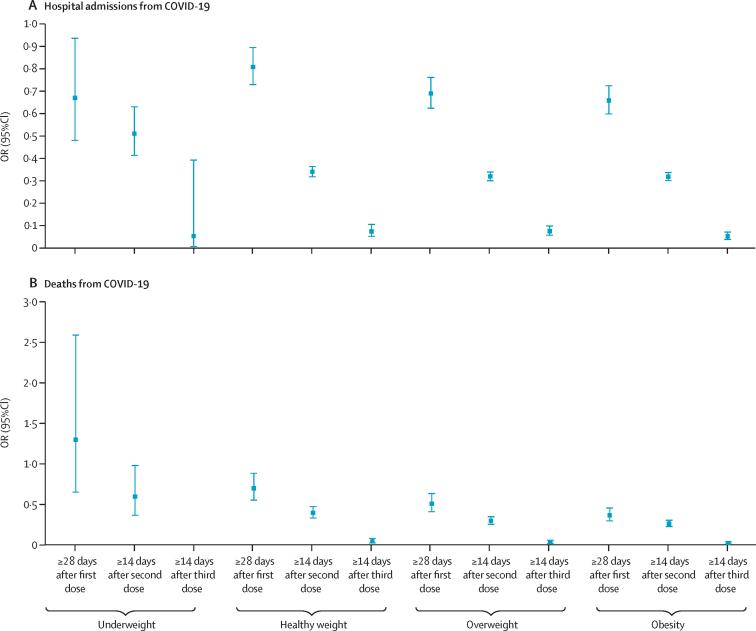
Among 9 171 524 participants (mean age 52 [SD 19] years; BMI 26·7 [5·6] kg/m), 566 461 tested positive for SARS-CoV-2 during follow-up, of whom 32 808 were admitted to hospital and 14 389 died. Of the total study sample, 19·2% (1 758 689) were unvaccinated, 3·1% (287 246) had one vaccine dose, 52·6% (4 828 327) had two doses, and 25·0% (2 297 262) had three doses. In people aged 40 years and older, uptake of two or three vaccine doses was more than 80% among people with overweight or obesity, which was slightly lower in people with underweight (70-83%). Although significant heterogeneity was found across BMI groups, protection against severe COVID-19 disease (comparing people who were vaccinated vs those who were not) was high after 14 days or more from the second dose for hospital admission (underweight: OR 0·51 [95% CI 0·41-0·63]; healthy weight: 0·34 [0·32-0·36]; overweight: 0·32 [0·30-0·34]; and obesity: 0·32 [0·30-0·34]) and death (underweight: 0·60 [0·36-0·98]; healthy weight: 0·39 [0·33-0·47]; overweight: 0·30 [0·25-0·35]; and obesity: 0·26 [0·22-0·30]). In the vaccinated cohort, there were significant linear associations between BMI and COVID-19 hospitalisation and death after the first dose, and J-shaped associations after the second dose.
INTERPRETATION
Using BMI categories, there is evidence of protection against severe COVID-19 in people with overweight or obesity who have been vaccinated, which was of a similar magnitude to that of people of healthy weight. Vaccine effectiveness was slightly lower in people with underweight, in whom vaccine uptake was also the lowest for all ages. In the vaccinated cohort, there were increased risks of severe COVID-19 outcomes for people with underweight or obesity compared with the vaccinated population with a healthy weight. These results suggest the need for targeted efforts to increase uptake in people with low BMI (<18·5 kg/m), in whom uptake is lower and vaccine effectiveness seems to be reduced. Strategies to achieve and maintain a healthy weight should be prioritised at the population level, which could help reduce the burden of COVID-19 disease.
FUNDING
UK Research and Innovation and National Institute for Health Research Oxford Biomedical Research Centre.
背景
较高的 BMI 与对流感疫苗的免疫反应降低有关。我们旨在通过使用来自英格兰的大型代表性人群队列研究,调查 BMI 与 COVID-19 疫苗接种率、疫苗有效性以及接种后严重 COVID-19 结局的风险之间的关系。
方法
在这项基于人群的队列研究中,我们使用了 QResearch 数据库的一般实践记录,并纳入了 2020 年 12 月 8 日(英国首次接种疫苗的日期)至 2021 年 11 月 17 日在英格兰参加该数据库的实践中登记的年龄在 18 岁或以上的患者,这些患者的数据中包括 BMI。通过计算各 BMI 类别中零、一、二或三剂疫苗的接种比例来计算接种率。通过嵌套匹配病例对照设计来评估接种疫苗与未接种疫苗的人之间严重 COVID-19 结局(即住院或死亡)的比值比(OR),同时考虑疫苗剂量和接种疫苗后的时间。还研究了 SARS-CoV-2 感染的疫苗有效性。多变量 Cox 比例风险模型估计了接种疫苗后 BMI(参考 BMI 为 23 kg/m)与严重 COVID-19 结局相关的风险。
结果
在 9171524 名参与者中(平均年龄 52 [19]岁;BMI 26.7 [5.6] kg/m),在随访期间,566461 人检测出 SARS-CoV-2 阳性,其中 32808 人住院,14389 人死亡。在整个研究样本中,19.2%(1758689 人)未接种疫苗,3.1%(287246 人)接种了一剂疫苗,52.6%(4828327 人)接种了两剂疫苗,25.0%(2297262 人)接种了三剂疫苗。在 40 岁及以上的人群中,超重或肥胖人群的两剂或三剂疫苗接种率超过 80%,而体重不足人群的接种率略低(70-83%)。尽管在 BMI 组之间存在显著的异质性,但接种疫苗后 14 天或更长时间,预防严重 COVID-19 疾病(比较接种疫苗和未接种疫苗的人)的效果很高,住院(体重不足:OR 0.51 [95%CI 0.41-0.63];健康体重:0.34 [0.32-0.36];超重:0.32 [0.30-0.34];肥胖:0.32 [0.30-0.34])和死亡(体重不足:0.60 [0.36-0.98];健康体重:0.39 [0.33-0.47];超重:0.30 [0.25-0.35];肥胖:0.26 [0.22-0.30])。在接种疫苗的队列中,接种第一剂疫苗后,BMI 与 COVID-19 住院和死亡之间存在显著的线性关联,接种第二剂疫苗后存在 J 形关联。
解释
使用 BMI 类别,有证据表明超重或肥胖人群接种疫苗后可预防严重的 COVID-19,其保护效果与健康体重人群相似。体重不足人群的疫苗有效性略低,在所有年龄段中,体重不足人群的疫苗接种率也最低。在接种疫苗的队列中,与接种疫苗的健康体重人群相比,体重不足或肥胖人群发生严重 COVID-19 结局的风险增加。这些结果表明,需要针对 BMI 较低(<18.5 kg/m)的人群进行有针对性的努力,以提高这些人群的疫苗接种率,因为这些人群的疫苗接种率较低,而且疫苗有效性似乎降低。应优先在人群层面实施实现和维持健康体重的策略,这有助于减轻 COVID-19 疾病的负担。
资助
英国研究与创新署和国家健康研究所牛津生物医学研究中心。


 Zotero 插件