
基于红光的双光氧化还原策略,类似于自然光合作用的Z型机制。
Red Light-Based Dual Photoredox Strategy Resembling the Z-Scheme of Natural Photosynthesis.
作者信息
Glaser Felix, Wenger Oliver S
机构信息
Department of Chemistry, University of Basel, St. Johanns-Ring 19, 4056 Basel, Switzerland.
出版信息
JACS Au. 2022 Jun 10;2(6):1488-1503. doi: 10.1021/jacsau.2c00265. eCollection 2022 Jun 27.
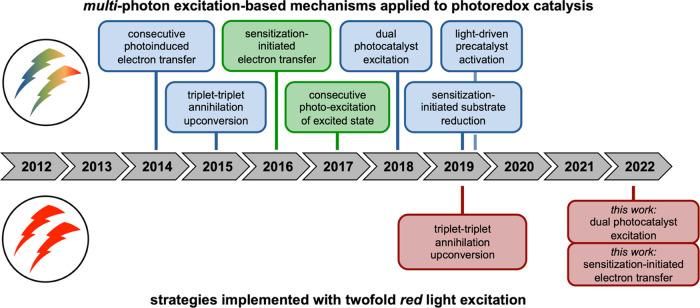
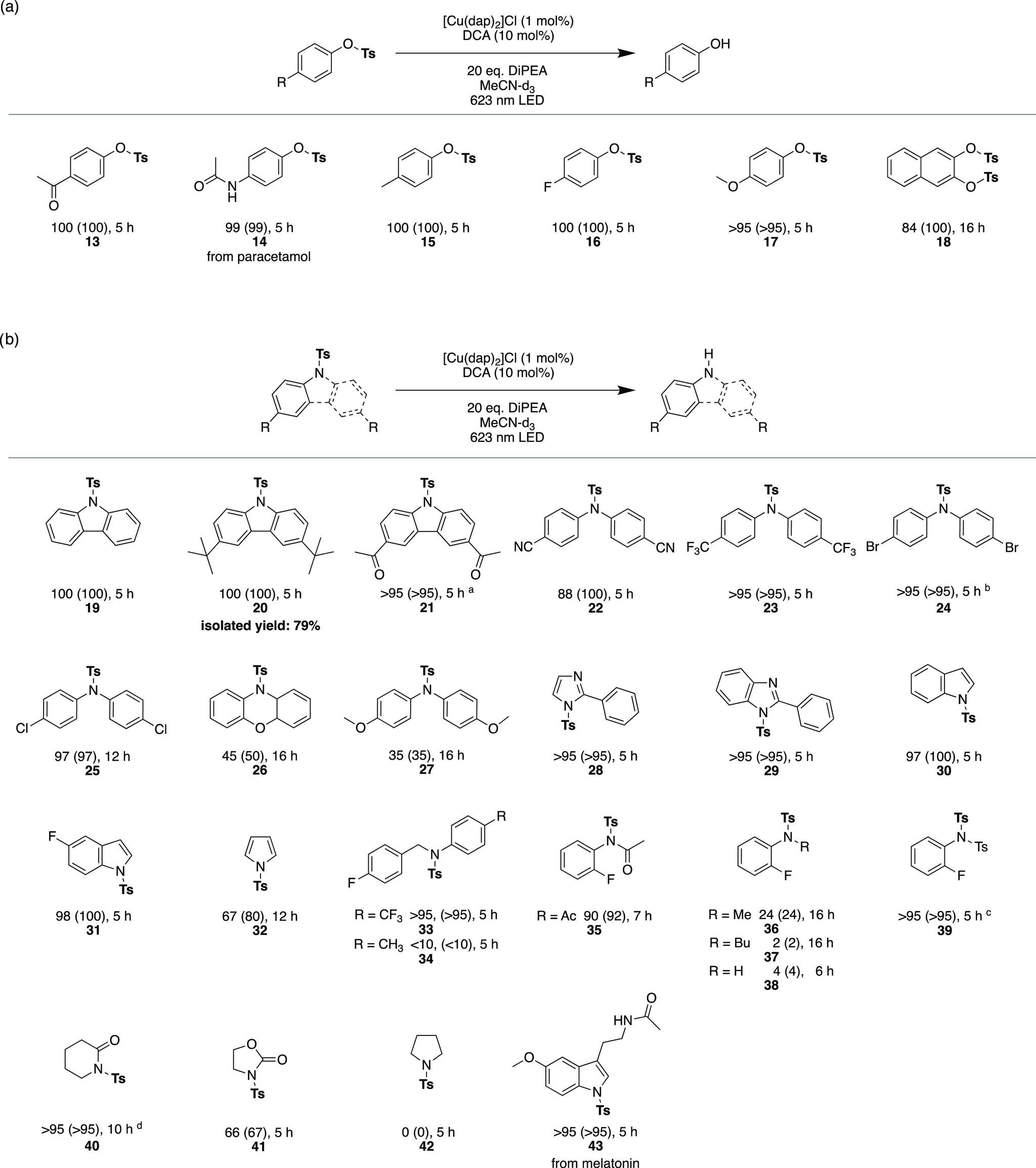
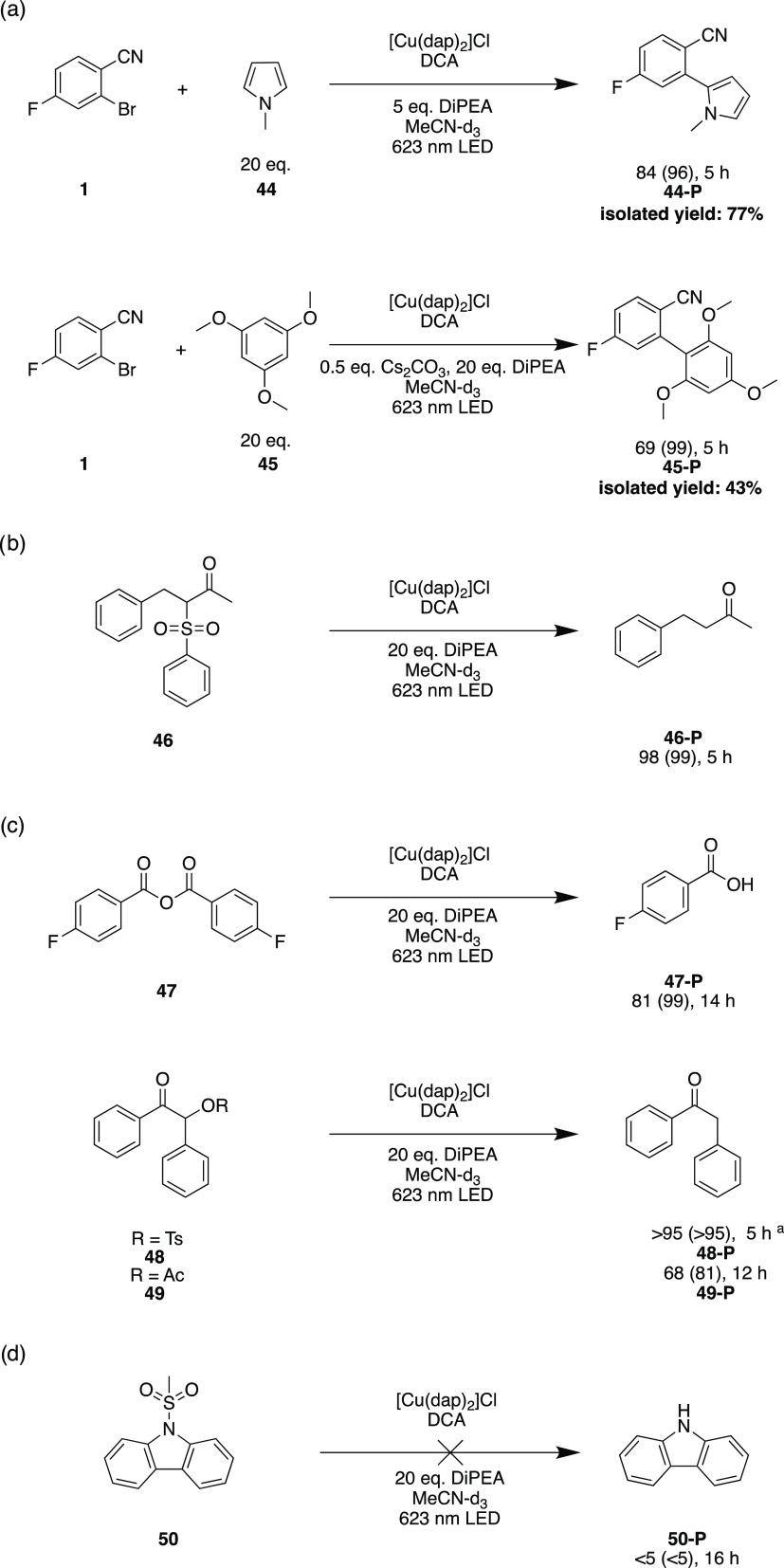
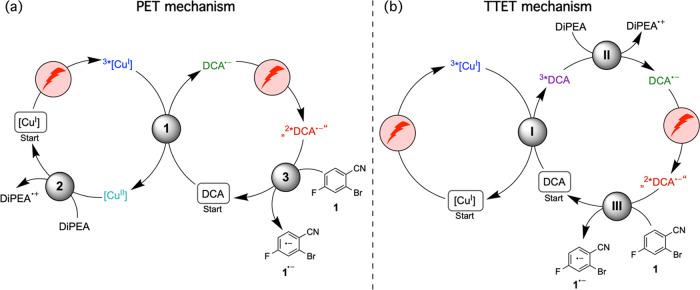
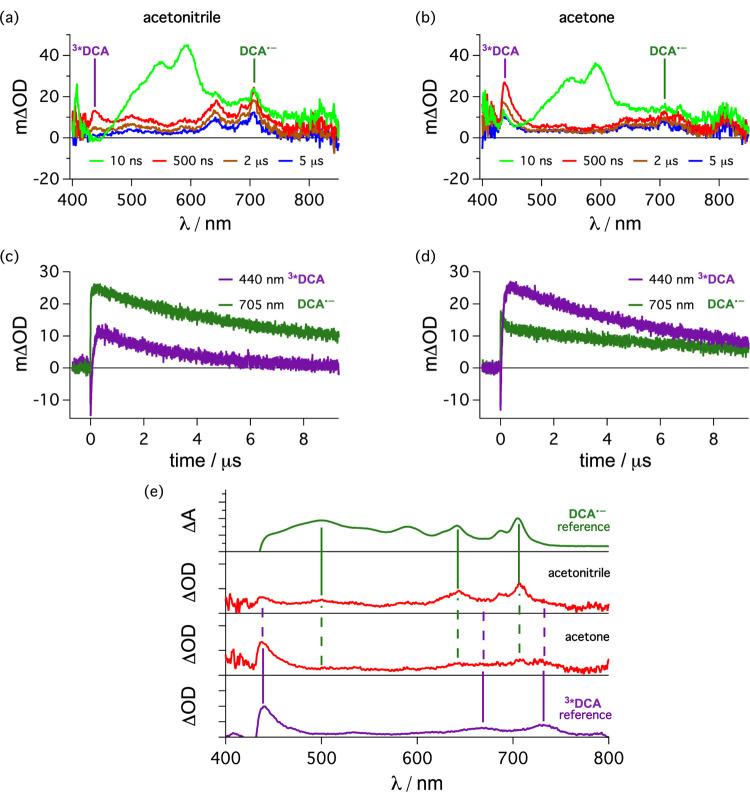
Photoredox catalysis typically relies on the use of single chromophores, whereas strategies, in which two different light absorbers are combined, are rare. In photosystems I and II of green plants, the two separate chromophores P and P both absorb light independently of one another, and then their excitation energy is combined in the so-called Z-scheme, to drive an overall reaction that is thermodynamically very demanding. Here, we adapt this concept to perform photoredox reactions on organic substrates with the combined energy input of two red photons instead of blue or UV light. Specifically, a Cu bis(α-diimine) complex in combination with formed 9,10-dicyanoanthracenyl radical anion in the presence of excess diisopropylethylamine catalyzes ca. 50 dehalogenation and detosylation reactions. This dual photoredox approach seems useful because red light is less damaging and has a greater penetration depth than blue or UV radiation. UV-vis transient absorption spectroscopy reveals that the subtle change in solvent from acetonitrile to acetone induces a changeover in the reaction mechanism, involving either a dominant photoinduced electron transfer or a dominant triplet-triplet energy transfer pathway. Our study illustrates the mechanistic complexity in systems operating under multiphotonic excitation conditions, and it provides insights into how the competition between desirable and unwanted reaction steps can become more controllable.
光氧化还原催化通常依赖于单一发色团的使用,而将两种不同光吸收剂结合的策略则很少见。在绿色植物的光系统I和II中,两个独立的发色团P和P彼此独立地吸收光,然后它们的激发能在所谓的Z方案中结合,以驱动一个热力学上要求很高的整体反应。在这里,我们采用这一概念,利用两个红光光子而不是蓝光或紫外光的组合能量输入,对有机底物进行光氧化还原反应。具体而言,一种双(α-二亚胺)铜配合物与在过量二异丙基乙胺存在下形成的9,10-二氰基蒽自由基阴离子催化约50个脱卤和脱甲苯磺酰基反应。这种双光氧化还原方法似乎很有用,因为红光比蓝光或紫外辐射的破坏性小且穿透深度更大。紫外-可见瞬态吸收光谱表明,溶剂从乙腈到丙酮的细微变化会引起反应机理的转变,涉及主要的光致电子转移或主要的三重态-三重态能量转移途径。我们的研究说明了在多光子激发条件下运行的系统中的机理复杂性,并为如何使期望和不期望的反应步骤之间的竞争变得更可控提供了见解。


 Zotero 插件