
国际德尔菲共识:关于心脏肾综合征中高钾血症最佳实践建议。
An international Delphi consensus regarding best practice recommendations for hyperkalaemia across the cardiorenal spectrum.
机构信息
Department of Cardiovascular Sciences, University of Leicester, Leicester, UK.
Monash University, Australia and the University of Warwick, Warwick, UK.
出版信息
Eur J Heart Fail. 2022 Sep;24(9):1467-1477. doi: 10.1002/ejhf.2612. Epub 2022 Aug 4.
AIMS
Renin-angiotensin-aldosterone system inhibitors (RAASi) are guideline-recommended therapy for individuals with cardiorenal disease. They are associated with increased risk of hyperkalaemia, a common and life-threatening disorder for this population. RAASi-induced hyperkalaemia often leads to dose reduction or discontinuation, reducing cardiorenal protection. Guideline recommendations differ between specialties for the clinical management of hyperkalaemia. Using a modified Delphi method, we developed consensus recommendations for optimal management of hyperkalaemia in adults with cardiorenal disease.
METHODS AND RESULTS
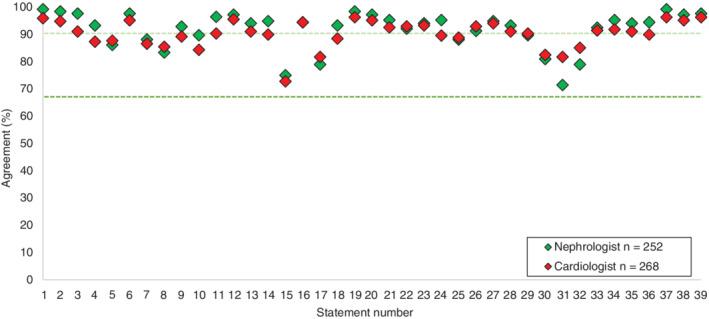
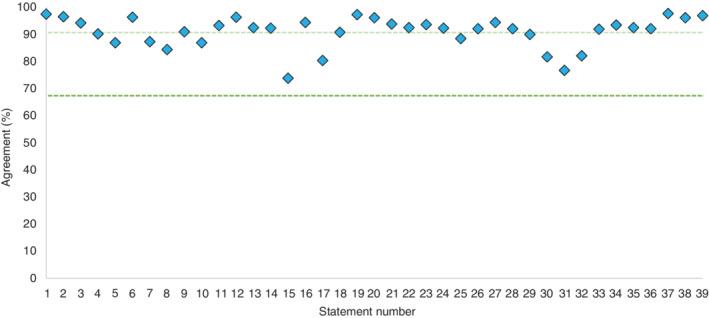
An international steering group of cardiologists and nephrologists developed 39 statements regarding hyperkalaemia care, including risk factors and risk stratification, prevention, correction, and cross-specialty coordination. Consensus was determined by agreement on an online questionnaire administered to cardiorenal specialists across Europe and North America. The threshold for consensus agreement was established a priori by the steering group at 67%. Across November 2021, 520 responses were received from Canada (n = 50), France (n = 50), Germany (n = 54), Italy (n = 58), Spain (n = 57), the UK (n = 49), and the US (n = 202); 268 from cardiologists and 252 from nephrologists. Twenty-nine statements attained very high agreement (≥90%) and 10 attained high agreement (≥67%-<90%), with strong alignment between cardiologists and nephrologists.
CONCLUSION
A high degree of consensus regarding hyperkalaemia evaluation and management exists among healthcare professionals. Based on high levels of agreement, the steering group derived six key recommendations for hyperkalaemia prevention and management in people with cardiorenal disease. Future studies examining the quality of hyperkalaemia care delivery are required.
目的
肾素-血管紧张素-醛固酮系统抑制剂(RAASi)是指南推荐的治疗心肾疾病患者的药物。它们与高钾血症风险增加有关,而高钾血症是该人群常见且危及生命的疾病。RAASi 引起的高钾血症常导致剂量减少或停药,从而降低心肾保护作用。指南推荐在心肾疾病患者高钾血症的临床管理方面,不同专业之间存在差异。我们使用改良 Delphi 法制定了心肾疾病成人高钾血症最佳管理的共识推荐意见。
方法和结果
由心脏病专家和肾脏病专家组成的国际指导小组制定了 39 条关于高钾血症护理的声明,包括危险因素和风险分层、预防、纠正以及跨专业协调。通过对欧洲和北美的心脏病和肾脏病专家进行在线问卷调查来确定共识。指导小组预先确定了共识协议的阈值为 67%。2021 年 11 月期间,来自加拿大(n=50)、法国(n=50)、德国(n=54)、意大利(n=58)、西班牙(n=57)、英国(n=49)和美国(n=202)的 520 名专家做出了回应;其中 268 名为心脏病专家,252 名为肾脏病专家。29 条声明获得了非常高的一致性(≥90%),10 条声明获得了高一致性(≥67%-<90%),心脏病专家和肾脏病专家之间的一致性很强。
结论
在医疗保健专业人员中,对高钾血症的评估和管理存在高度共识。基于高水平的一致性,指导小组得出了 6 条关于心肾疾病患者高钾血症预防和管理的关键建议。需要进一步研究以评估高钾血症护理的质量。

 Zotero 插件