
初次感染后对SARS-CoV-2再感染的观察性保护:一项丹麦队列研究,使用两年全国PCR检测数据,研究对象为未接种疫苗者。
Observed protection against SARS-CoV-2 reinfection following a primary infection: A Danish cohort study among unvaccinated using two years of nationwide PCR-test data.
作者信息
Michlmayr Daniela, Hansen Christian Holm, Gubbels Sophie Madeleine, Valentiner-Branth Palle, Bager Peter, Obel Niels, Drewes Birgitte, Møller Camilla Holten, Møller Frederik Trier, Legarth Rebecca, Mølbak Kåre, Ethelberg Steen
机构信息
Department of Bacteria, Parasites and Fungi, Statens Serum Institut, 5 Artillerivej, 2300 Copenhagen S, Denmark.
European Programme for Public Health Microbiology Training (EUPHEM), European Centre for Disease Prevention and Control (ECDC), Gustav III:s Boulevard 40, 16973 Solna, Sweden.
出版信息
Lancet Reg Health Eur. 2022 Sep;20:100452. doi: 10.1016/j.lanepe.2022.100452. Epub 2022 Jun 30.
BACKGROUND
The level of protection after a SARS-CoV-2 infection against reinfection and COVID-19 disease remains important with much of the world still unvaccinated.
METHODS
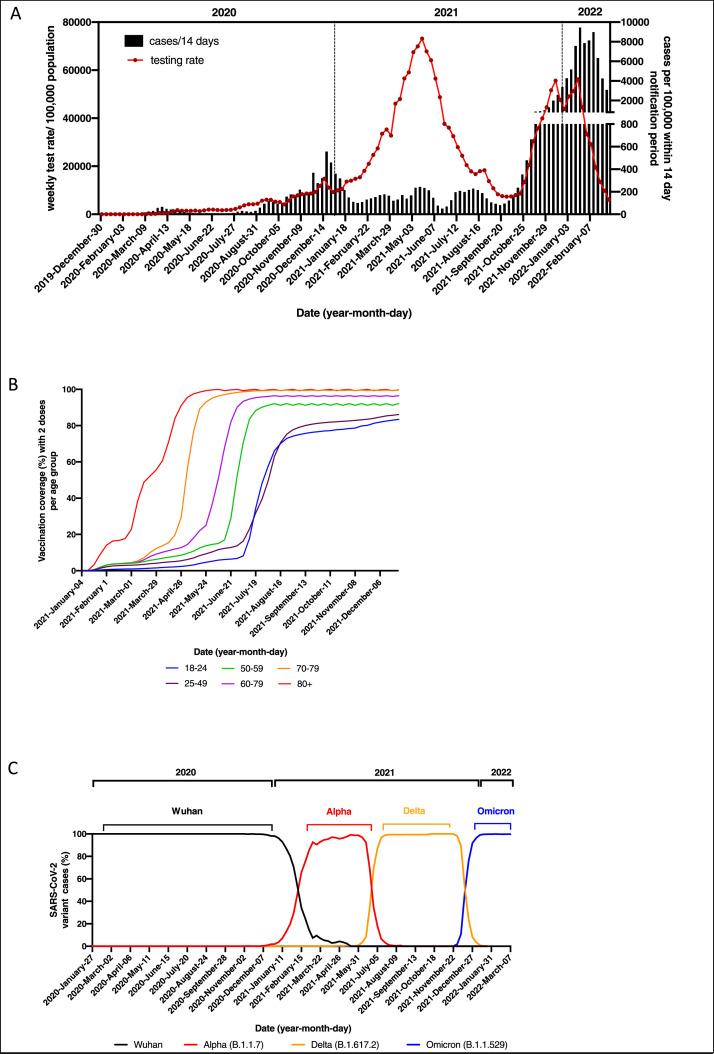
Analysing nationwide, individually referable, Danish register data including RT-PCR-test results, we conducted a cohort study using Cox regression to compare SARS-CoV-2 infection rates before and after a primary infection among still unvaccinated individuals, adjusting for sex, age, comorbidity and residency region. Estimates of protection against infection were calculated as 1 minus the hazard ratio. Estimates of protection against symptomatic infections and infections leading to hospitalisation were also calculated. The prevalence of infections classified as symptomatic or asymptomatic was compared for primary infections and reinfections. The study also assessed protection against each of the main viral variants after a primary infection with an earlier variant by restricting follow-up time to distinct, mutually exclusive periods during which each variant dominated.
FINDINGS
Until 1 July 2021 the estimated protection against reinfection was 83.4% (95%CI: 82.2-84.6%); but lower for the 65+ year-olds (72.2%; 95%CI: 53.2-81.0%). Moderately higher estimates were found for protection against symptomatic disease, 88.3% overall (95%CI: 85.9-90.3%). First-time cases who reported no symptoms were more likely to experience a reinfection (odds ratio: 1.48; 95%CI: 1.35-1.62). By autumn 2021, when infections were almost exclusively caused by the Delta variant, the estimated protection following a recent first infection was 91.3% (95%CI: 89.7-92.7%) compared to 71.4% (95%CI: 66.9-75.3%) after a first infection over a year earlier. With Omicron, a first infection with an earlier variant in the past 3-6 months gave an estimated 51.0% (95%CI: 50.1-52.0%) protection, whereas a first infection longer than 12 months earlier provided only 19.0% (95%CI: 17.2-20.5%) protection. Protection by an earlier variant-infection against hospitalisation due to a new infection was estimated at: 86.6% (95%CI: 46.3-96.7%) for Alpha, 97.2% (95%CI: 89.0-99.3%) for Delta, and 69.8% (95%CI: 51.5-81.2%) for the Omicron variant.
INTERPRETATION
SARS-CoV-2 infection offered a high level of sustained protection against reinfection, comparable with that offered by vaccines, but decreased with the introduction of new main virus variants; dramatically so when Omicron appeared. Protection was lower among the elderly but appeared more pronounced following symptomatic compared to asymptomatic infections. The level of estimated protection against serious disease was somewhat higher than that against infection and possibly longer lasting. Decreases in protection against reinfection, seemed primarily to be driven by viral evolution.
FUNDING
None.
背景
在世界上许多地区仍未接种疫苗的情况下,新型冠状病毒(SARS-CoV-2)感染后对再次感染和新冠疾病的保护水平仍然很重要。
方法
我们分析了丹麦全国范围内可单独溯源的登记数据,包括逆转录聚合酶链反应(RT-PCR)检测结果,采用Cox回归进行队列研究,以比较未接种疫苗个体初次感染前后的SARS-CoV-2感染率,并对性别、年龄、合并症和居住地区进行了调整。预防感染的估计值计算为1减去风险比。还计算了预防有症状感染和导致住院的感染的估计值。比较了初次感染和再次感染中分类为有症状或无症状感染的患病率。该研究还通过将随访时间限制在每个主要病毒变异株占主导的不同、相互排斥的时期,评估了初次感染较早变异株后对每种主要病毒变异株的保护作用。
结果
截至2021年7月1日,估计对再次感染的保护率为83.4%(95%置信区间:82.2-84.6%);但65岁及以上人群的保护率较低(72.2%;95%置信区间:53.2-81.0%)。发现预防有症状疾病的估计值略高,总体为88.3%(95%置信区间:85.9-90.3%)。报告无症状的初次感染者更有可能再次感染(优势比:1.48;95%置信区间:1.35-1.62)。到2021年秋季,当感染几乎完全由德尔塔变异株引起时,最近初次感染后的估计保护率为91.3%(95%置信区间:89.7-92.7%),而一年多前初次感染后的保护率为71.4%(95%置信区间:66.9-75.3%)。对于奥密克戎变异株,在过去3-6个月内初次感染较早变异株的估计保护率为51.0%(95%置信区间:50.1-52.0%),而初次感染超过12个月前的保护率仅为19.0%(95%置信区间:17.2-20.5%)。较早变异株感染对因新感染导致住院的保护率估计为:阿尔法变异株为86.6%(95%置信区间:46.3-96.7%),德尔塔变异株为97.2%(95%置信区间:89.0-99.3%),奥密克戎变异株为69.8%(95%置信区间:51.5-81.2%)。
解读
SARS-CoV-2感染对再次感染提供了高水平的持续保护,与疫苗提供的保护相当,但随着新的主要病毒变异株的出现而降低;奥密克戎出现时下降幅度很大。老年人的保护作用较低,但与无症状感染相比,有症状感染后的保护作用似乎更明显。预防严重疾病的估计保护水平略高于预防感染的水平,且可能持续时间更长。对再次感染的保护作用下降似乎主要是由病毒进化驱动的。
资金来源
无。


 Zotero 插件