
大象进化出了逃避 MDM2 介导的抑制和癌症的 p53 异构体。
The Elephant Evolved p53 Isoforms that Escape MDM2-Mediated Repression and Cancer.
机构信息
International Centre for Cancer Vaccine Science, University of Gdansk, ul. Kładki 24, Gdansk, Poland.
Institute of Genetics and Cancer, University of Edinburgh, Edinburgh, UK.
出版信息
Mol Biol Evol. 2022 Jul 2;39(7). doi: 10.1093/molbev/msac149.
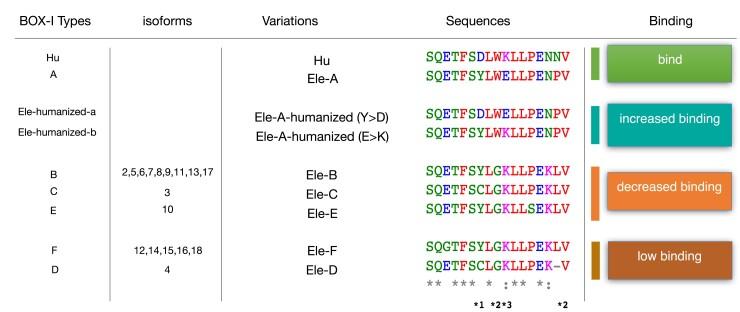
The p53 tumor suppressor is a transcription factor with roles in cell development, apoptosis, oncogenesis, aging, and homeostasis in response to stresses and infections. p53 is tightly regulated by the MDM2 E3 ubiquitin ligase. The p53-MDM2 pathway has coevolved, with MDM2 remaining largely conserved, whereas the TP53 gene morphed into various isoforms. Studies on prevertebrate ancestral homologs revealed the transition from an environmentally induced mechanism activating p53 to a tightly regulated system involving cell signaling. The evolution of this mechanism depends on structural changes in the interacting protein motifs. Elephants such as Loxodonta africana constitute ideal models to investigate this coevolution as they are large and long-living as well as having 20 copies of TP53 isoformic sequences expressing a variety of BOX-I MDM2-binding motifs. Collectively, these isoforms would enhance sensitivity to cellular stresses, such as DNA damage, presumably accounting for strong cancer defenses and other adaptations favoring healthy aging. Here we investigate the molecular evolution of the p53-MDM2 system by combining in silico modeling and in vitro assays to explore structural and functional aspects of p53 isoforms retaining the MDM2 interaction, whereas forming distinct pools of cell signaling. The methodology used demonstrates, for the first time that in silico docking simulations can be used to explore functional aspects of elephant p53 isoforms. Our observations elucidate structural and mechanistic aspects of p53 regulation, facilitate understanding of complex cell signaling, and suggest testable hypotheses of p53 evolution referencing Peto's Paradox.
p53 肿瘤抑制因子是一种转录因子,在细胞发育、凋亡、致癌、衰老和对压力和感染的内稳态中发挥作用。p53 受到 MDM2 E3 泛素连接酶的严格调控。p53-MDM2 途径共同进化,MDM2 基本保持保守,而 TP53 基因则演变成各种异构体。对前脊椎动物祖先同源物的研究揭示了从环境诱导激活 p53 的机制向涉及细胞信号的严格调控系统的转变。这种机制的进化取决于相互作用蛋白结构域的结构变化。非洲象(Loxodonta africana)等大象是研究这种共同进化的理想模型,因为它们体型庞大、寿命长,并且有 20 个 TP53 同工型序列,表达各种 BOX-I MDM2 结合基序。这些同工型共同作用,增强了对细胞应激(如 DNA 损伤)的敏感性,这可能是大象具有强大的癌症防御和其他有利于健康衰老的适应能力的原因。在这里,我们通过结合计算机建模和体外测定来研究 p53-MDM2 系统的分子进化,以探索保留 MDM2 相互作用的 p53 同工型的结构和功能方面,而形成不同的细胞信号池。所使用的方法首次证明,计算机对接模拟可以用于探索大象 p53 同工型的功能方面。我们的观察结果阐明了 p53 调节的结构和机制方面,促进了对复杂细胞信号的理解,并提出了可以测试的 p53 进化假说,参考了 Peto 的悖论。


 Zotero 插件