
韩国青少年在新冠疫情期间的生活方式变化与肥胖情况:基于2019年和2020年韩国青少年风险行为调查
Changes in lifestyle and obesity during the COVID-19 pandemic in Korean adolescents: based on the Korea Youth Risk Behavior Survey 2019 and 2020.
作者信息
Kang Sinyoung, Seo Moon Young, Kim Shin-Hye, Park Mi Jung
机构信息
Department of Pediatrics, Inje University Sanggye Paik Hospital, Seoul, Korea.
Department of Pediatrics, Uijeongbu Eulji Medical Center, Eulji University School of Medicine, Uijeongbu, Korea.
出版信息
Ann Pediatr Endocrinol Metab. 2022 Dec;27(4):281-288. doi: 10.6065/apem.2142228.114. Epub 2022 Jun 28.
PURPOSE
The coronavirus disease 2019 (COVID-19) pandemic has affected people's daily lives and increased their time spent at home. This study aims to investigate the changes in lifestyle factors and obesity among Korean adolescents before and during the COVID-19 outbreak.
METHODS
We used the data of 109,282 adolescents aged 12-18 years, from the Korea Youth Risk Behavior Survey conducted in 2019 and 2020 before and during the COVID-19 pandemic, respectively. The changes in the prevalence of obesity and lifestyle factors (diet, exercise, sitting time, and sleep duration) were assessed. The adjusted odds ratios (ORs) (95% confidence intervals [CIs]) of predictors for obesity were calculated.
RESULTS
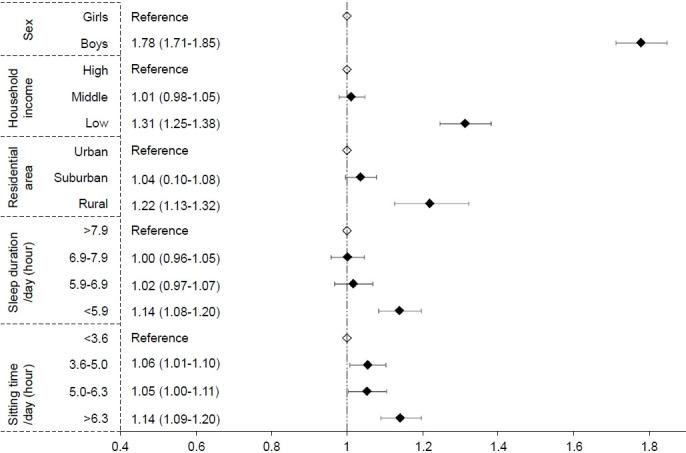
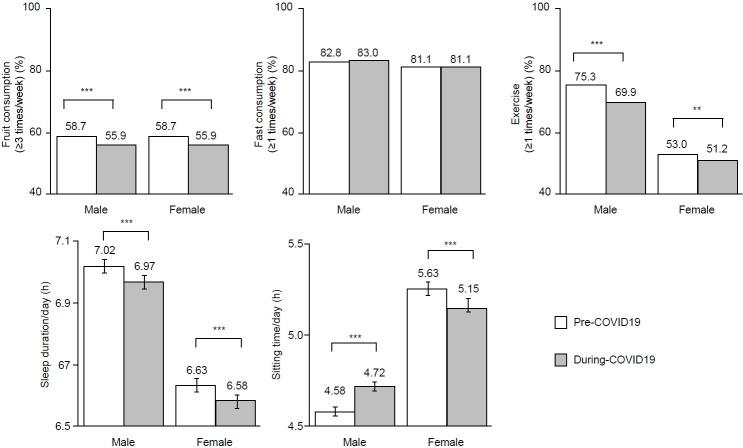
The prevalence of overweight (10% to 10.5%) and obesity (11.5% to 12.7%) increased significantly, especially among males younger than 15 years, whereas significant differences were absent among females. The mean body mass index z-score increased from 0.28 to 0.39 in males but decreased from 0.08 to 0.04 in females. Fruit consumption, regular exercise, and average sleep duration decreased, whereas sitting time increased. After controlling for covariates, a short sleep duration (OR, 1.14) and an increased sitting time (OR, 1.14) were significantly associated with an elevated risk for overweight/obesity.
CONCLUSION
During the COVID-19 pandemic, the prevalence of obesity and overweight increased, particularly in males, as did unfavorable trends in related lifestyle factors. Sex- and age-specific strategies to improve lifestyle factors associated with obesity are needed, especially during the COVID-19 pandemic.
目的
2019年冠状病毒病(COVID-19)大流行影响了人们的日常生活,并增加了他们在家的时间。本研究旨在调查COVID-19疫情爆发前和期间韩国青少年生活方式因素和肥胖情况的变化。
方法
我们使用了分别在2019年和2020年COVID-19大流行之前和期间进行的韩国青少年风险行为调查中109282名12至18岁青少年的数据。评估了肥胖患病率和生活方式因素(饮食、运动、久坐时间和睡眠时间)的变化。计算了肥胖预测因素的调整比值比(OR)(95%置信区间[CI])。
结果
超重(从10%增至10.5%)和肥胖(从11.5%增至12.7%)患病率显著上升,尤其是在15岁以下男性中,而女性中无显著差异。男性的平均体重指数z评分从0.28增至0.39,而女性则从0.08降至0.04。水果摄入量、定期运动和平均睡眠时间减少,而久坐时间增加。在控制协变量后,睡眠时间短(OR,1.14)和久坐时间增加(OR,1.14)与超重/肥胖风险升高显著相关。
结论
在COVID-19大流行期间,肥胖和超重患病率上升,尤其是在男性中,相关生活方式因素的不利趋势也是如此。需要针对性别和年龄制定策略来改善与肥胖相关的生活方式因素,尤其是在COVID-19大流行期间。

 Zotero 插件