
CD19 嵌合抗原受体 T 细胞治疗非霍奇金淋巴瘤后侵袭性真菌病的发生率较低。
Low incidence of invasive fungal disease following CD19 chimeric antigen receptor T-cell therapy for non-Hodgkin lymphoma.
机构信息
Division of Infectious Diseases, Brigham and Women's Hospital, Boston, MA.
Harvard Medical School, Boston, MA.
出版信息
Blood Adv. 2022 Aug 23;6(16):4821-4830. doi: 10.1182/bloodadvances.2022007474.
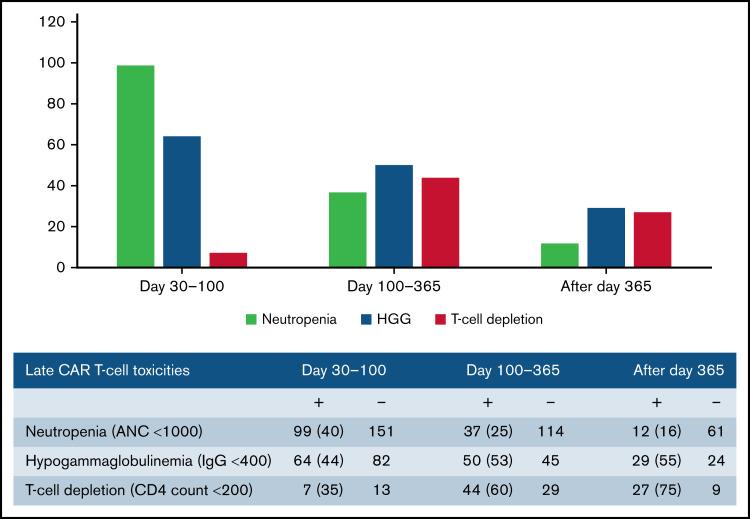
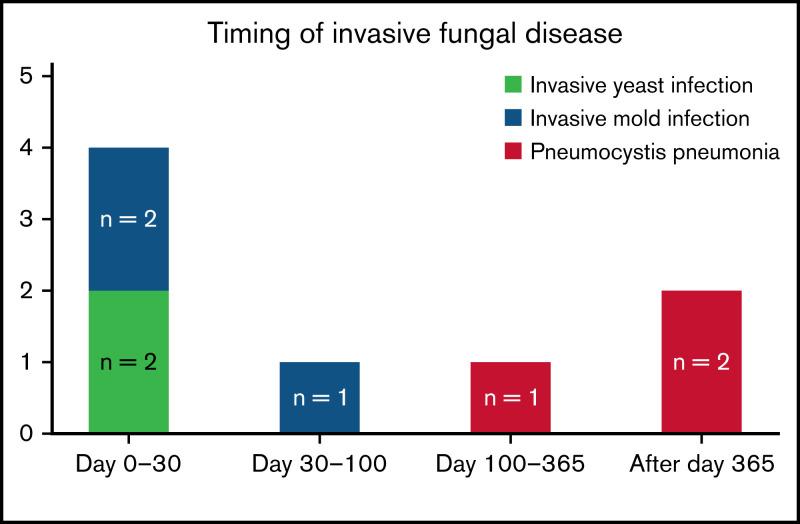
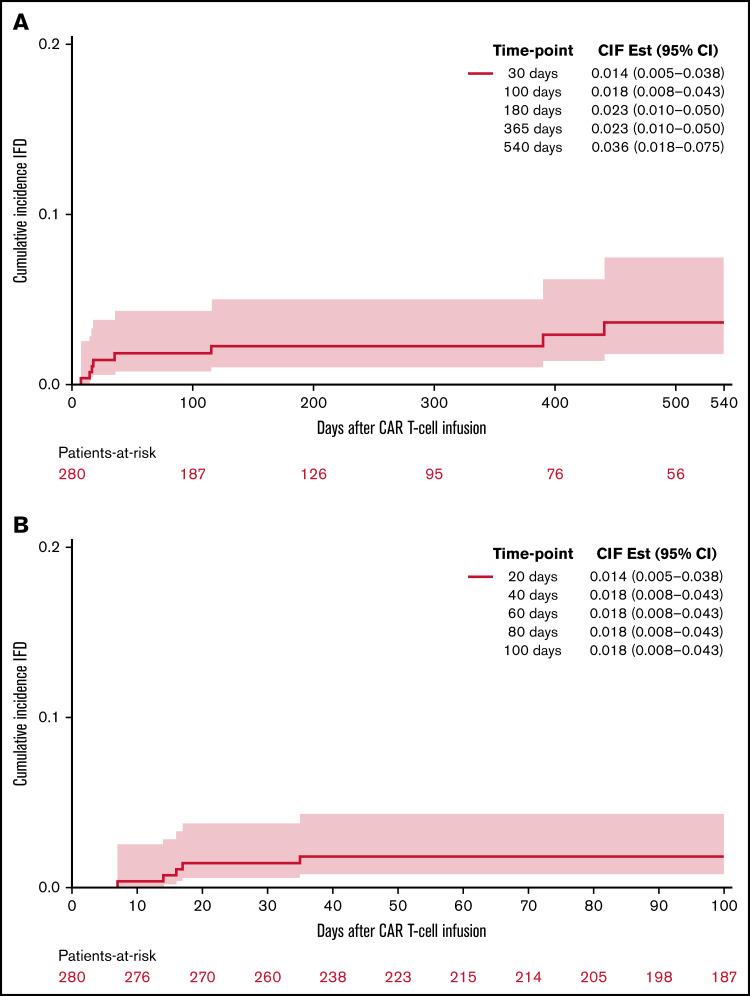
CAR T-cell therapy has revolutionized the treatment of hematologic malignancies, although its use may be complicated by toxicities, including cytokine release syndrome (CRS), immune effector cell-associated neurotoxicity syndrome (ICANS), and infections. Invasive fungal disease (IFD) has been reported after CAR T-cell therapy, but the incidence in the absence of antifungal prophylaxis is unknown. Optimal prophylaxis strategies are widely debated. We performed a single-center retrospective study of 280 adults receiving CD19 CAR T-cell therapy for non-Hodgkin lymphoma (NHL) from December 2017 through September 2021. Patients did not receive routine antiyeast or antimold prophylaxis. IFD was identified between day of cell infusion and last follow-up. Cumulative incidence functions were calculated at 100 days and 18 months based on time to IFD, using dates of IFD-free death, initiation of salvage treatment, and hematopoietic cell transplantation as competing risks. Eight patients (2.9%) developed IFD, including 3 Pneumocystis jirovecii pneumonia, 3 invasive mold infections (IMIs), and 2 invasive yeast infections (IYIs). The 100-day cumulative incidence of IFD accounting for competing risks was 1.8% (95% confidence interval [CI], 0.8% to 4.4%). Among the 280 patients, early toxicities including CRS (85%) and ICANS (55%) and late toxicities after day 30 including grades 3 and 4 neutropenia (41%) and low CD4 T-cell count (20%) were common. IFD was rare among patients who received CD19 CAR T-cell therapy for NHL in the absence of routine antifungal prophylaxis, despite frequent toxicities. These results suggest that, in settings with low institutional rates of IFD, routine antifungal prophylaxis may not be indicated.
嵌合抗原受体 T 细胞疗法(CAR T-cell therapy)已经彻底改变了血液系统恶性肿瘤的治疗方法,尽管其使用可能因毒性反应而变得复杂,包括细胞因子释放综合征(cytokine release syndrome,CRS)、免疫效应细胞相关神经毒性综合征(immune effector cell-associated neurotoxicity syndrome,ICANS)和感染。CAR T 细胞治疗后已报道有侵袭性真菌病(invasive fungal disease,IFD)发生,但在没有抗真菌预防的情况下,其发生率尚不清楚。最佳预防策略存在广泛争议。我们对 2017 年 12 月至 2021 年 9 月期间接受 CD19 CAR T 细胞治疗非霍奇金淋巴瘤(non-Hodgkin lymphoma,NHL)的 280 例成人患者进行了一项单中心回顾性研究。患者未接受常规抗真菌或抗霉菌预防。IFD 是在细胞输注日至最后一次随访期间确定的。根据 IFD 无死亡、挽救治疗开始和造血细胞移植的日期,基于 IFD 时间计算了 100 天和 18 个月的累积发生率函数,作为竞争风险。8 例(2.9%)患者发生 IFD,包括 3 例肺孢子菌肺炎(Pneumocystis jirovecii pneumonia)、3 例侵袭性霉菌感染(invasive mold infections,IMIs)和 2 例侵袭性酵母菌感染(invasive yeast infections,IYIs)。考虑竞争风险的 100 天 IFD 累积发生率为 1.8%(95%置信区间 [confidence interval,CI]:0.8%~4.4%)。在 280 例患者中,常见的早期毒性反应包括 CRS(85%)和 ICANS(55%),30 天后的晚期毒性反应包括 3 级和 4 级中性粒细胞减少症(41%)和低 CD4 T 细胞计数(20%)。在 NHL 患者中接受 CD19 CAR T 细胞治疗而未常规进行抗真菌预防的情况下,IFD 罕见,尽管存在频繁的毒性反应。这些结果表明,在 IFD 机构发生率较低的情况下,常规抗真菌预防可能不是必需的。

 Zotero 插件