
依替替班治疗慢性偏头痛患者的预防作用:长期降低疾病影响。
Long-term reductions in disease impact in patients with chronic migraine following preventive treatment with eptinezumab.
机构信息
The Los Angeles Headache Center, Los Angeles, CA, USA.
H. Lundbeck A/S, Copenhagen, Denmark.
出版信息
BMC Neurol. 2022 Jul 8;22(1):251. doi: 10.1186/s12883-022-02774-3.
BACKGROUND
Eptinezumab is an anti-calcitonin gene-related peptide humanized monoclonal antibody approved for the preventive treatment of migraine in adults. The PREVAIL study demonstrated a favorable safety profile with sustained reductions in overall migraine-related burden in patients with chronic migraine (CM). This post hoc analysis aimed to examine item-level changes in the Migraine Disability Assessment (MIDAS) questionnaire over 2 years in participants with CM on eptinezumab treatment.
METHODS
PREVAIL was an open-label, phase 3 trial that included 96 weeks of treatment where 128 adults received intravenous eptinezumab administered over 30 min every 12 weeks (wks) for up to 8 doses of 300 mg. MIDAS was administered at baseline, Wk12, and every 12wks thereafter. Two supplementary MIDAS items not included in the total score calculation assessed number of headache days in the past 3 months (MIDAS headache) and average headache pain severity (from 0 [none] to 10 [worst]). MIDAS total scores were summed from 5 items, each quantifying the number of days in the past 3 months with migraine-related disability. Items 1, 3, and 5 assessed absenteeism, namely how many days the patient missed work/school (Q1), household work (Q3), or family/social/leisure activities (Q5). Items 2 and 4 were measures of presenteeism, namely how many days the patient had reduced productivity in work/school (Q2) or household work (Q4).
RESULTS
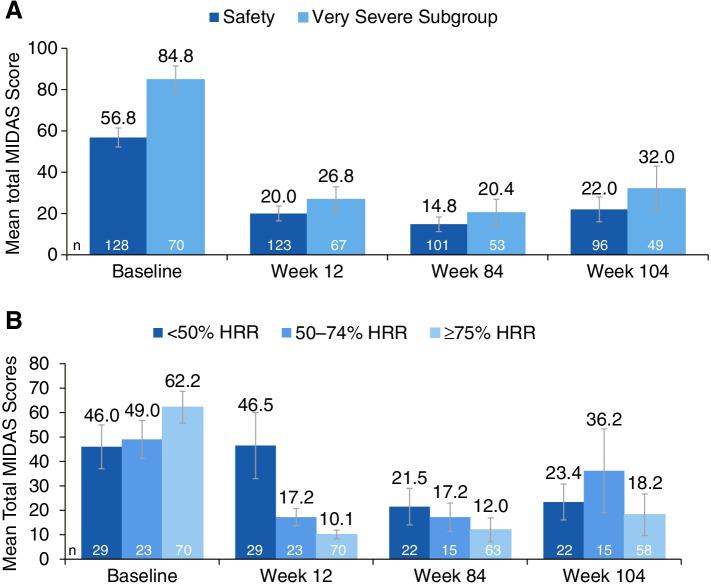
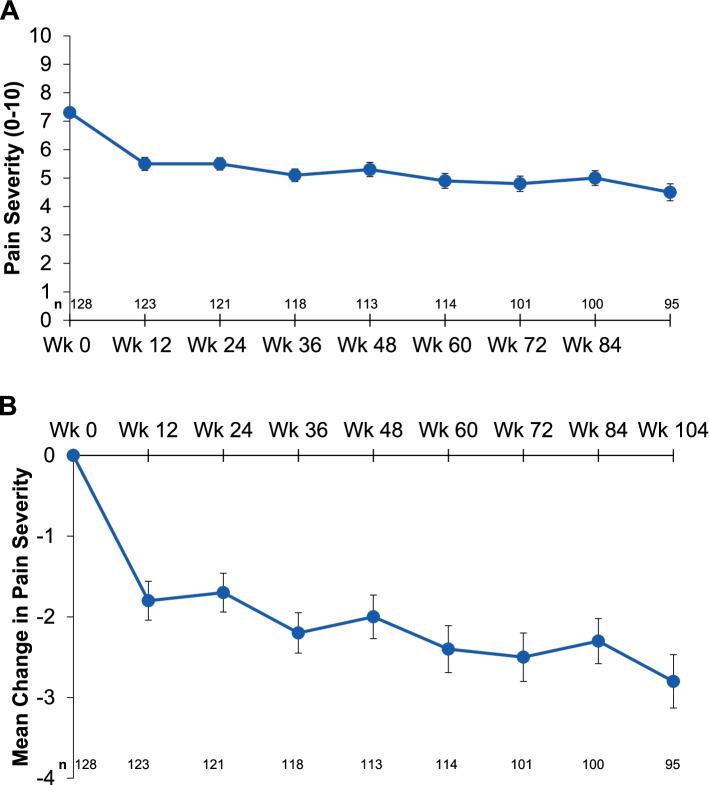
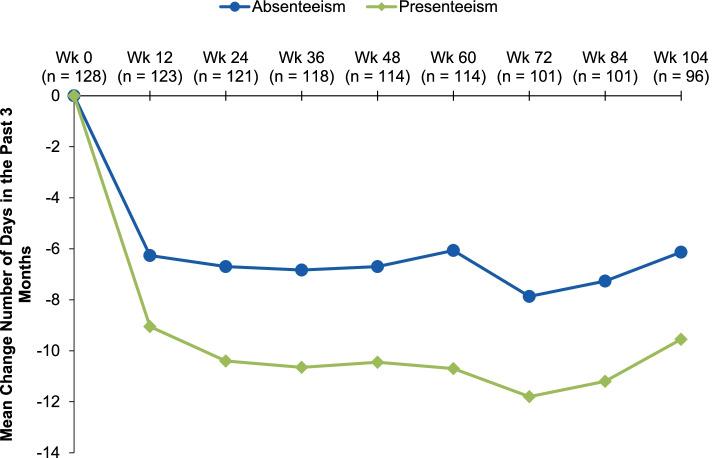
Mean MIDAS headache days decreased from 47.4 (baseline) to 17.1 (Wk12) and 16.3 (Wk104). The average headache pain severity score (0‒10) decreased from a mean of 7.3 (baseline) to 5.5 (Wk12) to 4.5 (Wk104). Mean MIDAS scores measuring absenteeism (Q1, 3, 5) changed from 9.7 days at baseline to 3.2 days (Wk12) and to 3.9 days (Wk104). Mean MIDAS scores measuring presenteeism (Q2, 4) at Wk12 decreased from 14.2 days at baseline to 5.2 days (Wk12, 104). Patients categorized with very severe MIDAS disability had a mean total MIDAS score of 84.8, with an average reduction of 56.7 days (Wk12), which was maintained at 32 days at Wk104.
CONCLUSIONS
Long-term treatment with eptinezumab in patients with CM suggested sustained reductions in MIDAS-quantified disability, consistent with the sustained reductions in headache frequency and pain severity.
TRIAL REGISTRATION
ClinicalTrials.gov identifier: NCT02985398 .
背景
依普替扎umab 是一种抗降钙素基因相关肽的人源化单克隆抗体,已被批准用于成人偏头痛的预防性治疗。PREVAIL 研究表明,接受依普替扎umab 治疗的慢性偏头痛(CM)患者具有良好的安全性,偏头痛相关负担整体持续减少。本事后分析旨在研究依普替扎umab 治疗的 CM 患者在 2 年内偏头痛残疾评估(MIDAS)问卷的项目水平变化。
方法
PREVAIL 是一项开放标签、3 期临床试验,包括 96 周的治疗期,128 名成年人接受静脉内依普替扎umab 治疗,每 12 周输注 30 分钟,最多 8 次,每次 300mg。MIDAS 在基线、第 12 周和此后每 12 周进行评估。两个补充的 MIDAS 项目未包括在总分计算中,评估过去 3 个月的头痛天数(MIDAS 头痛)和平均头痛严重程度(从 0 [无]到 10 [最严重])。MIDAS 总分为 5 个项目的总和,每个项目均量化过去 3 个月中偏头痛相关残疾的天数。项目 1、3 和 5 评估缺勤情况,即患者错过工作/学校(Q1)、家务(Q3)或家庭/社交/休闲活动(Q5)的天数。项目 2 和 4 是生产力下降的衡量标准,即患者在工作/学校(Q2)或家务(Q4)中的工作效率下降了多少天。
结果
平均 MIDAS 头痛天数从 47.4 天(基线)减少到 17.1 天(第 12 周)和 16.3 天(第 104 周)。平均头痛严重程度评分(0-10)从基线时的 7.3 分降至 5.5 分(第 12 周)至 4.5 分(第 104 周)。缺勤情况的 MIDAS 评分(Q1、3、5)从基线时的 9.7 天降至 3.2 天(第 12 周)和 3.9 天(第 104 周)。第 12 周时,评估生产力下降情况的 MIDAS 评分(Q2、4)从基线时的 14.2 天降至 5.2 天(第 12 周和第 104 周)。MIDAS 残疾严重程度非常严重的患者总 MIDAS 评分为 84.8 分,平均减少 56.7 天(第 12 周),第 104 周时仍维持在 32 天。
结论
CM 患者长期接受依普替扎umab 治疗可持续降低 MIDAS 残疾评分,与头痛频率和疼痛严重程度的持续降低一致。
试验注册
ClinicalTrials.gov 标识符:NCT02985398。

 Zotero 插件