
高频10千赫脊髓刺激改善难治性疼痛性糖尿病神经病变患者的健康相关生活质量:一项随机对照试验的12个月结果
High-Frequency 10-kHz Spinal Cord Stimulation Improves Health-Related Quality of Life in Patients With Refractory Painful Diabetic Neuropathy: 12-Month Results From a Randomized Controlled Trial.
作者信息
Petersen Erika A, Stauss Thomas G, Scowcroft James A, Brooks Elizabeth S, White Judith L, Sills Shawn M, Amirdelfan Kasra, Guirguis Maged N, Xu Jijun, Yu Cong, Nairizi Ali, Patterson Denis G, Tsoulfas Kostandinos C, Creamer Michael J, Galan Vincent, Bundschu Richard H, Mehta Neel D, Sayed Dawood, Lad Shivanand P, DiBenedetto David J, Sethi Khalid A, Goree Johnathan H, Bennett Matthew T, Harrison Nathan J, Israel Atef F, Chang Paul, Wu Paul W, Argoff Charles E, Nasr Christian E, Taylor Rod S, Caraway David L, Mekhail Nagy A
机构信息
Department of Neurosurgery, University of Arkansas for Medical Sciences, Little Rock.
Advanced Pain Management, Greenfield, WI.
出版信息
Mayo Clin Proc Innov Qual Outcomes. 2022 Jul 1;6(4):347-360. doi: 10.1016/j.mayocpiqo.2022.05.003. eCollection 2022 Aug.
OBJECTIVE
To evaluate high-frequency (10-kHz) spinal cord stimulation (SCS) treatment in refractory painful diabetic neuropathy.
PATIENTS AND METHODS
A prospective, multicenter randomized controlled trial was conducted between Aug 28, 2017 and March 16, 2021, comparing conventional medical management (CMM) with 10-kHz SCS+CMM. The participants had hemoglobin A1c level of less than or equal to 10% and pain greater than or equal to 5 of 10 cm on visual analog scale, with painful diabetic neuropathy symptoms 12 months or more refractory to gabapentinoids and at least 1 other analgesic class. Assessments included measures of pain, neurologic function, and health-related quality of life (HRQoL) over 12 months with optional crossover at 6 months.
RESULTS
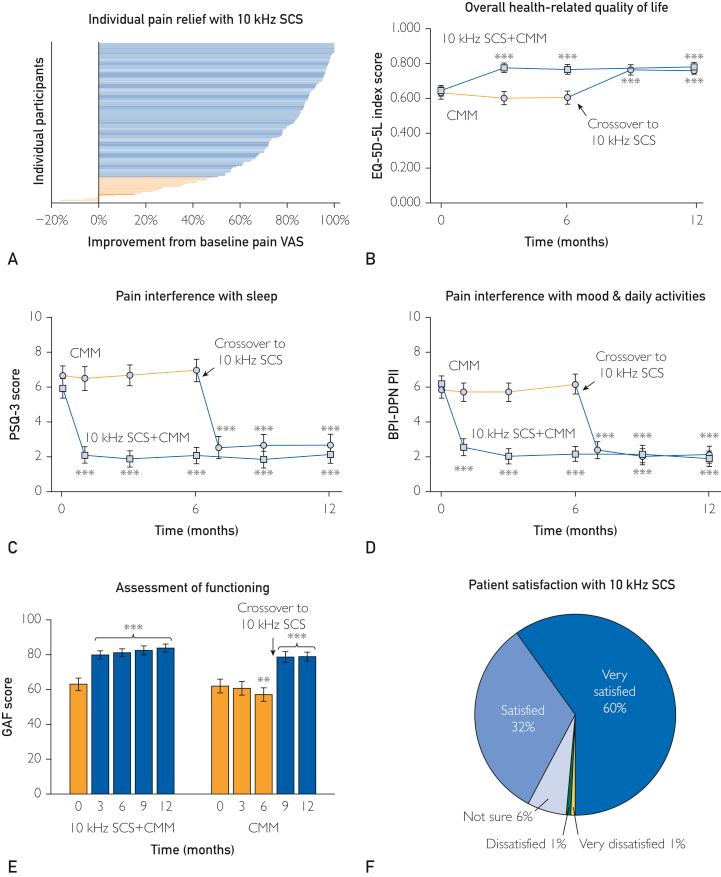
The participants were randomized 1:1 to CMM (n=103) or 10-kHz SCS+CMM (n=113). At 6 months, 77 of 95 (81%) CMM group participants opted for crossover, whereas none of the 10-kHz SCS group participants did so. At 12 months, the mean pain relief from baseline among participants implanted with 10-kHz SCS was 74.3% (95% CI, 70.1-78.5), and 121 of 142 (85%) participants were treatment responders (≥50% pain relief). Treatment with 10-kHz SCS improved HRQoL, including a mean improvement in the EuroQol 5-dimensional questionnaire index score of 0.136 (95% CI, 0.104-0.169). The participants also reported significantly less pain interference with sleep, mood, and daily activities. At 12 months, 131 of 142 (92%) participants were "satisfied" or "very satisfied" with the 10-kHz SCS treatment.
CONCLUSION
The 10-kHz SCS treatment resulted in substantial pain relief and improvement in overall HRQoL 2.5- to 4.5-fold higher than the minimal clinically important difference. The outcomes were durable over 12 months and support 10-kHz SCS treatment in patients with refractory painful diabetic neuropathy.
TRIAL REGISTRATION
clincaltrials.gov Identifier: NCT03228420.
目的
评估高频(10kHz)脊髓刺激(SCS)治疗难治性疼痛性糖尿病神经病变的效果。
患者与方法
于2017年8月28日至2021年3月16日进行了一项前瞻性、多中心随机对照试验,比较传统药物治疗(CMM)与10kHz SCS联合CMM。参与者的糖化血红蛋白水平小于或等于10%,视觉模拟量表上的疼痛程度大于或等于10厘米中的5厘米,患有疼痛性糖尿病神经病变症状,对加巴喷丁类药物及至少1种其他镇痛药物治疗12个月或更长时间无效。评估包括12个月内的疼痛、神经功能和健康相关生活质量(HRQoL)测量,6个月时可选择交叉治疗。
结果
参与者按1:1随机分为CMM组(n = 103)或10kHz SCS联合CMM组(n = 113)。6个月时,95名CMM组参与者中有77名(81%)选择交叉治疗,而10kHz SCS组参与者中无人选择。12个月时,接受10kHz SCS治疗的参与者自基线起的平均疼痛缓解率为74.3%(95%CI,70.1 - 78.5),142名参与者中有121名(85%)为治疗反应者(疼痛缓解≥50%)。10kHz SCS治疗改善了HRQoL,包括欧洲五维健康量表指数得分平均提高0.136(95%CI,0.104 - 0.169)。参与者还报告疼痛对睡眠、情绪和日常活动的干扰明显减少。12个月时,142名参与者中有131名(92%)对10kHz SCS治疗“满意”或“非常满意”。
结论
10kHz SCS治疗带来了显著的疼痛缓解,整体HRQoL改善比最小临床重要差异高2.5至4.5倍。治疗效果在12个月内持久,支持10kHz SCS用于治疗难治性疼痛性糖尿病神经病变患者。
试验注册
美国国立医学图书馆临床试验注册中心标识符:NCT03228420 。

 Zotero 插件