
膳食纤维补充剂对成人慢性便秘的影响:一项更新的随机对照试验的系统评价和荟萃分析。
The Effect of Fiber Supplementation on Chronic Constipation in Adults: An Updated Systematic Review and Meta-Analysis of Randomized Controlled Trials.
机构信息
Department of Nutritional Sciences, King's College London, London, United Kingdom.
出版信息
Am J Clin Nutr. 2022 Oct 6;116(4):953-969. doi: 10.1093/ajcn/nqac184.
BACKGROUND
Chronic constipation is a prevalent disorder that remains challenging to treat. Studies suggest increasing fiber intake may improve symptoms, although recommendations on the fiber type, dose, and treatment duration are unclear.
OBJECTIVES
We investigated the effects of fiber supplementation on stool output, gut transit time, symptoms, and quality of life in adults with chronic constipation via a systematic review and meta-analysis of randomized controlled trials (RCTs).
METHODS
Studies were identified using electronic databases, backward citation, and hand searches of abstracts. RCTs reporting administration of fiber supplementation in adults with chronic constipation were included. Risks of bias (RoB) was assessed with the Cochrane RoB 2.0 tool. Results were synthesized using risk ratios (RRs), mean differences, or standardized mean differences (SMDs) and 95% CIs using a random-effects model.
RESULTS
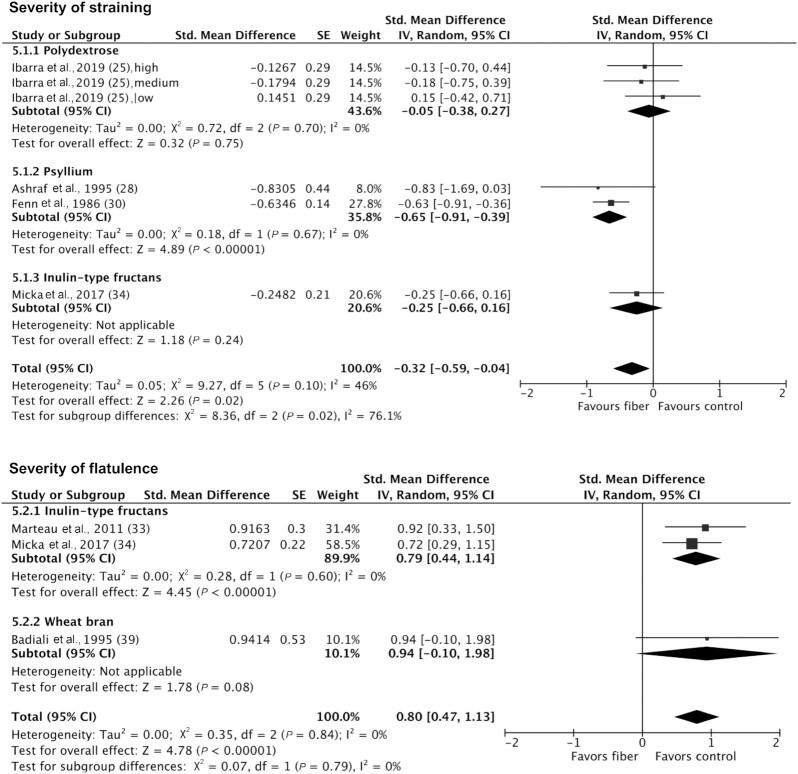
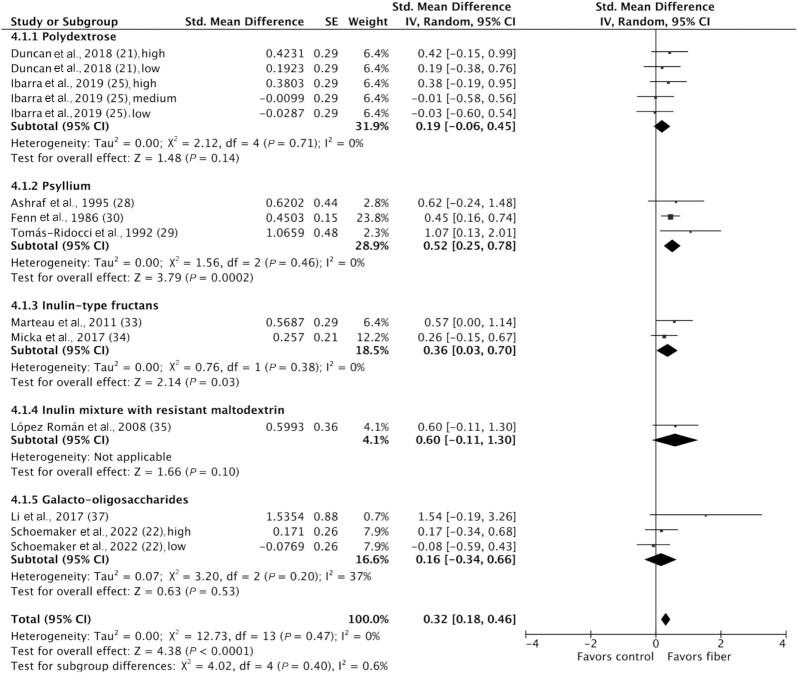
Sixteen RCTs with 1251 participants were included. Overall, 311 of 473 (66%) participants responded to fiber treatment and 134 of 329 (41%) responded to control treatment [RR: 1.48 (95% CI: 1.17, 1.88; P = 0.001); I2 = 57% (P = 0.007)], with psyllium and pectin having significant effects. A higher response to treatment was apparent in fiber groups compared to control groups irrespective of the treatment duration, but only with higher fiber doses (>10 g/d). Fiber increased stool frequency [SMD: 0.72 (95% CI: 0.36, 1.08; P = 0.0001); I2 = 86% (P < 0.00001)]; psyllium and pectin had significant effects, and improvement was apparent only with higher fiber doses and greater treatment durations (≥4 weeks). Fiber improved stool consistency (SMD: 0.32; 95% CI: 0.18, 0.46; P < 0.0001), particularly with higher fiber doses. Flatulence was higher in fiber groups compared to control groups(SMD: 0.80; 95% CI: 0.47, 1.13; P < 0.00001).
CONCLUSIONS
Fiber supplementation is effective at improving constipation. Particularly, psyllium, doses >10 g/d and treatment durations of at least 4 weeks appear optimal, though caution is needed when interpreting the results due to considerable heterogeneity. These findings provide promising evidence on the optimal type and regime of fiber supplementation, which could be used to standardize recommendations to patients. The protocol for this review is registered at PROSPERO as CRD42020191404.
背景
慢性便秘是一种普遍存在的疾病,仍然难以治疗。研究表明,增加膳食纤维的摄入量可能会改善症状,但膳食纤维的类型、剂量和治疗持续时间的建议尚不清楚。
目的
我们通过对随机对照试验(RCT)的系统评价和荟萃分析,研究了膳食纤维补充剂对慢性便秘成人的粪便排出量、肠道转运时间、症状和生活质量的影响。
方法
使用电子数据库、回溯引文和摘要的手工搜索来确定研究。纳入了报告在慢性便秘成人中给予膳食纤维补充剂的 RCT。使用 Cochrane 偏倚风险(RoB)工具评估偏倚风险(RoB)。使用风险比(RR)、均值差或标准化均数差(SMD)和 95%置信区间(CI),采用随机效应模型对结果进行综合。
结果
纳入了 16 项 RCT,共 1251 名参与者。总的来说,473 名参与者中有 311 名(66%)对纤维治疗有反应,329 名中有 134 名(41%)对对照组有反应[RR:1.48(95%CI:1.17,1.88;P=0.001);I2=57%(P=0.007)],其中车前子和果胶有显著效果。与对照组相比,纤维组的治疗反应更高,无论治疗持续时间如何,但只有高纤维剂量(>10g/d)才有这种效果。纤维增加了粪便频率[SMD:0.72(95%CI:0.36,1.08;P=0.0001);I2=86%(P<0.00001)];车前子和果胶有显著效果,只有高纤维剂量和更长的治疗时间(≥4 周)才能改善。纤维改善了粪便稠度(SMD:0.32;95%CI:0.18,0.46;P<0.0001),特别是高纤维剂量。与对照组相比,纤维组的腹胀发生率更高(SMD:0.80;95%CI:0.47,1.13;P<0.00001)。
结论
膳食纤维补充剂对改善便秘有效。特别是车前子、剂量>10g/d 和至少 4 周的治疗时间似乎是最佳的,但由于存在很大的异质性,因此在解释结果时需要谨慎。这些发现为膳食纤维补充的最佳类型和方案提供了有希望的证据,这可以用于为患者制定标准化的建议。本研究的方案已在 PROSPERO 上注册,注册号为 CRD42020191404。


 Zotero 插件