
瑞士一家大学医院医护人员中SARS-CoV-2的大流行影响及急性后遗症
The pandemic toll and post-acute sequelae of SARS-CoV-2 in healthcare workers at a Swiss University Hospital.
作者信息
Nehme Mayssam, Vieux Laure, Courvoisier Delphine S, Braillard Olivia, Spechbach Hervé, Jacquerioz Frederique, Salamun Julien, Assal Frederic, Lador Frederic, Coen Matteo, Agoritsas Thomas, Reny Jean-Luc, Graf Christophe, Benzakour Lamyae, Favale Riccardo, Soccal Paola M, Bondolfi Guido, Tardin Aglaé, Zekry Dina, Stringhini Silvia, Baggio Stéphanie, Genevay Stéphane, Lauper Kim, Meyer Philippe, Kwabena Poku Nana, Landis Basile N, Grira Marwène, Sandoval José, Ehrsam Julien, Regard Simon, Genecand Camille, Kopp Garance, Guerreiro Ivan, Allali Gilles, Vetter Pauline, Kaiser Laurent, Chappuis François, Chenaud Catherine, Guessous Idris
机构信息
Division of Primary care Medicine of the Geneva University Hospitals, Geneva, Switzerland.
Division of Occupational Medicine, Geneva University Hospital, Geneva, Switzerland.
出版信息
Prev Med Rep. 2022 Oct;29:101899. doi: 10.1016/j.pmedr.2022.101899. Epub 2022 Jul 8.
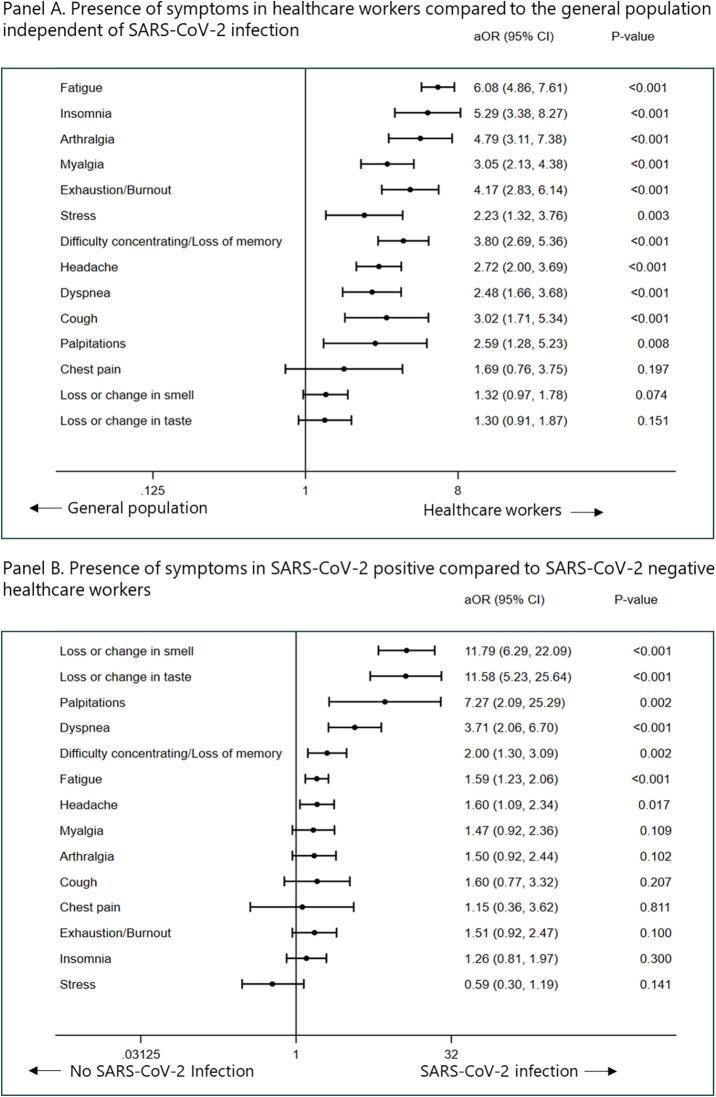
Healthcare workers have potentially been among the most exposed to SARS-CoV-2 infection as well as the deleterious toll of the pandemic. This study has the objective to differentiate the pandemic toll from post-acute sequelae of SARS-CoV-2 infection in healthcare workers compared to the general population. The study was conducted between April and July 2021 at the Geneva University Hospitals, Switzerland. Eligible participants were all tested staff, and outpatient individuals tested for SARS-CoV-2 at the same hospital. The primary outcome was the prevalence of symptoms in healthcare workers compared to the general population, with measures of COVID-related symptoms and functional impairment, using prevalence estimates and multivariable logistic regression models. Healthcare workers (n = 3083) suffered mostly from fatigue (25.5 %), headache (10.0 %), difficulty concentrating (7.9 %), exhaustion/burnout (7.1 %), insomnia (6.2 %), myalgia (6.7 %) and arthralgia (6.3 %). Regardless of SARS-CoV-2 infection, all symptoms were significantly higher in healthcare workers than the general population (n = 3556). SARS-CoV-2 infection in healthcare workers was associated with loss or change in smell, loss or change in taste, palpitations, dyspnea, difficulty concentrating, fatigue, and headache. Functional impairment was more significant in healthcare workers compared to the general population (aOR 2.28; 1.76-2.96), with a positive association with SARS-CoV-2 infection (aOR 3.81; 2.59-5.60). Symptoms and functional impairment in healthcare workers were increased compared to the general population, and potentially related to the pandemic toll as well as post-acute sequelae of SARS-CoV-2 infection. These findings are of concern, considering the essential role of healthcare workers in caring for all patients including and beyond COVID-19.
医护人员可能是接触严重急性呼吸综合征冠状病毒2(SARS-CoV-2)感染以及疫情有害影响风险最高的人群之一。本研究旨在区分医护人员与普通人群相比,SARS-CoV-2感染的后遗症与疫情造成的影响。该研究于2021年4月至7月在瑞士日内瓦大学医院进行。符合条件的参与者为所有接受检测的工作人员以及在同一家医院接受SARS-CoV-2检测的门诊患者。主要结果是医护人员与普通人群相比症状的患病率,采用患病率估计值和多变量逻辑回归模型,对与新冠病毒相关的症状和功能障碍进行测量。医护人员(n = 3083)主要出现疲劳(25.5%)、头痛(10.0%)、注意力不集中(7.9%)、疲惫/倦怠(7.1%)、失眠(6.2%)、肌痛(6.7%)和关节痛(6.3%)。无论是否感染SARS-CoV-2,医护人员出现的所有症状均显著高于普通人群(n = 3556)。医护人员感染SARS-CoV-2与嗅觉丧失或改变、味觉丧失或改变、心悸、呼吸困难、注意力不集中、疲劳和头痛有关。与普通人群相比,医护人员的功能障碍更为显著(调整后比值比为2.28;1.76 - 2.96),且与SARS-CoV-2感染呈正相关(调整后比值比为3.81;2.59 - 5.60)。与普通人群相比,医护人员的症状和功能障碍有所增加,可能与疫情影响以及SARS-CoV-2感染的后遗症有关。鉴于医护人员在照顾包括新冠肺炎患者及其他患者在内的所有患者方面发挥的重要作用,这些发现令人担忧。
 Zotero 插件