
影响次最大强度骑行时底物氧化的因素:模型分析。
Factors Influencing Substrate Oxidation During Submaximal Cycling: A Modelling Analysis.
机构信息
Sports Performance Research Institute New Zealand (SPRINZ), Auckland University of Technology, Auckland, New Zealand.
出版信息
Sports Med. 2022 Nov;52(11):2775-2795. doi: 10.1007/s40279-022-01727-7. Epub 2022 Jul 12.
BACKGROUND
Multiple factors influence substrate oxidation during exercise including exercise duration and intensity, sex, and dietary intake before and during exercise. However, the relative influence and interaction between these factors is unclear.
OBJECTIVES
Our aim was to investigate factors influencing the respiratory exchange ratio (RER) during continuous exercise and formulate multivariable regression models to determine which factors best explain RER during exercise, as well as their relative influence.
METHODS
Data were extracted from 434 studies reporting RER during continuous cycling exercise. General linear mixed-effect models were used to determine relationships between RER and factors purported to influence RER (e.g., exercise duration and intensity, muscle glycogen, dietary intake, age, and sex), and to examine which factors influenced RER, with standardized coefficients used to assess their relative influence.
RESULTS
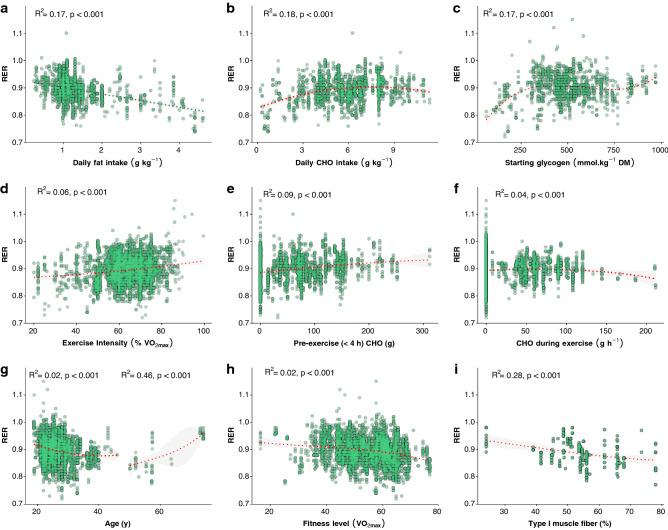
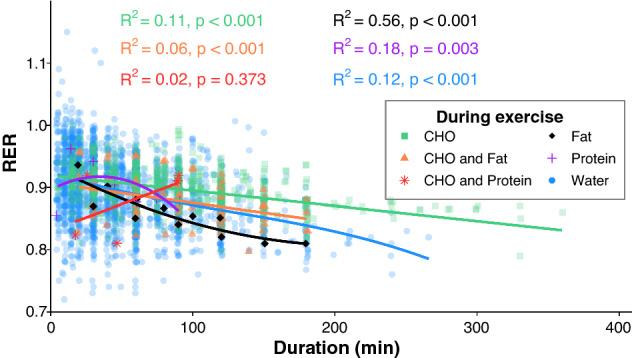
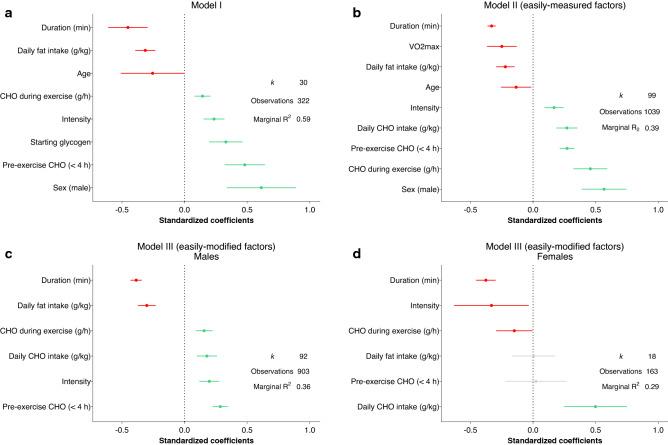
The RER decreases with exercise duration, dietary fat intake, age, VO, and percentage of type I muscle fibers, and increases with dietary carbohydrate intake, exercise intensity, male sex, and carbohydrate intake before and during exercise. The modelling could explain up to 59% of the variation in RER, and a model using exclusively easily modified factors (exercise duration and intensity, and dietary intake before and during exercise) could only explain 36% of the variation in RER. Variables with the largest effect on RER were sex, dietary intake, and exercise duration. Among the diet-related factors, daily fat and carbohydrate intake have a larger influence than carbohydrate ingestion during exercise.
CONCLUSION
Variability in RER during exercise cannot be fully accounted for by models incorporating a range of participant, diet, exercise, and physiological characteristics. To better understand what influences substrate oxidation during exercise further research is required on older subjects and females, and on other factors that could explain additional variability in RER.
背景
多种因素会影响运动中的底物氧化,包括运动持续时间和强度、性别以及运动前后的饮食摄入。然而,这些因素的相对影响和相互作用尚不清楚。
目的
我们旨在研究影响连续运动中呼吸商(RER)的因素,并制定多变量回归模型,以确定哪些因素能最好地解释运动中的 RER,以及它们的相对影响。
方法
从 434 项报告连续踏车运动中 RER 的研究中提取数据。使用广义线性混合效应模型来确定 RER 与被认为影响 RER 的因素(例如运动持续时间和强度、肌肉糖原、饮食摄入、年龄和性别)之间的关系,并检查哪些因素影响 RER,使用标准化系数来评估它们的相对影响。
结果
RER 随运动持续时间、饮食脂肪摄入、年龄、VO 和 I 型肌纤维百分比的增加而降低,随饮食碳水化合物摄入、运动强度、男性和运动前后的碳水化合物摄入的增加而增加。模型可以解释高达 59%的 RER 变化,仅使用易于修改的因素(运动持续时间和强度以及运动前后的饮食摄入)的模型只能解释 RER 变化的 36%。对 RER 影响最大的变量是性别、饮食和运动持续时间。在与饮食相关的因素中,每日脂肪和碳水化合物的摄入比运动中碳水化合物的摄入对 RER 的影响更大。
结论
包含一系列参与者、饮食、运动和生理特征的模型并不能完全解释运动中 RER 的变化。为了更好地理解运动中底物氧化的影响,需要对老年受试者和女性以及其他可以解释 RER 额外变化的因素进行进一步研究。


 Zotero 插件