
在重症 COVID-19 患者中可诱导自发 NLRP3 炎性小体驱动的 IL-1-β 分泌,并对阿那白滞素治疗有反应。
Spontaneous NLRP3 inflammasome-driven IL-1-β secretion is induced in severe COVID-19 patients and responds to anakinra treatment.
机构信息
UOSD Centro per le Malattie Autoinfiammatorie e Immunodeficienze, IRCCS Istituto Giannina Gaslini, Genova, Italy; DINOGMI, Università degli Studi di Genova, Genova, Italy.
UOSD Centro per le Malattie Autoinfiammatorie e Immunodeficienze, IRCCS Istituto Giannina Gaslini, Genova, Italy.
出版信息
J Allergy Clin Immunol. 2022 Oct;150(4):796-805. doi: 10.1016/j.jaci.2022.05.029. Epub 2022 Jul 11.
BACKGROUND
Severe acute respiratory syndrome coronavirus 2 (SARS-CoV-2) infection may result in a severe pneumonia associated with elevation of blood inflammatory parameters, reminiscent of cytokine storm syndrome. Steroidal anti-inflammatory therapies have shown efficacy in reducing mortality in critically ill patients; however, the mechanisms by which SARS-CoV-2 triggers such an extensive inflammation remain unexplained.
OBJECTIVES
To dissect the mechanisms underlying SARS-CoV-2-associated inflammation in patients with severe coronavirus disease 2019 (COVID-19), we studied the role of IL-1β, a pivotal cytokine driving inflammatory phenotypes, whose maturation and secretion are regulated by inflammasomes.
METHODS
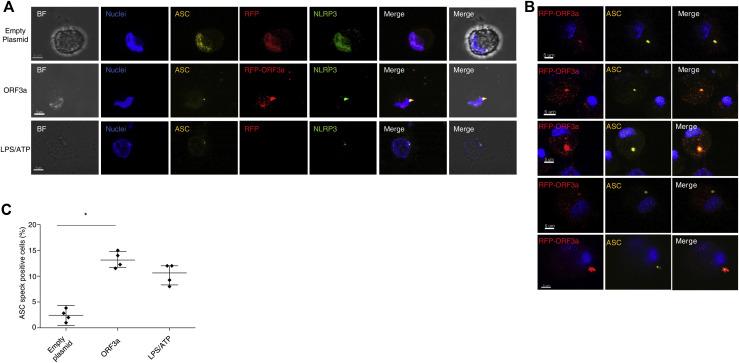
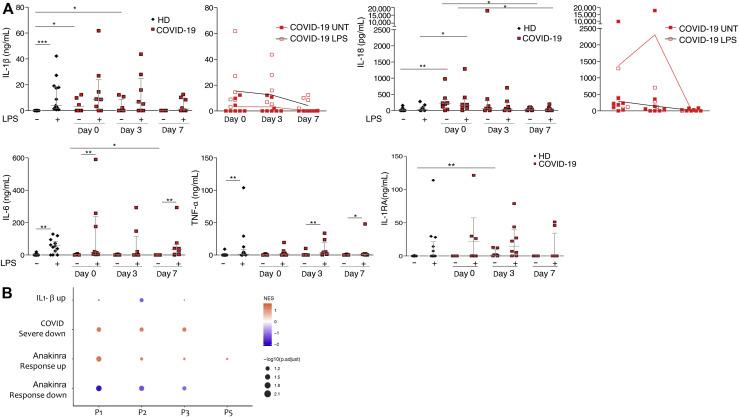
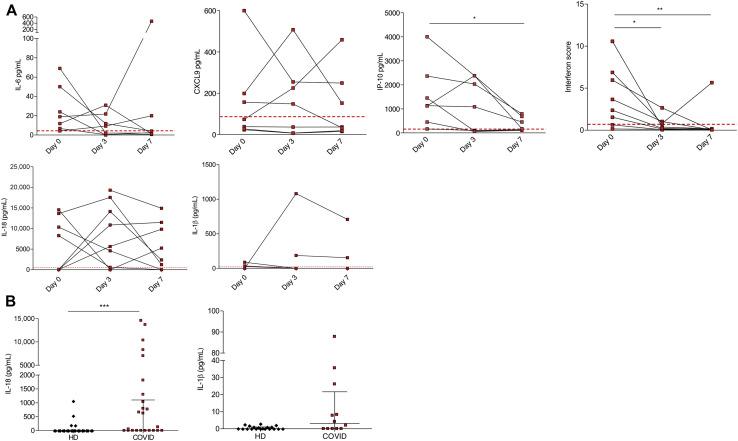
We analyzed nod-like receptor protein 3 pathway activation by means of confocal microscopy, plasma cytokine measurement, cytokine secretion following in vitro stimulation of blood circulating monocytes, and whole-blood RNA sequencing. The role of open reading frame 3a SARS-CoV-2 protein was assessed by confocal microscopy analysis following nucleofection of a monocytic cell line.
RESULTS
We found that circulating monocytes from patients with COVID-19 display ASC (adaptor molecule apoptotic speck like protein-containing a CARD) specks that colocalize with nod-like receptor protein 3 inflammasome and spontaneously secrete IL-1β in vitro. This spontaneous activation reverts following patient's treatment with the IL-1 receptor antagonist anakinra. Transfection of a monocytic cell line with cDNA coding for the ORF3a SARS-CoV-2 protein resulted in ASC speck formation.
CONCLUSIONS
These results provide further evidence that IL-1β targeting could represent an effective strategy in this disease and suggest a mechanistic explanation for the strong inflammatory manifestations associated with COVID-19.
背景
严重急性呼吸综合征冠状病毒 2(SARS-CoV-2)感染可能导致与血液炎症参数升高相关的严重肺炎,使人联想到细胞因子风暴综合征。甾体抗炎治疗已显示出在重症患者中降低死亡率的疗效;然而,SARS-CoV-2 引发如此广泛炎症的机制仍不清楚。
目的
为了剖析严重 2019 年冠状病毒病(COVID-19)患者中与 SARS-CoV-2 相关的炎症的机制,我们研究了白细胞介素 1β(IL-1β)的作用,IL-1β 是驱动炎症表型的关键细胞因子,其成熟和分泌受炎性小体调节。
方法
我们通过共聚焦显微镜、血浆细胞因子测量、体外刺激循环单核细胞后的细胞因子分泌以及全血 RNA 测序分析了核苷酸结合寡聚化结构域样受体蛋白 3 途径的激活。通过核转染单核细胞系,对 SARS-CoV-2 开放阅读框 3a 蛋白的作用进行了共聚焦显微镜分析。
结果
我们发现,COVID-19 患者的循环单核细胞显示 ASC(凋亡相关斑点样蛋白包含 CARD)斑点,与核苷酸结合寡聚化结构域样受体蛋白 3 炎性小体共定位,并在体外自发分泌 IL-1β。这种自发激活在患者接受白细胞介素 1 受体拮抗剂 anakinra 治疗后恢复。用编码 SARS-CoV-2 ORF3a 蛋白的 cDNA 转染单核细胞系可导致 ASC 斑点形成。
结论
这些结果进一步证明靶向 IL-1β 可能是该疾病的有效策略,并为 COVID-19 相关强烈炎症表现提供了机制解释。


 Zotero 插件