
中国上海新冠疫情大流行之前及期间下呼吸道感染儿童呼吸道病原体的比较
Comparison of Respiratory Pathogens in Children With Lower Respiratory Tract Infections Before and During the COVID-19 Pandemic in Shanghai, China.
作者信息
Xu Menghua, Liu Pengcheng, Su Liyun, Cao Lingfeng, Zhong Huaqing, Lu Lijuan, Jia Ran, Xu Jin
机构信息
Department of Clinical Laboratory, Children's Hospital of Fudan University, National Children's Medical Center, Shanghai, China.
出版信息
Front Pediatr. 2022 Jun 30;10:881224. doi: 10.3389/fped.2022.881224. eCollection 2022.
OBJECTIVES
This study aimed to assess the impact of COVID-19 on the prevalence of respiratory pathogens among hospitalized children with lower respiratory tract infections (LRTIs) in Shanghai.
METHODS
Respiratory specimens were collected from children with LRTIs in Children's Hospital of Fudan University from February 2019 to January 2021 and common respiratory pathogens were detected using multiplex PCR. The data of 13 respiratory pathogens were analyzed and compared between the year of 2020 (from February 2020 to January 2021) and 2019 (from February 2019 to January 2020).
RESULTS
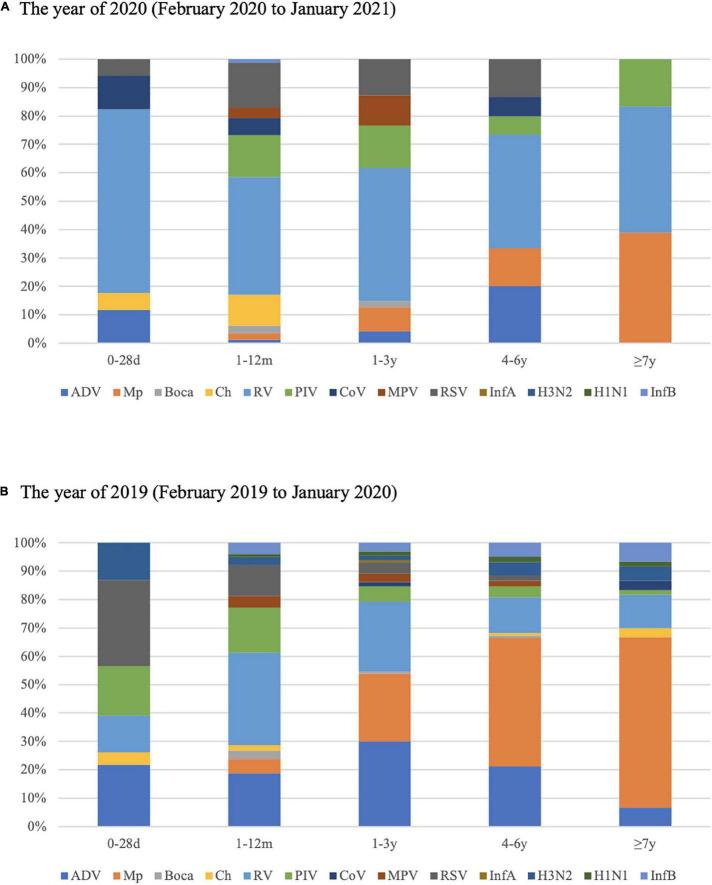
A total of 1,049 patients were enrolled, including 417 patients in 2019 and 632 patients in 2020. In 2020, 27.53% of patients were tested positive for at least one pathogen, which was significantly lower than that in 2019 (78.66%). The top three pathogens were Mycoplasma pneumoniae (Mp), human adenovirus (ADV) and human rhinovirus (RV) in 2019, whereas RV, human respiratory syncytial virus (RSV) and human parainfluenza virus (PIV) were the predominant ones in 2020. The positive rates of Mp, ADV, RV, PIV, Influenza virus B (InfB), H3N2, and H1N1 were significantly decreased in 2020. RV was the most detectable respiratory pathogen in 2020, and become the most frequent pathogen in all five age groups. PIV had a high prevalence from October to December 2020 which was even higher than that in 2019. Influenza virus A (InfA) was not detected in 2020. Co-infection was significantly less frequent in 2020.
CONCLUSION
The public health interventions aiming to eliminate COVID-19 have great impact on the prevalence of common respiratory pathogens. The prevalence of RV and PIV reminds us a possible resurgence of some pathogens.
目的
本研究旨在评估新型冠状病毒肺炎(COVID-19)对上海住院的下呼吸道感染(LRTIs)儿童呼吸道病原体流行情况的影响。
方法
收集2019年2月至2021年1月复旦大学附属儿科医院LRTIs儿童的呼吸道标本,采用多重聚合酶链反应(PCR)检测常见呼吸道病原体。分析并比较2020年(2020年2月至2021年1月)和2019年(2019年2月至2020年1月)13种呼吸道病原体的数据。
结果
共纳入1049例患者,其中2019年417例,2020年632例。2020年,27.53%的患者至少一种病原体检测呈阳性,显著低于2019年(78.66%)。2019年排名前三的病原体是肺炎支原体(Mp)、人腺病毒(ADV)和人鼻病毒(RV),而2020年主要病原体是RV、人呼吸道合胞病毒(RSV)和人副流感病毒(PIV)。2020年Mp、ADV、RV、PIV、B型流感病毒(InfB)、H3N2和H1N1的阳性率显著下降。RV是2020年最易检测到的呼吸道病原体,并且在所有五个年龄组中成为最常见的病原体。2020年10月至12月PIV患病率较高,甚至高于2019年。2020年未检测到甲型流感病毒(InfA)。2020年合并感染明显减少。
结论
旨在消除COVID-19的公共卫生干预措施对常见呼吸道病原体的流行情况有很大影响。RV和PIV的流行提醒我们一些病原体可能会再次出现。


 Zotero 插件