
在一家老年急性护理医院多次暴发期间对 SARS-CoV-2 传播链进行重建:一项结合回顾性流行病学和基因组学的研究。
Reconstruction of transmission chains of SARS-CoV-2 amidst multiple outbreaks in a geriatric acute-care hospital: a combined retrospective epidemiological and genomic study.
机构信息
Infection Control Programme & WHO Collaborating Centre on Patient Safety, Geneva University Hospitals, Geneva, Switzerland.
MRC Centre for Global Infectious Disease Analysis, Imperial College London, London, United Kingdom.
出版信息
Elife. 2022 Jul 19;11:e76854. doi: 10.7554/eLife.76854.
BACKGROUND
There is ongoing uncertainty regarding transmission chains and the respective roles of healthcare workers (HCWs) and elderly patients in nosocomial outbreaks of severe acute respiratory syndrome coronavirus 2 (SARS-CoV-2) in geriatric settings.
METHODS
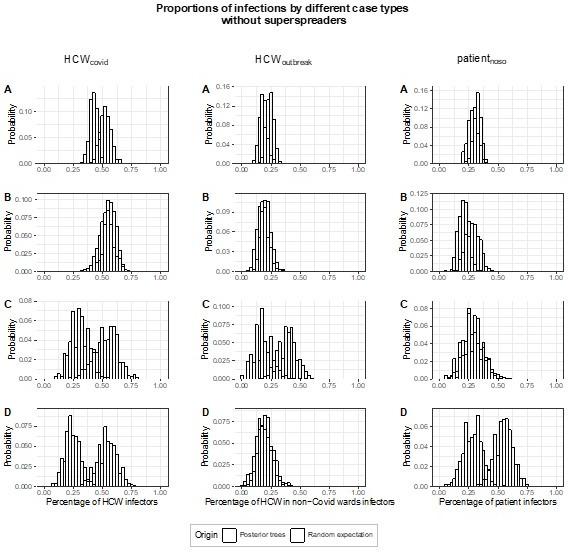
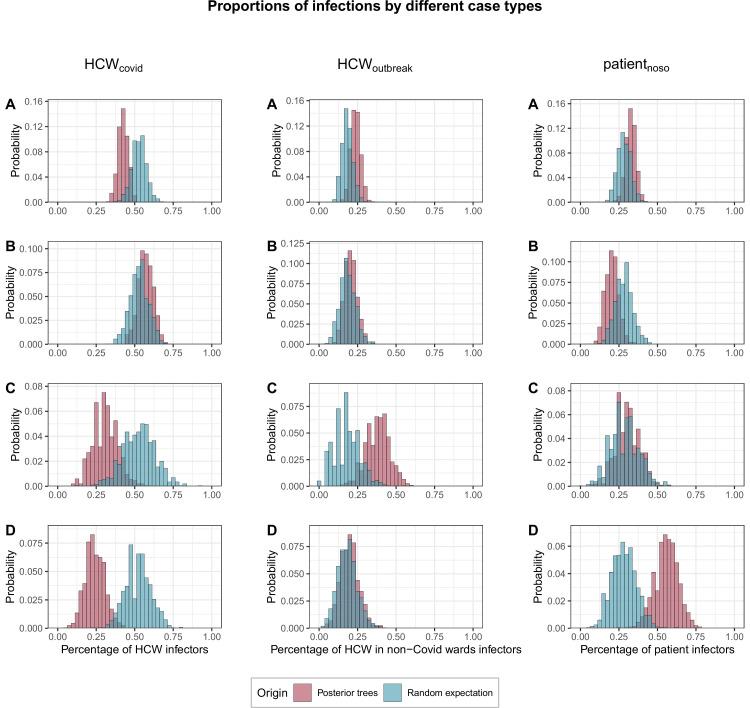
We performed a retrospective cohort study including patients with nosocomial coronavirus disease 2019 (COVID-19) in four outbreak-affected wards, and all SARS-CoV-2 RT-PCR positive HCWs from a Swiss university-affiliated geriatric acute-care hospital that admitted both Covid-19 and non-Covid-19 patients during the first pandemic wave in Spring 2020. We combined epidemiological and genetic sequencing data using a Bayesian modelling framework, and reconstructed transmission dynamics of SARS-CoV-2 involving patients and HCWs, to determine who infected whom. We evaluated general transmission patterns according to case type (HCWs working in dedicated Covid-19 cohorting wards: HCW; HCWs working in non-Covid-19 wards where outbreaks occurred: HCW; patients with nosocomial Covid-19: patient) by deriving the proportion of infections attributed to each case type across all posterior trees and comparing them to random expectations.
RESULTS
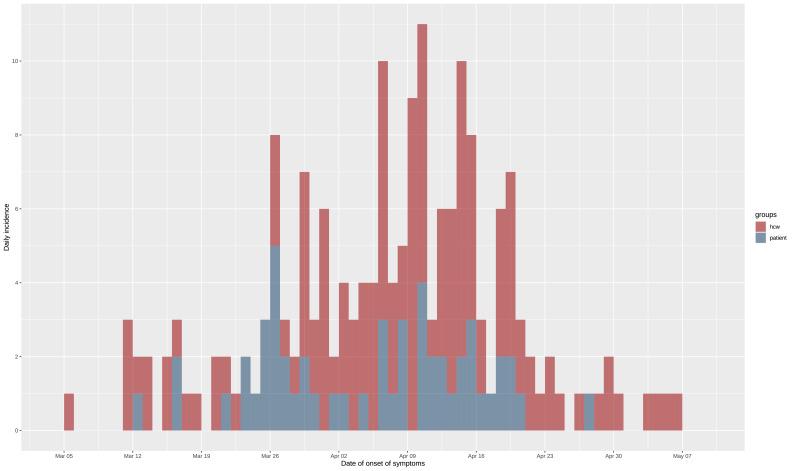
During the study period (1 March to 7 May 2020), we included 180 SARS-CoV-2 positive cases: 127 HCWs (91 HCW, 36 HCW) and 53 patients. The attack rates ranged from 10% to 19% for patients, and 21% for HCWs. We estimated that 16 importation events occurred with high confidence (4 patients, 12 HCWs) that jointly led to up to 41 secondary cases; in six additional cases (5 HCWs, 1 patient), importation was possible with a posterior probability between 10% and 50%. Most patient-to-patient transmission events involved patients having shared a ward (95.2%, 95% credible interval [CrI] 84.2%-100%), in contrast to those having shared a room (19.7%, 95% CrI 6.7%-33.3%). Transmission events tended to cluster by case type: patient were almost twice as likely to be infected by other patient than expected (observed:expected ratio 2.16, 95% CrI 1.17-4.20, p=0.006); similarly, HCW were more than twice as likely to be infected by other HCW than expected (2.72, 95% CrI 0.87-9.00, p=0.06). The proportion of infectors being HCW was as expected as random. We found a trend towards a greater proportion of high transmitters (≥2 secondary cases) among HCW than patient in the late phases (28.6% vs. 11.8%) of the outbreak, although this was not statistically significant.
CONCLUSIONS
Most importation events were linked to HCW. Unexpectedly, transmission between HCW was more limited than transmission between patients and HCW. This finding highlights gaps in infection control and suggests the possible areas of improvements to limit the extent of nosocomial transmission.
FUNDING
This study was supported by a grant from the Swiss National Science Foundation under the NRP78 funding scheme (Grant no. 4078P0_198363).
背景
在老年环境中,关于严重急性呼吸系统综合症冠状病毒 2 (SARS-CoV-2)医院感染爆发的传播链以及医护人员(HCW)和老年患者各自的作用,仍存在不确定性。
方法
我们进行了一项回顾性队列研究,纳入了四家受疫情影响的病房发生的有症状的 2019 年冠状病毒病(COVID-19)患者,以及在 2020 年春季第一波大流行期间,瑞士一家大学附属医院的所有 SARS-CoV-2 RT-PCR 阳性 HCW,该医院收治了 COVID-19 患者和非 COVID-19 患者。我们使用贝叶斯建模框架结合流行病学和基因测序数据,重建了涉及患者和 HCW 的 SARS-CoV-2 传播动态,以确定谁感染了谁。我们根据病例类型(专门收治 COVID-19 的 HCW:HCW;在发生疫情的非 COVID-19 病房工作的 HCW:HCW;发生医院感染的 COVID-19 患者:患者)评估了一般传播模式,通过从所有后验树中得出归因于每种病例类型的感染比例,并将其与随机预期进行比较。
结果
在研究期间(2020 年 3 月 1 日至 5 月 7 日),我们纳入了 180 例 SARS-CoV-2 阳性病例:127 例 HCW(91 例 HCW,36 例 HCW)和 53 例患者。患者的发病率为 10%-19%,HCW 的发病率为 21%。我们估计有 16 次进口事件发生的可能性较大(4 例患者,12 例 HCW),这共同导致了多达 41 例继发病例;在另外 6 例病例中(5 例 HCW,1 例患者),进口的可能性在 10%-50%之间。大多数患者间传播事件涉及到共同病房的患者(95.2%,95%可信区间 [CrI] 84.2%-100%),而涉及共同病房的患者则占 19.7%(95% CrI 6.7%-33.3%)。传播事件往往按病例类型聚集:患者被其他患者感染的可能性几乎是预期的两倍(观察到的:预期比值 2.16,95% CrI 1.17-4.20,p=0.006);同样,HCW 被其他 HCW 感染的可能性是预期的两倍以上(2.72,95% CrI 0.87-9.00,p=0.06)。HCW 作为感染者的比例与随机预期相符。我们发现,在疫情后期(28.6% vs. 11.8%),HCW 中的高传播者(≥2 例继发病例)比例有增加的趋势,尽管这并不具有统计学意义。
结论
大多数输入事件都与 HCW 有关。出乎意料的是,HCW 之间的传播比 HCW 与患者之间的传播更为有限。这一发现突显了感染控制方面的差距,并提示了可能需要改进的领域,以限制医院内传播的范围。
资金
本研究得到了瑞士国家科学基金会 NRP78 资助计划(资助号 4078P0_198363)的支持。






 Zotero 插件