
基于人群的宏基因组学分析揭示了肌少症中肠道微生物组的改变:来自湘雅肌少症研究的数据。
Population-based metagenomics analysis reveals altered gut microbiome in sarcopenia: data from the Xiangya Sarcopenia Study.
机构信息
Department of Orthopaedics, Xiangya Hospital, Central South University, Changsha, Hunan, China.
Division of Rheumatology, Allergy, and Immunology, Department of Medicine, Massachusetts General Hospital, Harvard Medical School, Boston, MA, USA.
出版信息
J Cachexia Sarcopenia Muscle. 2022 Oct;13(5):2340-2351. doi: 10.1002/jcsm.13037. Epub 2022 Jul 18.
BACKGROUND
Several studies have examined gut microbiota and sarcopenia using 16S ribosomal RNA amplicon sequencing; however, this technique may not be able to identify altered specific species and functional capacities of the microbes. We performed shotgun metagenomic sequencing to compare the gut microbiome composition and function between individuals with and without sarcopenia.
METHODS
Participants were from a community-based observational study conducted among the residents of rural areas in China. Appendicular skeletal muscle mass was assessed using direct segmental multi-frequency bioelectrical impedance and grip strength using a Jamar Hydraulic Hand dynamometer. Physical performance was evaluated using the Short Physical Performance Battery, 5-time chair stand test and gait speed with the 6 m walk test. Sarcopenia and its severity were diagnosed according to the Asian Working Group for Sarcopenia 2019 algorithm. The gut microbiome was profiled by shotgun metagenomic sequencing to determine the microbial composition and function. A gut microbiota-based model for classification of sarcopenia was constructed using the random forest model, and its performance was assessed using the area under receiver-operating characteristic curve (AUC).
RESULTS
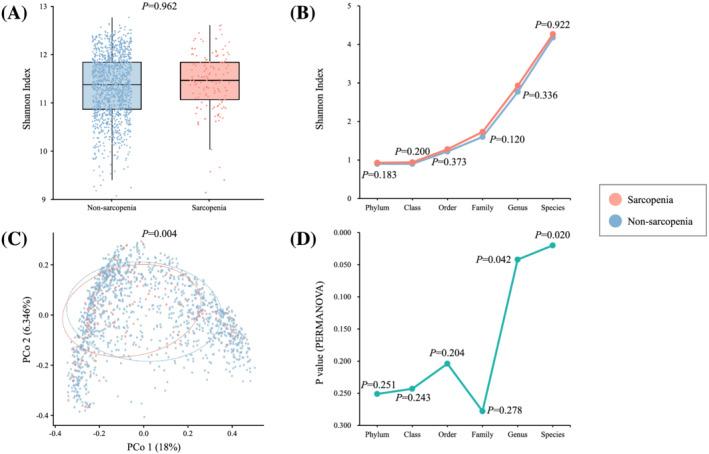
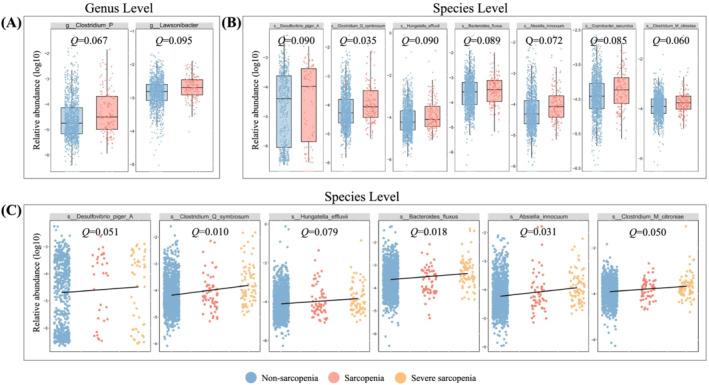
The study sample included 1417 participants (women: 58.9%; mean age: 63.3 years; sarcopenia prevalence: 10.0%). β-diversity indicated by Bray-Curtis distance (genetic level: P = 0.004; taxonomic level of species: P = 0.020), but not α-diversity indicated by Shannon index (genetic level: P = 0.962; taxonomic level of species: P = 0.922), was significantly associated with prevalent sarcopenia. After adjusting for potential confounders, participants with sarcopenia had higher relative abundance of Desulfovibrio piger (P = 0.003, Q = 0.090), Clostridium symbiosum (P < 0.001, Q = 0.035), Hungatella effluvii (P = 0.003, Q = 0.090), Bacteroides fluxus (P = 0.002, Q = 0.089), Absiella innocuum (P = 0.002, Q = 0.072), Coprobacter secundus (P = 0.002, Q = 0.085) and Clostridium citroniae (P = 0.001, Q = 0.060) than those without sarcopenia. The relative abundance of six species (Desulfovibrio piger, Clostridium symbiosum, Hungatella effluvii, Bacteroides fluxus, Absiella innocuum, and Clostridium citroniae) was also positively associated with sarcopenia severity. A differential species-based model was constructed to separate participants with sarcopenia from controls. The value of the AUC was 0.852, suggesting that model has a decent discriminative performance. Desulfovibrio piger ranked the highest in this model. Functional annotation analysis revealed that the phenylalanine, tyrosine, and tryptophan biosynthesis were depleted (P = 0.006, Q = 0.071), while alpha-Linolenic acid metabolism (P = 0.008, Q = 0.094), furfural degradation (P = 0.001, Q = 0.029) and staurosporine biosynthesis (P = 0.006, Q = 0.072) were enriched in participants with sarcopenia. Desulfovibrio piger was significantly associated with staurosporine biosynthesis (P < 0.001).
CONCLUSIONS
This large population-based observational study provided empirical evidence that alterations in the gut microbiome composition and function were observed among individuals with sarcopenia.
背景
多项研究通过 16S 核糖体 RNA 扩增子测序检查了肠道微生物群和肌肉减少症;然而,该技术可能无法识别特定物种的改变和微生物的功能能力。我们进行了 shotgun 宏基因组测序,以比较有和没有肌肉减少症的个体之间的肠道微生物组组成和功能。
方法
参与者来自中国农村地区的一项基于社区的观察性研究。使用直接节段多频生物电阻抗和 Jamar 液压握力计评估四肢骨骼肌质量。使用简短的身体表现电池、5 次椅子站立测试和 6 米步行测试评估身体表现。根据 2019 年亚洲肌肉减少症工作组的算法诊断肌肉减少症及其严重程度。通过 shotgun 宏基因组测序来确定微生物组成和功能,对肠道微生物组进行分析。使用随机森林模型构建基于肠道微生物群的分类模型,使用接收者操作特征曲线 (AUC) 下的面积评估其性能。
结果
研究样本包括 1417 名参与者(女性:58.9%;平均年龄:63.3 岁;肌肉减少症患病率:10.0%)。Bray-Curtis 距离(遗传水平:P=0.004;物种分类水平:P=0.020)表示的 β-多样性,而不是 Shannon 指数(遗传水平:P=0.962;物种分类水平:P=0.922)表示的 α-多样性,与普遍存在的肌肉减少症显著相关。调整潜在混杂因素后,患有肌肉减少症的参与者的 Desulfovibrio piger(P=0.003,Q=0.090)、Clostridium symbiosum(P<0.001,Q=0.035)、Hungatella effluvii(P=0.003,Q=0.090)、Bacteroides fluxus(P=0.002,Q=0.089)、Absiella innocuum(P=0.002,Q=0.072)、Coprobacter secundus(P=0.002,Q=0.085)和 Clostridium citroniae(P=0.001,Q=0.060)的相对丰度较高。六种物种(Desulfovibrio piger、Clostridium symbiosum、Hungatella effluvii、Bacteroides fluxus、Absiella innocuum 和 Clostridium citroniae)的相对丰度也与肌肉减少症的严重程度呈正相关。构建了基于差异物种的模型来区分患有肌肉减少症的患者和对照组。AUC 的值为 0.852,表明模型具有良好的判别性能。Desulfovibrio piger 在该模型中排名最高。功能注释分析显示苯丙氨酸、酪氨酸和色氨酸生物合成被消耗(P=0.006,Q=0.071),而 α-亚麻酸代谢(P=0.008,Q=0.094)、糠醛降解(P=0.001,Q=0.029)和 Staurosporine 生物合成(P=0.006,Q=0.072)在患有肌肉减少症的参与者中丰富。Desulfovibrio piger 与 Staurosporine 生物合成显著相关(P<0.001)。
结论
这项大型基于人群的观察性研究提供了经验证据,表明肌肉减少症个体的肠道微生物组组成和功能发生了改变。



 Zotero 插件