
设计的镍酶模型进行硫酯合成,模拟前生物能量转换。
Thioester synthesis by a designed nickel enzyme models prebiotic energy conversion.
机构信息
The Ohio State Biochemistry Program, The Ohio State University, Columbus, OH 43210.
Department of Chemistry, Trinity University, San Antonio, TX 78212.
出版信息
Proc Natl Acad Sci U S A. 2022 Jul 26;119(30):e2123022119. doi: 10.1073/pnas.2123022119. Epub 2022 Jul 18.
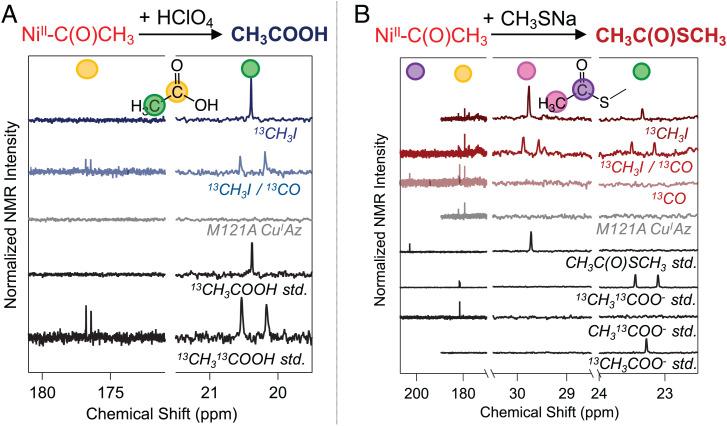
The formation of carbon-carbon bonds from prebiotic precursors such as carbon dioxide represents the foundation of all primordial life processes. In extant organisms, this reaction is carried out by the carbon monoxide dehydrogenase (CODH)/acetyl coenzyme A synthase (ACS) enzyme, which performs the cornerstone reaction in the ancient Wood-Ljungdahl metabolic pathway to synthesize the key biological metabolite, acetyl-CoA. Despite its significance, a fundamental understanding of this transformation is lacking, hampering efforts to harness analogous chemistry. To address these knowledge gaps, we have designed an artificial metalloenzyme within the azurin protein scaffold as a structural, functional, and mechanistic model of ACS. We demonstrate the intermediacy of the Ni species and requirement for ordered substrate binding in the bioorganometallic carbon-carbon bond-forming reaction from the one-carbon ACS substrates. The electronic and geometric structures of the nickel-acetyl intermediate have been characterized using time-resolved optical, electron paramagnetic resonance, and X-ray absorption spectroscopy in conjunction with quantum chemical calculations. Moreover, we demonstrate that the nickel-acetyl species is chemically competent for selective acyl transfer upon thiol addition to biosynthesize an activated thioester. Drawing an analogy to the native enzyme, a mechanism for thioester generation by this ACS model has been proposed. The fundamental insight into the enzymatic process provided by this rudimentary ACS model has implications for the evolution of primitive ACS-like proteins. Ultimately, these findings offer strategies for development of highly active catalysts for sustainable generation of liquid fuels from one-carbon substrates, with potential for broad applications across diverse fields ranging from energy storage to environmental remediation.
前生物前体(如二氧化碳)形成碳-碳键代表了所有原始生命过程的基础。在现存的生物体中,该反应是由一氧化碳脱氢酶(CODH)/乙酰辅酶 A 合酶(ACS)酶进行的,该酶执行古老的 Wood-Ljungdahl 代谢途径中的基石反应,合成关键的生物代谢物乙酰辅酶 A。尽管其意义重大,但对这种转化缺乏基本的理解,阻碍了利用类似化学的努力。为了解决这些知识空白,我们在蓝蛋白支架内设计了一种人工金属酶,作为 ACS 的结构、功能和机制模型。我们从一碳 ACS 底物证明了 Ni 物种的中间体和有序底物结合的要求在生物有机碳-碳键形成反应中。使用时间分辨光学、电子顺磁共振和 X 射线吸收光谱结合量子化学计算,对镍-乙酰中间体的电子和几何结构进行了表征。此外,我们证明镍-乙酰物种在硫醇添加后具有化学能力进行选择性酰基转移,以生物合成激活的硫酯。通过类比天然酶,提出了该 ACS 模型生成硫酯的机制。该基本 ACS 模型提供的酶促过程的基本见解对原始 ACS 样蛋白的进化具有重要意义。最终,这些发现为从一碳底物可持续生成液体燃料的高效催化剂的开发提供了策略,具有广泛的应用前景,从储能到环境修复等各个领域。


 Zotero 插件