
3%卡努卡油乳膏治疗中重度湿疹的疗效:一项单盲随机赋形剂对照试验。
Efficacy of a 3% Kānuka oil cream for the treatment of moderate-to-severe eczema: A single blind randomised vehicle-controlled trial.
作者信息
Shortt Nicholas, Martin Alexander, Kerse Kyley, Shortt Gabrielle, Vakalalabure Iva, Barker Luke, Singer Joseph, Black Bianca, Liu Angela, Eathorne Allie, Weatherall Mark, Rademaker Marius, Armour Mike, Beasley Richard, Semprini Alex
机构信息
Medical Research Institute of New Zealand, Wellington, New Zealand.
Victoria University of Wellington, Wellington, New Zealand.
出版信息
EClinicalMedicine. 2022 Jul 15;51:101561. doi: 10.1016/j.eclinm.2022.101561. eCollection 2022 Sep.
BACKGROUND
Māori, the indigenous people of New Zealand, have traditionally used the kānuka tree as part of their healing system, Rongoā Māori, and the oil from the kānuka tree has demonstratable anti-inflammatory and anti-bacterial properties. This trial investigated the efficacy and safety of a 3% kānuka oil (KO) cream compared to vehicle control (VC) for the topical treatment of eczema. The trial was conducted through a nationwide community pharmacy research network.
METHODS
This single-blind, parallel-group, randomised, vehicle-controlled trial was undertaken in 11 research trained community pharmacies across New Zealand. Eighty adult participants with self-reported moderate-to-severe eczema, assessed by Patient Orientated Eczema Measure (POEM) were randomised by blinded investigators to apply 3% KO cream or VC topically, twice daily, for six weeks. Randomisation was stratified by site and eczema severity, moderate versus severe. Primary outcome was difference in POEM scores at week six between groups by intention to treat. The study is registered on the Australian New Zealand Clinical Trial Registry (ANZCTR) reference number, ACTRN12618001754235.
FINDINGS
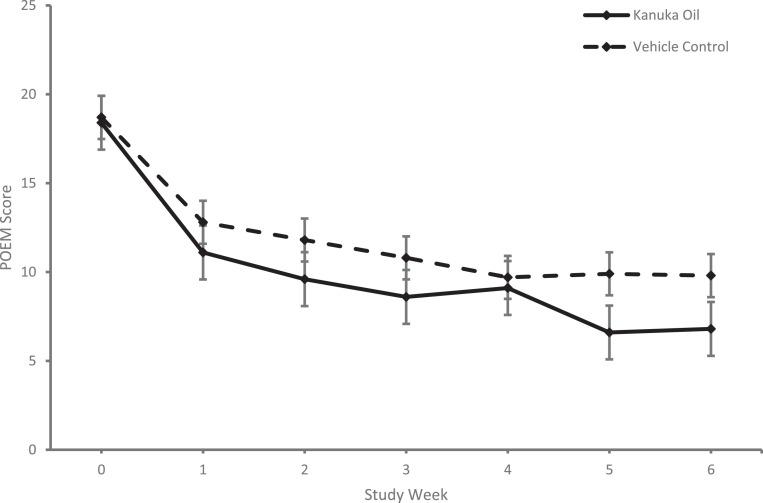
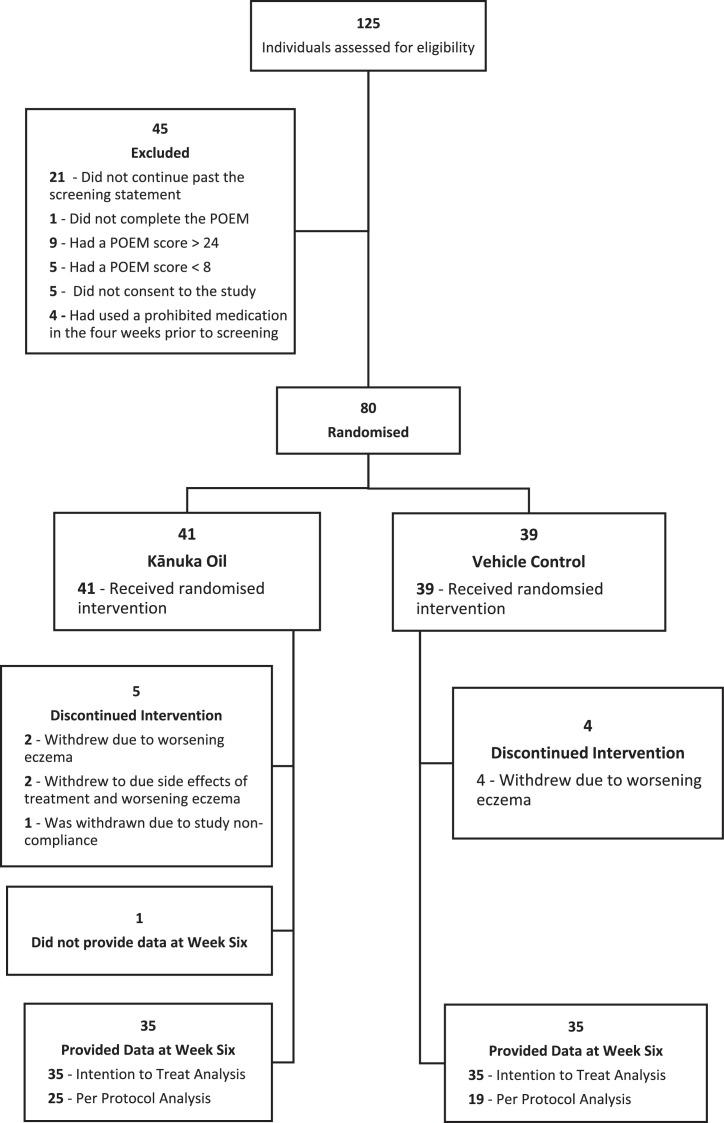
Eighty participants were recruited between 17 May 2019 and 10 May 2021 (41 KO group, 39 VC group). Mean POEM score (standard deviation) improved between baseline and week six for KO group, 18·4 (4·4) to 6·8 (5·5), and VC group, 18·7 (4·5) to 9·8 (6·5); mean difference between groups (95% confidence interval) was -3·1 (-6·0 to -0·2), = 0·036. There were three adverse events reported in the KO group related to the intervention and two in the control group.
INTERPRETATION
The KO group had a significant improvement in POEM score compared to VC. Rates of adverse events and withdrawals were similar between groups with no serious adverse events reported. Treatment acceptability was high for both groups across all domains. Our results suggest that in adults with moderate-to-severe eczema, the addition of KO to a daily emollient regimen led to a reduction in POEM score compared to VC. KO may represent an effective, safe, and well tolerated treatment for moderate-to-severe eczema in adults.
FUNDING
Hikurangi Bioactives (Ruatoria, New Zealand) and HoneyLab (Tauranga, New Zealand), supported by a grant from Callaghan Innovation.
背景
新西兰的原住民毛利人传统上一直将卡努卡树作为其传统治疗体系——毛利传统疗法(Rongoā Māori)的一部分,卡努卡树的油具有显著的抗炎和抗菌特性。本试验研究了3%卡努卡树油(KO)乳膏与赋形剂对照(VC)相比,用于局部治疗湿疹的疗效和安全性。该试验通过全国性的社区药房研究网络进行。
方法
本单盲、平行组、随机、赋形剂对照试验在新西兰11家经过研究培训的社区药房进行。80名自我报告患有中度至重度湿疹的成年参与者,通过患者导向性湿疹量表(POEM)进行评估,由盲法研究者随机分组,分别局部应用3% KO乳膏或VC,每日两次,持续六周。随机分组按地点和湿疹严重程度(中度与重度)进行分层。主要结局是按意向性分析,两组在第6周时POEM评分的差异。该研究已在澳大利亚新西兰临床试验注册中心(ANZCTR)注册,注册号为ACTRN12618001754235。
结果
在2019年5月17日至2021年5月10日期间招募了80名参与者(KO组41名,VC组39名)。KO组在基线至第6周期间,平均POEM评分(标准差)从18.4(4.4)改善至6.8(5.5);VC组从18.7(4.5)改善至9.8(6.5);两组之间的平均差异(95%置信区间)为-3.1(-6.0至-0.2),P = 0.036。KO组报告了3例与干预相关的不良事件,对照组报告了2例。
解读
与VC组相比,KO组的POEM评分有显著改善。两组之间的不良事件发生率和退出率相似,未报告严重不良事件。两组在所有领域的治疗可接受性都很高。我们的结果表明,在患有中度至重度湿疹的成年人中,在每日润肤剂治疗方案中添加KO与VC相比,可降低POEM评分。KO可能是治疗成年人中度至重度湿疹的一种有效、安全且耐受性良好的治疗方法。
资助
由Callaghan Innovation提供的一笔赠款资助,新西兰鲁阿塔里亚的希库兰吉生物活性物质公司和新西兰陶朗加的蜂蜜实验室公司。
 Zotero 插件