
病毒学和免疫动力学揭示了高传染性的原始 SARS-CoV-2 株在家庭内的传播。
Virology and immune dynamics reveal high household transmission of ancestral SARS-CoV-2 strain.
机构信息
Department of Paediatrics, The University of Melbourne, Parkville, Victoria, Australia.
Infection and Immunity, Murdoch Children's Research Institute, Parkville, Victoria, Australia.
出版信息
Pediatr Allergy Immunol. 2022 Jul;33(7). doi: 10.1111/pai.13824.
BACKGROUND
Household studies are crucial for understanding the transmission of SARS-CoV-2 infection, which may be underestimated from PCR testing of respiratory samples alone. We aim to combine the assessment of household mitigation measures; nasopharyngeal, saliva, and stool PCR testing; along with mucosal and systemic SARS-CoV-2-specific antibodies, to comprehensively characterize SARS-CoV-2 infection and transmission in households.
METHODS
Between March and September 2020, we obtained samples from 92 participants in 26 households in Melbourne, Australia, in a 4-week period following the onset of infection with ancestral SARS-CoV-2 variants.
RESULTS
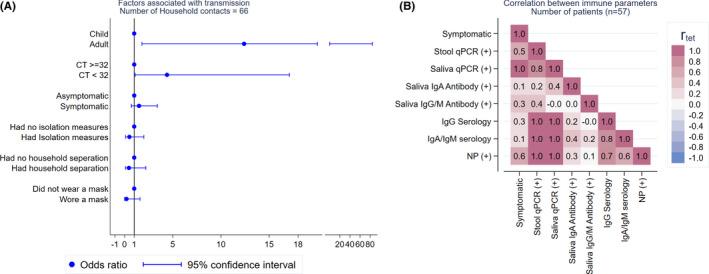
The secondary attack rate was 36% (24/66) when using nasopharyngeal swab (NPS) PCR positivity alone. However, when respiratory and nonrespiratory samples were combined with antibody responses in blood and saliva, the secondary attack rate was 76% (50/66). SARS-CoV-2 viral load of the index case and household isolation measures were key factors that determine secondary transmission. In 27% (7/26) of households, all family members tested positive by NPS for SARS-CoV-2 and were characterized by lower respiratory Ct values than low transmission families (Median 22.62 vs. 32.91; IQR 17.06-28.67 vs. 30.37-34.24). High transmission families were associated with enhanced plasma antibody responses to multiple SARS-CoV-2 antigens and the presence of neutralizing antibodies. Three distinguishing saliva SARS-CoV-2 antibody features were identified according to age (IgA1 to Spike 1, IgA1 to nucleocapsid protein (NP)), suggesting that adults and children generate distinct mucosal antibody responses during the acute phase of infection.
CONCLUSION
Utilizing respiratory and nonrespiratory PCR testing, along with the measurement of SARS-CoV-2-specific local and systemic antibodies, provides a more accurate assessment of infection within households and highlights some of the immunological differences in response between children and adults.
背景
家庭研究对于了解 SARS-CoV-2 感染的传播至关重要,仅通过呼吸道样本的 PCR 检测可能会低估感染情况。我们旨在结合家庭缓解措施评估、鼻咽、唾液和粪便 PCR 检测以及黏膜和系统 SARS-CoV-2 特异性抗体,全面描述家庭内 SARS-CoV-2 感染和传播情况。
方法
2020 年 3 月至 9 月,我们在澳大利亚墨尔本的 26 个家庭中招募了 92 名参与者,在感染原始 SARS-CoV-2 变体后 4 周内采集样本。
结果
单独使用鼻咽拭子(NPS)PCR 阳性时,二级发病率为 36%(24/66)。然而,当将呼吸道和非呼吸道样本与血液和唾液中的抗体反应结合使用时,二级发病率为 76%(50/66)。指数病例的 SARS-CoV-2 病毒载量和家庭隔离措施是决定二次传播的关键因素。在 27%(7/26)的家庭中,所有家庭成员的 NPS 均检测到 SARS-CoV-2 呈阳性,且下呼吸道 Ct 值低于低传播家庭(中位数 22.62 比 32.91;IQR 17.06-28.67 比 30.37-34.24)。高传播家庭与多种 SARS-CoV-2 抗原的血浆抗体反应增强以及中和抗体的存在有关。根据年龄(Spike 1 与 IgA1、核衣壳蛋白(NP)与 IgA1)确定了 3 个有区别的唾液 SARS-CoV-2 抗体特征,表明成人和儿童在感染急性期产生不同的黏膜抗体反应。
结论
利用呼吸道和非呼吸道 PCR 检测以及 SARS-CoV-2 特异性局部和系统抗体的测量,更准确地评估家庭内的感染情况,并突出了儿童和成人之间在反应方面的一些免疫学差异。


 Zotero 插件