
膳食α-亚麻酸摄入量及生物标志物与结直肠癌发病的关联:前瞻性队列研究的剂量反应荟萃分析
Association of Dietary Intake and Biomarker of α-Linolenic Acid With Incident Colorectal Cancer: A Dose-Response Meta-Analysis of Prospective Cohort Studies.
作者信息
Dai Ze-Bin, Ren Xiao-Li, Xue Yi-Lang, Tian Ya, He Bing-Bing, Xu Chang-Long, Yang Bo
机构信息
The Second Affiliated Hospital and Yuying Children's Hospital of Wenzhou Medical University, Wenzhou, China.
Institute of Lipids Medicine, Wenzhou Medical University, Wenzhou, China.
出版信息
Front Nutr. 2022 Jul 7;9:948604. doi: 10.3389/fnut.2022.948604. eCollection 2022.
BACKGROUND AND OBJECTIVE
There is keen interest in better understanding the impacts of alpha-linolenic acid (ALA), a plant-derived n-3 fatty acid, in ameliorating the development of cancer; however, results of several prospective cohorts present an inconsistent association between ALA intake and the incident colorectal cancer (CRC). We aimed to investigate the summary association of dietary intake and biomarkers of ALA with CRC risk based on the prospective cohorts.
METHODS
Pertinent prospective cohorts were identified in Cochrane Library, PubMed, and EMBASE from inception to February 2022. Study-specific risk ratios (RRs) with 95% confidence intervals (CIs) for comparing the top with the bottom quartiles of ALA levels were combined using a random-effects model. Nonlinear dose-response relationships of ALA levels in diet and blood with CRC risk were assessed using the restricted cubic spline models, respectively.
RESULTS
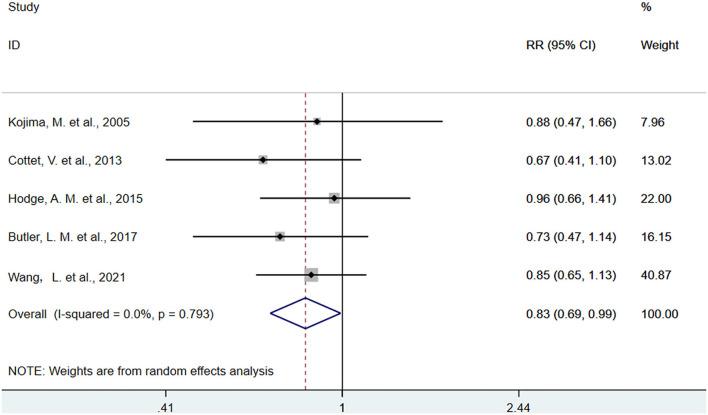
Over the duration of follow-up with a median of 9.3 years ranging from 1 to 28 years, 12,239 CRC cases occurred among 861,725 participants from 15 cohorts (11 studies on diet and 5 studies on biomarkers including 4 on blood and 1 on adipose tissue). The summary RR was 1.03 (95% CI: 0.97, 1.10; I: 0.00%) for dietary intake and 0.83 (95% CI: 0.69, 0.99; I: 0.00%) for biomarker. Each 0.1% increase in the levels of ALA in blood was associated with a 10% reduction in risk of CRC (summary RR: 0.90, 95% CI: 0.80, 0.99; I: 38.60%), whereas no significant dose-response association was found between dietary intake of ALA and the incident CRC (p for non-linearity = 0.18; p for linearity = 0.24).
CONCLUSIONS
Blood levels of ALA were inversely and linearly associated with the risk of CRC, which suggested that increased intake of ALA to improve circulating levels was beneficial for CRC prevention.
背景与目的
人们对更好地理解植物源n-3脂肪酸α-亚麻酸(ALA)在改善癌症发展方面的影响有着浓厚兴趣;然而,几项前瞻性队列研究的结果显示,ALA摄入量与结直肠癌(CRC)发病之间的关联并不一致。我们旨在基于前瞻性队列研究,调查ALA的膳食摄入量和生物标志物与CRC风险的总体关联。
方法
从Cochrane图书馆、PubMed和EMBASE数据库建库至2022年2月,检索相关的前瞻性队列研究。采用随机效应模型合并各研究中比较ALA水平最高四分位数与最低四分位数时的研究特异性风险比(RRs)及95%置信区间(CIs)。分别使用受限立方样条模型评估饮食和血液中ALA水平与CRC风险的非线性剂量反应关系。
结果
在中位随访时间为9.3年(范围1至28年)期间,15个队列中的861,725名参与者中发生了12,239例CRC病例(11项关于饮食的研究和5项关于生物标志物的研究,包括4项关于血液的研究和1项关于脂肪组织的研究)。膳食摄入量的汇总RR为1.03(95%CI:0.97,1.10;I²:0.00%),生物标志物的汇总RR为0.83(95%CI:0.69,0.99;I²:0.00%)。血液中ALA水平每增加0.1%,CRC风险降低10%(汇总RR:0.90,95%CI:0.80,0.99;I²:38.60%),而膳食中ALA摄入量与CRC发病之间未发现显著的剂量反应关联(非线性p值=0.18;线性p值=0.24)。
结论
血液中ALA水平与CRC风险呈负线性相关,这表明增加ALA摄入量以提高循环水平对预防CRC有益。


 Zotero 插件