
失业、经济困难和经济衰退对自杀行为的影响及干预措施:综述。
The Role of Unemployment, Financial Hardship, and Economic Recession on Suicidal Behaviors and Interventions to Mitigate Their Impact: A Review.
机构信息
Australian Institute for Suicide Research and Prevention and WHO Collaborating Centre for Research and Training in Suicide Prevention, School of Applied Psychology, Griffith University, Brisbane, QLD, Australia.
出版信息
Front Public Health. 2022 Jul 6;10:907052. doi: 10.3389/fpubh.2022.907052. eCollection 2022.
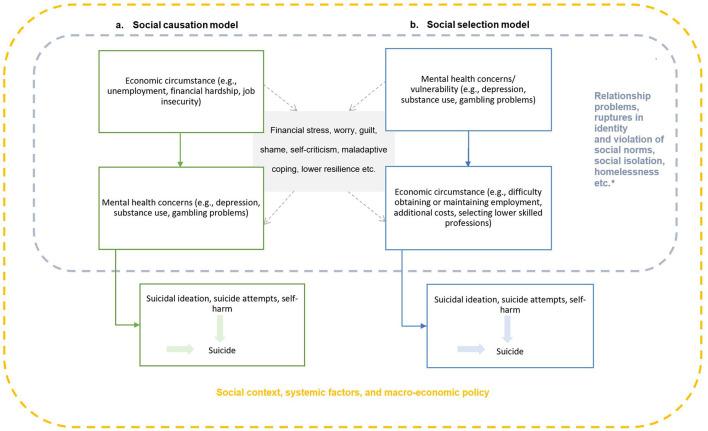
Understanding the social determinants and risk factors for suicidal behaviors underlies the development of effective suicide prevention interventions. This review focused on recently published literature (2010 onwards), with the aim to determine the role of economic factors (at the individual and population level) on suicidal behaviors and ideation as well as the effectiveness of interventions addressing these factors in reducing suicidal behaviors and ideation. Where available, literature examining the economic impact of COVID-19 was highlighted. Economic recession and unemployment are associated with increased risk of suicidal behavior at the population and individual level. Additionally, personal financial problems such as debt and financial strain are associated with increased risk of suicidal behavior and ideation at the individual level. Regarding interventions, unemployment benefits, employment protection legislation, higher minimum wage and active labor market programs may reduce suicide at the population level. However, it is not clear what impact they have at the individual level, nor in relation to suicide attempts, self-harm, or suicidal ideation. There was a lack of evidence as to the effectiveness of financially focused suicide prevention interventions at either level. Current findings were contextualized within, and advance, prominent social theoretical models. Recommendations focused on future areas of research, including the unfolding economic impact of COVID-19, as well as the co-design and evaluation of tailored interventions and/or gatekeeper training for those in the financial and welfare sector, and enhanced early education aimed at increasing financial literacy in young people before onset or exacerbation of financial hardship.
了解自杀行为的社会决定因素和风险因素是制定有效自杀预防干预措施的基础。本综述侧重于最近发表的文献(2010 年以后),旨在确定经济因素(个人和人群层面)在自杀行为和意念中的作用,以及针对这些因素的干预措施在降低自杀行为和意念方面的有效性。凡涉及研究 COVID-19 对经济影响的文献,均予突出强调。经济衰退和失业与人群和个人层面自杀行为风险增加有关。此外,个人财务问题,如债务和财务压力,与个人层面自杀行为和意念风险增加有关。关于干预措施,失业救济金、就业保护立法、提高最低工资和积极的劳动力市场计划可能会降低人群层面的自杀率。但是,尚不清楚它们对个人层面,或与自杀企图、自残或自杀意念有何影响。在这两个层面上,针对财务问题的预防自杀干预措施的有效性证据不足。目前的研究结果与突出的社会理论模型有关。建议侧重于未来的研究领域,包括正在显现的 COVID-19 对经济的影响,以及针对金融和福利部门人员的量身定制的干预措施和/或把关者培训的共同设计和评估,以及增强旨在提高年轻人金融知识的早期教育,以防止或减轻经济困难的发生或恶化。
 Zotero 插件