
Cantú 综合征中的 Kir6.1 和 SUR2B。
Kir6.1 and SUR2B in Cantú syndrome.
机构信息
Department of Cell Biology and Physiology, Center for the Investigation of Membrane Excitability Diseases (CIMED), Washington University, St. Louis, Missouri.
出版信息
Am J Physiol Cell Physiol. 2022 Sep 1;323(3):C920-C935. doi: 10.1152/ajpcell.00154.2022. Epub 2022 Jul 25.
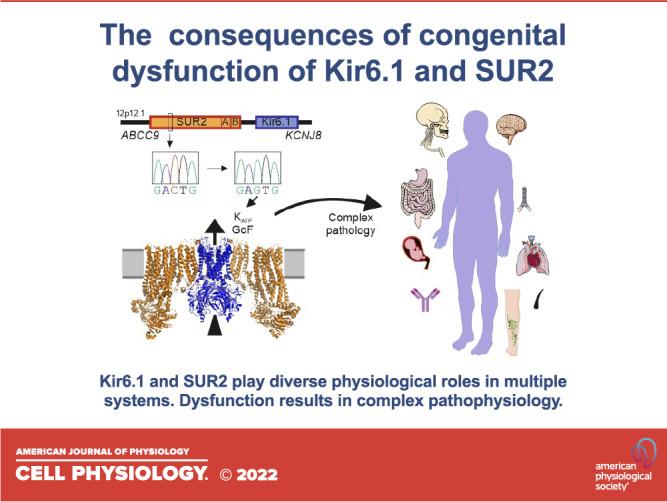
Kir6.1 and SUR2 are subunits of ATP-sensitive potassium (K) channels expressed in a wide range of tissues. Extensive study has implicated roles of these channel subunits in diverse physiological functions. Together they generate the predominant K conductance in vascular smooth muscle and are the target of vasodilatory drugs. Roles for Kir6.1/SUR2 dysfunction in disease have been suggested based on studies of animal models and human genetic discoveries. In recent years, it has become clear that gain-of-function (GoF) mutations in both genes result in Cantú syndrome (CS)-a complex, multisystem disorder. There is currently no targeted therapy for CS, but studies of mouse models of the disease reveal that pharmacological reversibility of cardiovascular and gastrointestinal pathologies can be achieved by administration of the K channel inhibitor, glibenclamide. Here we review the function, structure, and physiological and pathological roles of Kir6.1/SUR2B channels, with a focus on CS. Recent studies have led to much improved understanding of the underlying pathologies and the potential for treatment, but important questions remain: Can the study of genetically defined CS reveal new insights into Kir6.1/SUR2 function? Do these reveal new pathophysiological mechanisms that may be important in more common diseases? And is our pharmacological armory adequately stocked?
Kir6.1 和 SUR2 是广泛表达于多种组织中的 ATP 敏感性钾 (K) 通道亚单位。大量研究表明这些通道亚单位在多种生理功能中发挥作用。它们共同产生血管平滑肌中的主要 K 电导,并作为血管舒张药物的靶点。基于动物模型和人类遗传发现的研究,提示 Kir6.1/SUR2 功能障碍在疾病中的作用。近年来,已经清楚地表明这两个基因的获得性功能 (GoF) 突变导致 Cantú 综合征 (CS)——一种复杂的多系统疾病。目前尚没有针对 CS 的靶向治疗方法,但对疾病小鼠模型的研究表明,通过给予 K 通道抑制剂格列本脲,可使心血管和胃肠道病变的药理学逆转成为可能。本文综述了 Kir6.1/SUR2B 通道的功能、结构以及生理和病理作用,重点关注 CS。最近的研究极大地提高了对潜在病理和治疗潜力的认识,但仍存在重要问题:对基因定义明确的 CS 的研究能否揭示 Kir6.1/SUR2 功能的新见解?这些发现是否揭示了可能在更常见疾病中重要的新病理生理机制?我们的药理学武器库是否充足?
 Zotero 插件