
实验性诱导脓毒症后猪唾液中氧化还原状态生物标志物的变化
Changes in Biomarkers of Redox Status in Saliva of Pigs after an Experimental Sepsis Induction.
作者信息
López-Martínez María José, Escribano Damián, Ortín-Bustillo Alba, Franco-Martínez Lorena, González-Arostegui Luis Guillermo, Cerón José Joaquín, Rubio Camila Peres
机构信息
Interdisciplinary Laboratory of Clinical Analysis, Interlab-UMU, Regional Campus of International Excellence "Mare Nostrum", University of Murcia, 30100 Murcia, Spain.
Department of Animal Production, Regional Campus of International Excellence "Mare Nostrum", University of Murcia, 30100 Murcia, Spain.
出版信息
Antioxidants (Basel). 2022 Jul 16;11(7):1380. doi: 10.3390/antiox11071380.
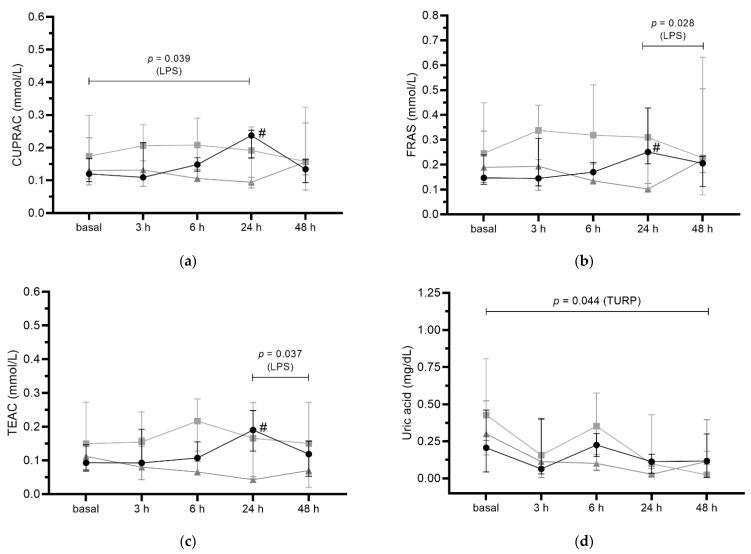
Saliva from pigs is gaining attention as an easy sample to obtain, being a source of biomarkers that can provide information on animal health and welfare. This study aimed to evaluate the changes that can occur in salivary biomarkers of the redox status of pigs with an experimentally induced sepsis. For that, the cupric reducing antioxidant capacity (CUPRAC), ferric reducing ability of saliva (FRAS), Trolox equivalent antioxidant capacity (TEAC), advanced oxidation protein products (AOPP), ferrous oxidation-xylenol orange (FOX), peroxide activity (POX-Act), and reactive oxygen-derived compounds (d-ROMs) were measured in the saliva of pigs with experimentally induced sepsis by endotoxin lipopolysaccharide (LPS), non-septic inflammation induced by turpentine, and in healthy individuals before and after 3 h, 6 h, 24 h, and 48 h. AOPP, POX-Act, and d-ROMs in the sepsis group were higher than in the control from 3 h to 24 h after the inoculation. CUPRAC, FRAS, and TEAC were higher in sepsis than the control group at 24 h. These changes were of higher magnitude than those that occurred in the turpentine group. In conclusion, our findings reveal that sepsis produces changes in salivary biomarkers of redox status, which opens the possibility of using them as potential biomarkers in this species.
猪的唾液作为一种易于获取的样本正受到关注,它是生物标志物的来源,能够提供有关动物健康和福利的信息。本研究旨在评估实验性诱导败血症的猪唾液中氧化还原状态生物标志物可能发生的变化。为此,在通过内毒素脂多糖(LPS)实验性诱导败血症的猪、松节油诱导的非败血症炎症猪以及健康个体的唾液中,于3小时、6小时、24小时和48小时前后测量了铜还原抗氧化能力(CUPRAC)、唾液铁还原能力(FRAS)、Trolox等效抗氧化能力(TEAC)、晚期氧化蛋白产物(AOPP)、亚铁氧化-二甲酚橙(FOX)、过氧化物活性(POX-Act)和活性氧衍生化合物(d-ROMs)。接种后3小时至24小时,败血症组的AOPP、POX-Act和d-ROMs高于对照组。败血症组在24小时时的CUPRAC、FRAS和TEAC高于对照组。这些变化的幅度大于松节油组发生的变化。总之,我们的研究结果表明,败血症会导致唾液氧化还原状态生物标志物发生变化,这为将其用作该物种潜在的生物标志物提供了可能性。

 Zotero 插件