
口腔临床分离的、和的抗生素敏感性及耐药基因
Antibiotic Susceptibility and Resistance Genes in Oral Clinical Isolates of , and .
作者信息
Castillo Yormaris, Delgadillo Nathaly Andrea, Neuta Yineth, Hernández Andrés, Acevedo Tania, Cárdenas Edwin, Montaño Andrea, Lafaurie Gloria Inés, Castillo Diana Marcela
机构信息
Unidad de Investigación Básica Oral-UIBO, Vicerrectoría de Investigaciones, Facultad de Odontología, Universidad El Bosque, 110121 Bogotá, Colombia.
Facultad de Odontología, Universidad El Bosque, 110121 Bogotá, Colombia.
出版信息
Antibiotics (Basel). 2022 Jul 4;11(7):888. doi: 10.3390/antibiotics11070888.
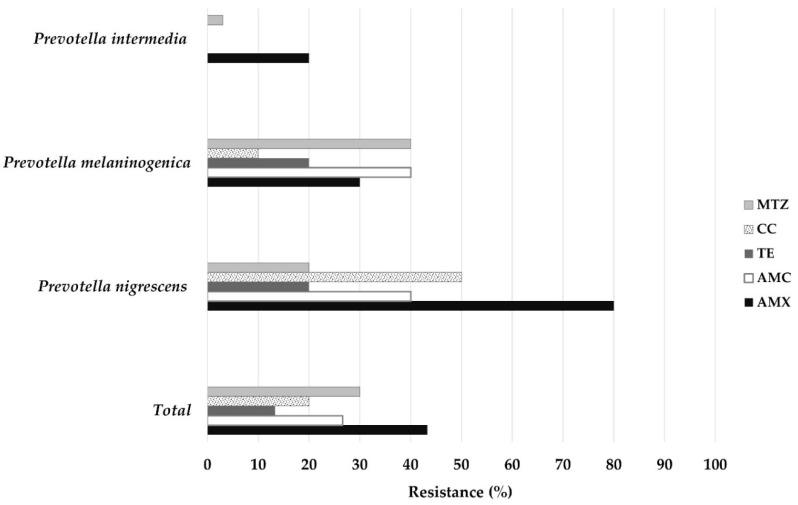
The genus is a normal constituent of the oral microbiota, and is commonly isolated from mechanically treated polymicrobial infections. However, antibiotic treatment is necessary for some patients. This study compared the antibiotic susceptibility and the presence of resistance genes in clinical oral isolates of , , and . Antibiotic susceptibility was assessed using the agar dilution method. PCR confirmed the species and resistance gene frequency in the species. The frequencies of species , , and were 30.2%, 45.7%, and 24.1%, respectively. No isolates of were resistant to amoxicillin/clavulanic acid, tetracycline, or clindamycin. and were resistant to amoxicillin/clavulanic acid and tetracycline at frequencies of 40% and 20%, respectively. was resistant to metronidazole at a frequency of 30%, at 20%, and at 40%. and were resistant to 50% and 10% clindamycin, respectively. The gene most frequently detected was , at 43.3%, followed by at 36.6%, at 26.6%, at 20%, , , and at 16.6%, and at 3.3%. was the species with the highest resistance to antibiotics such as amoxicillin/clavulanic acid, amoxicillin, and clindamycin, in addition to being the species with the largest number of genes compared to and
该属是口腔微生物群的正常组成部分,通常从机械处理的多微生物感染中分离出来。然而,一些患者需要进行抗生素治疗。本研究比较了临床口腔分离株中[具体菌名未给出]、[具体菌名未给出]和[具体菌名未给出]的抗生素敏感性和耐药基因的存在情况。使用琼脂稀释法评估抗生素敏感性。PCR确定了[具体菌名未给出]种的菌种和耐药基因频率。[具体菌名未给出]种、[具体菌名未给出]种和[具体菌名未给出]种的频率分别为30.2%、45.7%和24.1%。没有[具体菌名未给出]的分离株对阿莫西林/克拉维酸、四环素或克林霉素耐药。[具体菌名未给出]和[具体菌名未给出]对阿莫西林/克拉维酸和四环素的耐药频率分别为40%和20%。[具体菌名未给出]对甲硝唑的耐药频率为30%,[具体菌名未给出]为20%,[具体菌名未给出]为40%。[具体菌名未给出]和[具体菌名未给出]对克林霉素的耐药率分别为50%和10%。最常检测到的基因是[具体基因名未给出],占43.3%,其次是[具体基因名未给出],占36.6%,[具体基因名未给出]占26.6%,[具体基因名未给出]占20%,[具体基因名未给出]、[具体基因名未给出]和[具体基因名未给出]占16.6%,[具体基因名未给出]占3.3%。[具体菌名未给出]是对阿莫西林/克拉维酸、阿莫西林和克林霉素等抗生素耐药性最高的菌种,此外,与[具体菌名未给出]和[具体菌名未给出]相比,它也是拥有基因数量最多的菌种

 Zotero 插件