
基于胶原的微粗糙钛表面成骨纳米涂层。
Collagen-Based Osteogenic Nanocoating of Microrough Titanium Surfaces.
机构信息
Department of Oral and Maxillofacial Surgery, George-Augusta-University, 37075 Göttingen, Germany.
Institute for Bioprocessing and Analytical Measurement Techniques, 37308 Heiligenstadt, Germany.
出版信息
Int J Mol Sci. 2022 Jul 15;23(14):7803. doi: 10.3390/ijms23147803.
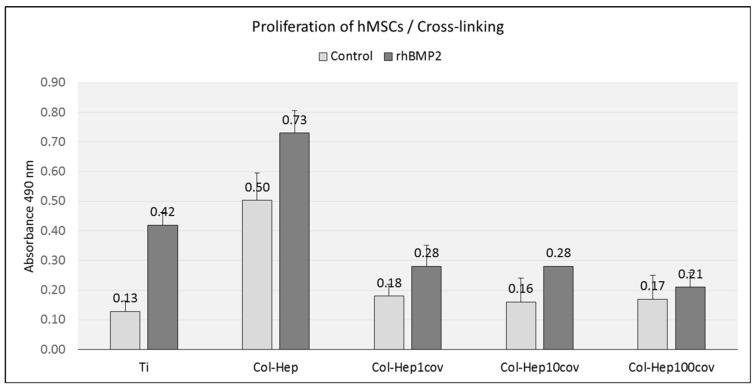
The aim of the present study was to develop a collagen/heparin-based multilayer coating on titanium surfaces for retarded release of recombinant human bone morphogenic protein 2 (rhBMP2) to enhance the osteogenic activity of implant surfaces. Polyelectrolyte multilayer (PEM) coatings were constructed on sandblasted/acid-etched surfaces of titanium discs using heparin and collagen. PEM films of ten double layers were produced and overlayed with 200 µL of a rhBMP2 solution containing 15 µg rhBMP2. Subsequently, cross-linking of heparin molecules was performed using EDC/NHS chemistry to immobilize the incorporated rhBMP2. Release characteristics for 3 weeks, induction of Alkaline Phosphatase (ALP) in C2C12 cells and proliferation of human mesenchymal stem cells (hMSCs) were evaluated to analyze the osteogenic capacity of the surface. The coating incorporated 10.5 µg rhBMP2 on average per disc and did not change the surface morphology. The release profile showed a delivery of 14.5% of the incorporated growth factor during the first 24 h with a decline towards the end of the observation period with a total release of 31.3%. Cross-linking reduced the release with an almost complete suppression at 100% cross-linking. Alkaline Phosphatase was significantly increased on day 1 and day 21, indicating that the growth factor bound in the coating remains active and available after 3 weeks. Proliferation of hMSCs was significantly enhanced by the non-cross-linked PEM coating. Nanocoating using collagen/heparin-based PEMs can incorporate clinically relevant amounts of rhBMP2 on titanium surfaces with a retarded release and a sustained enhancement of osteogenic activity without changing the surface morphology.
本研究旨在开发一种基于胶原/肝素的多层涂层,用于在钛表面上缓释重组人骨形态发生蛋白 2(rhBMP2),以增强植入物表面的成骨活性。使用肝素和胶原蛋白在喷砂/酸蚀处理的钛盘表面构建聚电解质多层(PEM)涂层。生产了十层双层 PEM 薄膜,并在其上面覆盖了 200 µL 含有 15 µg rhBMP2 的 rhBMP2 溶液。随后,使用 EDC/NHS 化学交联肝素分子以固定掺入的 rhBMP2。通过评估 rhBMP2 的 3 周释放特性、C2C12 细胞中碱性磷酸酶(ALP)的诱导以及人间充质干细胞(hMSC)的增殖来分析表面的成骨能力。该涂层平均每片盘掺入 10.5 µg rhBMP2,且不改变表面形貌。释放曲线显示,在最初的 24 小时内,有 14.5%的掺入生长因子被释放,在观察期结束时,释放量下降到 31.3%,呈下降趋势。交联将释放量减少了近 100%,几乎完全抑制了释放。碱性磷酸酶在第 1 天和第 21 天显著增加,表明涂层中结合的生长因子在 3 周后仍然保持活性和可用。非交联 PEM 涂层显著增强了 hMSC 的增殖。基于胶原/肝素的 PEM 的纳米涂层可以在钛表面上掺入临床上相关量的 rhBMP2,具有缓释作用,并持续增强成骨活性,而不改变表面形貌。


 Zotero 插件