
2 型糖尿病诊断时的糖尿病足风险分类与随后的死亡率风险:一项基于人群的队列研究。
Diabetic Foot Risk Classification at the Time of Type 2 Diabetes Diagnosis and Subsequent Risk of Mortality: A Population-Based Cohort Study.
机构信息
Institute of Applied Health Research, University of Birmingham, Birmingham, United Kingdom.
Department of Diabetes and Endocrinology, University Hospital Birmingham Foundation Trust, Birmingham, United Kingdom.
出版信息
Front Endocrinol (Lausanne). 2022 Jul 11;13:888924. doi: 10.3389/fendo.2022.888924. eCollection 2022.
AIM
We aimed to compare the mortality of individuals at low, moderate, and high risk of diabetic foot disease (DFD) in the context of newly diagnosed type 2 diabetes, before developing active diabetic foot problem.
METHODS
This was a population-based cohort study of adults with newly diagnosed type 2 diabetes utilizing IQVIA Medical Research Data. The outcome was all-cause mortality among individuals with low, moderate, and high risk of DFD, and also in those with no record of foot assessment and those who declined foot examination.
RESULTS
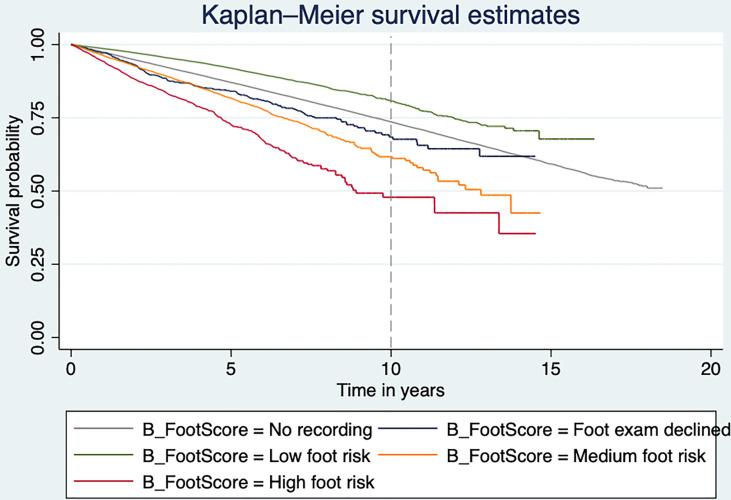
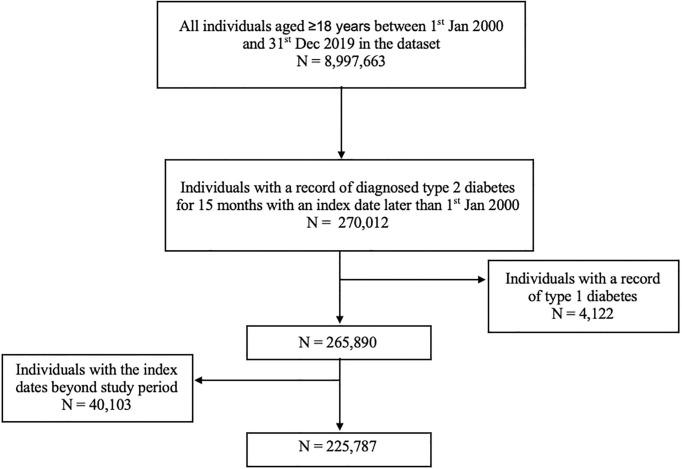
Of 225,787 individuals with newly diagnosed type 2 diabetes, 34,061 (15.1%) died during the study period from January 1, 2000 to December 31, 2019. Moderate risk and high risk of DFD were associated with increased mortality risk compared to low risk of DFD (adjusted hazard ratio [aHR] 1.50, 95% CI 1.42, 1.58; aHR 2.01, 95% CI 1.84, 2.20, respectively). Individuals who declined foot examination or who had no record also had increased mortality risk of 75% and 25% vs. those at low risk of DFD, respectively (aHR 1.75, 95% CI 1.51, 2.04; aHR 1.25, 95% CI 1.20, 1.30).
CONCLUSION
Individuals with new-onset type 2 diabetes who had moderate to high risk of DFD were more likely to die compared to those at low risk of DFD. The associations between declined foot examination and absence of foot examinations, and increased risk of mortality further highlight the importance of assessing foot risk as it identifies not only patients at risk of diabetic foot ulceration but also mortality.
目的
我们旨在比较新诊断 2 型糖尿病患者中糖尿病足病(DFD)低、中、高危个体的死亡率,这些患者在出现活动性糖尿病足问题之前。
方法
这是一项基于人群的队列研究,研究对象为使用 IQVIA 医疗研究数据的新诊断 2 型糖尿病成年人。结局为 DFD 低、中、高危个体以及无足部评估记录和拒绝足部检查个体的全因死亡率。
结果
在 225787 名新诊断 2 型糖尿病患者中,34061 名(15.1%)在 2000 年 1 月 1 日至 2019 年 12 月 31 日的研究期间死亡。与 DFD 低风险相比,中度风险和高风险与死亡率风险增加相关(调整后的危险比[aHR]1.50,95%可信区间[CI]1.42,1.58;aHR 2.01,95%CI 1.84,2.20)。拒绝足部检查或无足部检查记录的个体与 DFD 低风险个体相比,死亡率风险分别增加 75%和 25%(aHR 1.75,95%CI 1.51,2.04;aHR 1.25,95%CI 1.20,1.30)。
结论
与 DFD 低风险个体相比,新发 2 型糖尿病患者中具有中到高度 DFD 风险的个体更有可能死亡。拒绝足部检查和无足部检查记录与死亡率风险增加之间的关联进一步强调了评估足部风险的重要性,因为它不仅可以识别有糖尿病足溃疡风险的患者,还可以识别有死亡风险的患者。
 Zotero 插件