
凝结芽孢杆菌联合壳寡糖通过调节肠道菌群改善 DSS 诱导的小鼠结肠炎。
Bacillus coagulans in Combination with Chitooligosaccharides Regulates Gut Microbiota and Ameliorates the DSS-Induced Colitis in Mice.
机构信息
Antibiotics Research and Re-evaluation Key Laboratory of Sichuan Province, Sichuan Industrial Institute of Antibiotics, School of Pharmacy, Chengdu Universitygrid.411292.d, Chengdu, People's Republic of China.
State Key Laboratory of Agricultural Microbiology, Hubei Hongshan Laboratory, College of Life Science and Technology, Huazhong Agricultural Universitygrid.35155.37, Wuhan, People's Republic of China.
出版信息
Microbiol Spectr. 2022 Aug 31;10(4):e0064122. doi: 10.1128/spectrum.00641-22. Epub 2022 Jul 28.
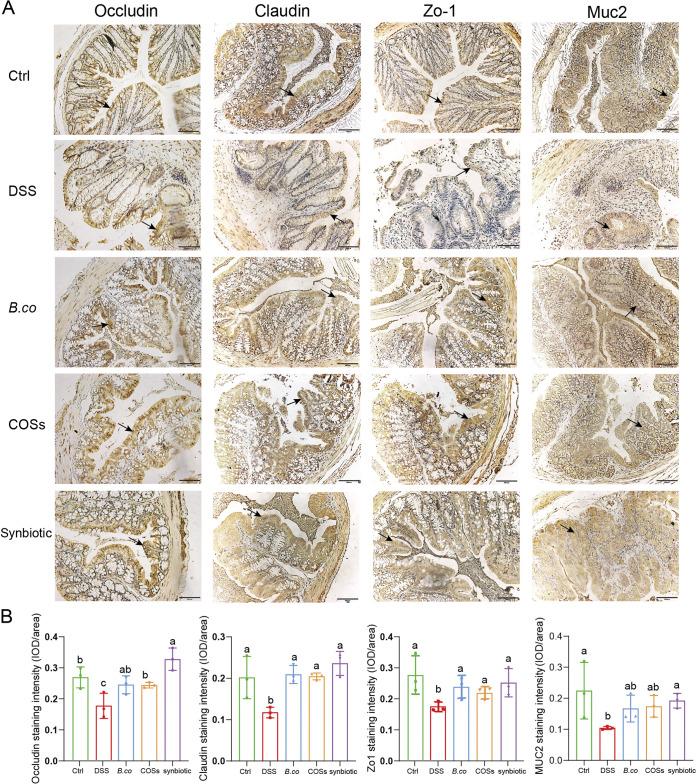
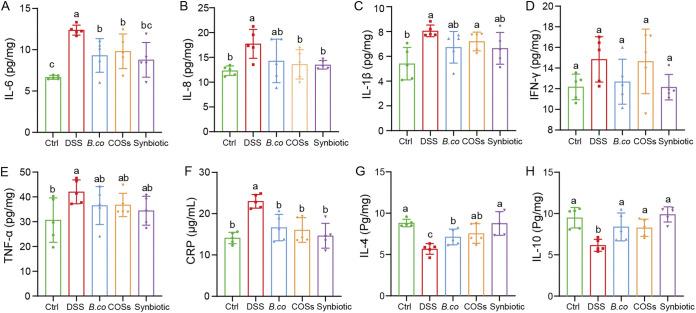
Ulcerative colitis (UC) are chronic inflammatory disorders, which may be caused by intestinal barrier dysfunction, immune system disorders and intestinal microbiota dysbiosis. Synbiotic, the combination of probiotics and prebiotics, is thought to be a pragmatic approach in mitigating inflammation in UC. Bacillus coagulans has been recognized as a potential probiotic for treating intestinal diseases because of its favorable industrial and probiotic properties, including sporulation and lactic acid production. In this study, we evaluated the treatment effects of the FCYS01 spores with or without the chitooligosaccharides (COSs) on UC generated using dextran sulfate sodium (DSS) in mice. Supplementation of spores, prebiotic COSs or the synbiotic (the spores + COSs) had a significant positive effect on DSS-induced UC. The disease activity index and histological damage score were significantly reduced after these supplementations. Compared to DSS group, these supplementations also significantly modulated the cytokines IL-4, IL-6, IL-8, IL-10, and C-reactive protein (CRP) levels and significantly maintained expressions of tight junction proteins and mucin protein and promotes recovery of the intestinal barrier. In addition, these supplementations regulate the composition of gut microbiota and improve the production of short-chain fatty acids (SCFAs), through enrichment of SCFA-producing bacteria, such as and species. In summary, the synbiotic ameliorated the overall inflammatory status of the experimental UC model and showed a better treatment effect than or COSs did alone as revealed by the markers such as, colon length, IL-4 and Occludin levels. Probiotic and prebiotic are believed to be useful in alleviating the inflammatory, thereby resolving or preventing the severity of UC. Spore-forming bacteria Bacillus coagulans show advantages of stability and probiotic effects, being suggested as the important probiotics for UC treatment. Here, we demonstrate that administration of spores, chitooligosaccharides (COSs), or the synbiotic attenuates DSS-induced colitis and significantly correlates with altered gut immune responses. The treatment effect of the synbiotic is inferred to be relied on the enrichment of probiotic bacteria, such as and species, which are reported to be crucial important for gut health. Our findings facilitate the development of therapeutic and preventive strategies for UC using spore-forming lactic acid bacteria in combination with COSs.
溃疡性结肠炎(UC)是一种慢性炎症性疾病,可能由肠道屏障功能障碍、免疫系统紊乱和肠道微生物失调引起。共生元,即益生菌和益生元的组合,被认为是减轻 UC 炎症的一种实用方法。凝结芽孢杆菌由于其良好的工业和益生菌特性,包括孢子形成和产乳酸,已被认为是治疗肠道疾病的潜在益生菌。在这项研究中,我们评估了 FCYS01 孢子与壳寡糖(COSs)联合或不联合应用于葡聚糖硫酸钠(DSS)诱导的小鼠 UC 的治疗效果。补充孢子、益生元 COS 或共生元(孢子+COS)对 DSS 诱导的 UC 有显著的积极影响。这些补充剂可显著降低疾病活动指数和组织学损伤评分。与 DSS 组相比,这些补充剂还显著调节了细胞因子 IL-4、IL-6、IL-8、IL-10 和 C 反应蛋白(CRP)水平,并显著维持了紧密连接蛋白和粘蛋白蛋白的表达,促进了肠道屏障的恢复。此外,这些补充剂通过富集产生短链脂肪酸(SCFAs)的细菌,如和 ,调节肠道微生物群落的组成,提高 SCFAs 的产生。总之,共生元改善了实验性 UC 模型的整体炎症状态,与单独使用 或 COSs 相比,通过改善标记物如结肠长度、IL-4 和 Occludin 水平,显示出更好的治疗效果。益生菌和益生元被认为有助于减轻炎症,从而缓解或预防 UC 的严重程度。产孢子细菌凝结芽孢杆菌表现出稳定性和益生菌作用的优势,被认为是 UC 治疗的重要益生菌。在这里,我们证明了 孢子、壳寡糖(COSs)或共生元的给药可减轻 DSS 诱导的结肠炎,并与改变的肠道免疫反应显著相关。共生元的治疗效果推断依赖于益生菌的富集,如 和 ,这些细菌被报道对肠道健康至关重要。我们的发现为使用产孢子乳酸菌与 COSs 联合治疗 UC 提供了治疗和预防策略的发展。



 Zotero 插件