
所有类型的肥胖和身体活动不足与哮喘患者日常生活活动受限风险相关。
All Types Obesity and Physical Inactivity Associated with the Risk of Activity of Daily Living Limitations Among People with Asthma.
作者信息
Alhammad Saad A, Alwadeai Khalid S
机构信息
Department of Rehabilitation Science, College of Applied Medical Sciences, King Saud University, Riyadh, Kingdom of Saudi Arabia.
出版信息
J Multidiscip Healthc. 2022 Jul 22;15:1573-1583. doi: 10.2147/JMDH.S368660. eCollection 2022.
PURPOSE
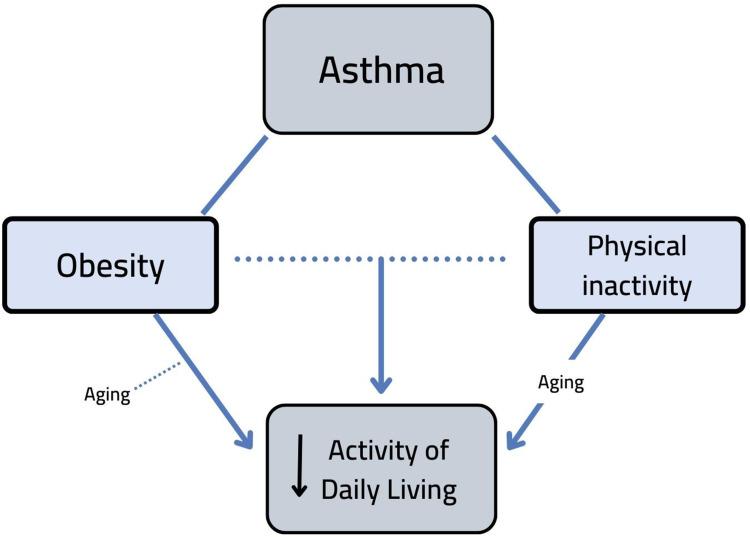
To examine the association between all types of obesity, physical inactivity, and the risk of activity of daily living limitations in people with asthma.
PATIENTS AND METHODS
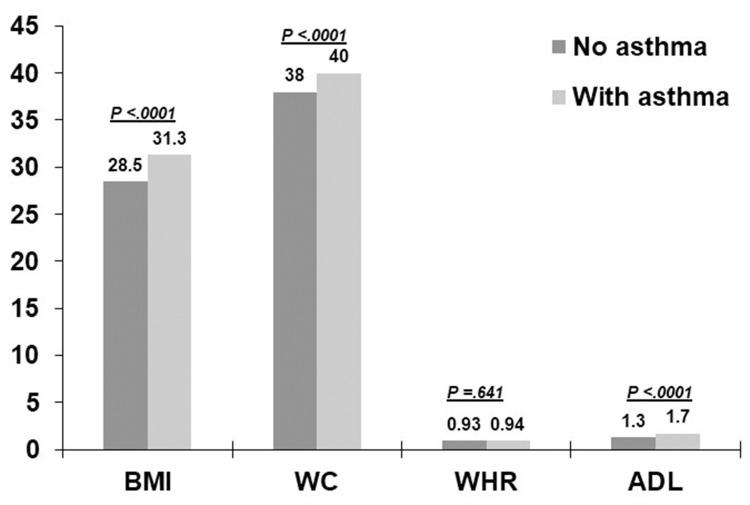
In this cross-sectional study, data from 2555 people aged between 25 and 74 years were acquired from the National Survey of Midlife Development in the United States Refresher conducted between 2011 and 2014. Self-reported questions were used to specify the presence or absence of asthma and physical inactivity. All participants were categorized as having no asthma or asthma. Obesity was defined based on three distinctive indicators: body mass index, waist circumference, and waist-to-hip ratio.
RESULTS
Logistic regression analysis showed that people with asthma who had all types of obesity alone or both all types of obesity and physical inactivity were significantly (P <0.0001) almost more than three times more likely to have limitations in the activity of daily living than those without this condition, even after adjusting for all covariates. Moreover, the odds of activity of daily living limitations were 1.69 times increased in asthma patients with physical inactivity alone, but this increase in risk was not significant (P =0.465). In addition, the odds of activity of daily living limitations were significantly (P <0.0001) more than twice independently in people with asthma aged between 60 and 74 years, female, undergraduate level of education, smoking, and having joint/bone underlying diseases.
CONCLUSION
The results demonstrated that the presence of all types of obesity is related to a higher risk of activity of daily living limitations in people with asthma than in those without asthma. Having both all types of obesity and physical inactivity are also linked to a greater risk of activity of daily living limitations in these patients.
目的
研究各类肥胖、身体活动不足与哮喘患者日常生活活动受限风险之间的关联。
患者与方法
在这项横断面研究中,2011年至2014年间开展的美国中年发展全国调查更新版收集了2555名年龄在25至74岁之间人群的数据。通过自我报告问题来确定是否患有哮喘和身体活动不足情况。所有参与者被分为无哮喘或患有哮喘。肥胖根据三个不同指标定义:体重指数、腰围和腰臀比。
结果
逻辑回归分析显示,仅患有各类肥胖或同时患有各类肥胖和身体活动不足的哮喘患者,即便在对所有协变量进行调整后,其日常生活活动受限的可能性显著高于(P<0.0001)无此情况的患者,几乎是其三倍多。此外,仅身体活动不足的哮喘患者日常生活活动受限的几率增加了1.69倍,但这种风险增加并不显著(P =0.465)。此外,年龄在60至74岁之间、女性、本科教育水平、吸烟且患有关节/骨骼基础疾病的哮喘患者,其日常生活活动受限的几率独立显著增加(P<0.0001),超过两倍。
结论
结果表明,各类肥胖的存在与哮喘患者日常生活活动受限的较高风险相关,高于无哮喘患者。同时患有各类肥胖和身体活动不足也与这些患者日常生活活动受限的更大风险相关。

 Zotero 插件