
新冠疫情期间美国人类活动和社会人口统计学的时空影响。
Spatiotemporal impacts of human activities and socio-demographics during the COVID-19 outbreak in the US.
机构信息
Lyles School of Civil Engineering, Purdue University, West Lafayette, USA.
Department of Civil, Construction and Environmental Engineering, The University of Alabama, Tuscaloosa, USA.
出版信息
BMC Public Health. 2022 Aug 1;22(1):1466. doi: 10.1186/s12889-022-13793-7.
BACKGROUND
Understanding non-epidemiological factors is essential for the surveillance and prevention of infectious diseases, and the factors are likely to vary spatially and temporally as the disease progresses. However, the impacts of these influencing factors were primarily assumed to be stationary over time and space in the existing literature. The spatiotemporal impacts of mobility-related and social-demographic factors on disease dynamics remain to be explored.
METHODS
Taking daily cases data during the coronavirus disease 2019 (COVID-19) outbreak in the US as a case study, we develop a mobility-augmented geographically and temporally weighted regression (M-GTWR) model to quantify the spatiotemporal impacts of social-demographic factors and human activities on the COVID-19 dynamics. Different from the base GTWR model, the proposed M-GTWR model incorporates a mobility-adjusted distance weight matrix where travel mobility is used in addition to the spatial adjacency to capture the correlations among local observations.
RESULTS
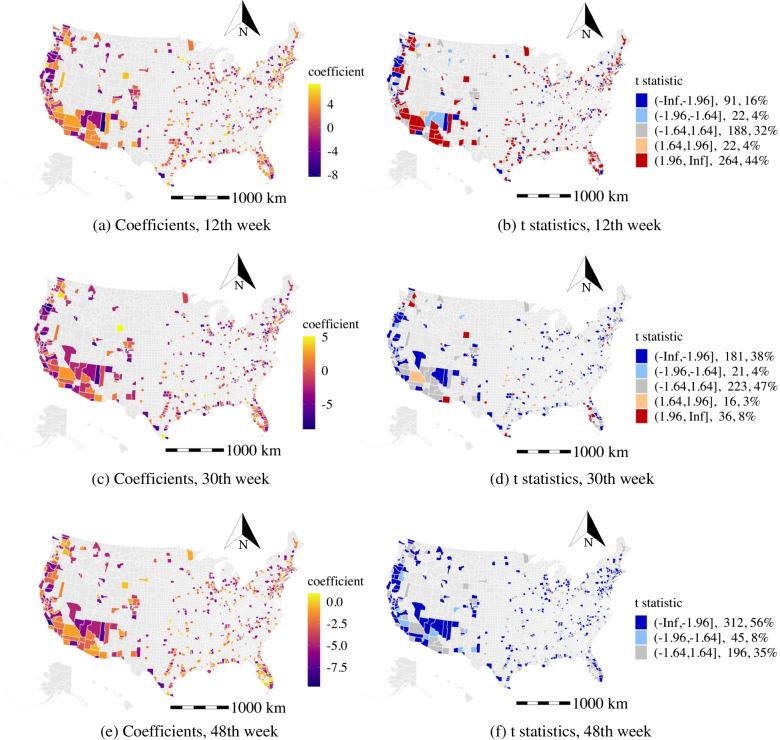
The results reveal that the impacts of social-demographic and human activity variables present significant spatiotemporal heterogeneity. In particular, a 1% increase in population density may lead to 0.63% more daily cases, and a 1% increase in the mean commuting time may result in 0.22% increases in daily cases. Although increased human activities will, in general, intensify the disease outbreak, we report that the effects of grocery and pharmacy-related activities are insignificant in areas with high population density. And activities at the workplace and public transit are found to either increase or decrease the number of cases, depending on particular locations.
CONCLUSIONS
Through a mobility-augmented spatiotemporal modeling approach, we could quantify the time and space varying impacts of non-epidemiological factors on COVID-19 cases. The results suggest that the effects of population density, socio-demographic attributes, and travel-related attributes will differ significantly depending on the time of the pandemic and the underlying location. Moreover, policy restrictions on human contact are not universally effective in preventing the spread of diseases.
背景
了解非流行病学因素对于传染病的监测和预防至关重要,并且这些因素可能随着疾病的发展在空间和时间上发生变化。然而,在现有文献中,这些影响因素的影响主要被假设为在时间和空间上是固定的。移动性相关因素和社会人口因素对疾病动态的时空影响仍有待探索。
方法
以美国 2019 年冠状病毒病(COVID-19)疫情期间的每日病例数据为例,我们开发了一种移动增强的地理和时间加权回归(M-GTWR)模型,以量化社会人口因素和人类活动对 COVID-19 动态的时空影响。与基础 GTWR 模型不同,所提出的 M-GTWR 模型包含一个经过移动调整的距离权重矩阵,其中除了空间邻接性之外,还使用出行流动性来捕捉局部观测值之间的相关性。
结果
结果表明,社会人口和人类活动变量的影响存在显著的时空异质性。具体而言,人口密度增加 1%可能导致每日病例增加 0.63%,平均通勤时间增加 1%可能导致每日病例增加 0.22%。尽管人类活动的增加通常会加剧疾病的爆发,但我们报告称,在人口密度高的地区,与杂货店和药店相关的活动的影响并不显著。并且,工作场所和公共交通的活动发现会根据特定地点的不同而增加或减少病例数。
结论
通过移动增强的时空建模方法,我们可以量化非流行病学因素对 COVID-19 病例的时变和空变影响。结果表明,人口密度、社会人口属性和与旅行相关的属性的影响在大流行的不同时间和潜在位置会有显著差异。此外,限制人类接触的政策在防止疾病传播方面并非普遍有效。




 Zotero 插件