
哌拉西林-他唑巴坦与碳青霉烯类药物治疗产超广谱β-内酰胺酶大肠埃希菌菌血症患者的疗效比较:低 OXA-1 共产生率地区的初步分析。
Comparison of the Treatment Outcome of Piperacillin-Tazobactam versus Carbapenems for Patients with Bacteremia Caused by Extended-Spectrum β-Lactamase-Producing Escherichia coli in Areas with Low Frequency of Coproduction of OXA-1: a Preliminary Analysis.
机构信息
Department of Infectious Diseases, Cancer Institute Hospital, Japanese Foundation for Cancer Research, Tokyo, Japan.
Department of Hematology, Iizuka Hospital, Iizuka, Fukuoka, Japan.
出版信息
Microbiol Spectr. 2022 Aug 31;10(4):e0220622. doi: 10.1128/spectrum.02206-22. Epub 2022 Aug 2.
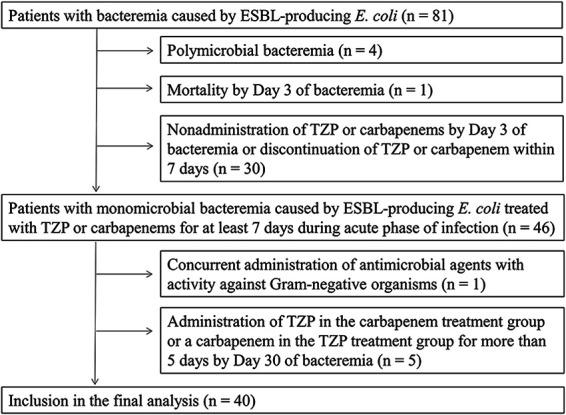
Although piperacillin-tazobactam (TZP) was shown to be less effective than carbapenems in treating bacteremia due to extended-spectrum β-lactamase-producing (ESBL)-producing organisms in a randomized controlled trial, the fact that many of the causative organisms co-produced inhibitor-resistant OXA-1 along with ESBLs may have influenced the results. In this study, we compared the therapeutic effectiveness of TZP and carbapenem in treating ESBL-producing Escherichia coli bacteremia in areas with low frequency of OXA-1 co-production. Forty patients, 14 in the TZP treatment group and 26 in the carbapenem treatment group, were included in the analysis. There were no significant differences in patient background between the two groups. Urinary tract infection or cholangitis was the source of bacteremia in 26 patients (65%), and the Pitt bacteremia score was zero or one in 35 patients (87.5%). Only four (11.4%) of the 35 causative isolates available for microbiological analysis harbored , and only three (8.6%) were non-susceptible to TZP. Seventeen (48.6%) isolates carried , none of which carried other β-lactamase genes. No significant difference in the frequency of treatment failure on day 14 of bacteremia was documented between the TZP and carbapenem treatment groups in both the crude analysis and the inverse probability of treatment weighting-adjusted analysis. This study demonstrates that TZP may be a treatment option for non-severe cases of ESBL-producing E. coli bacteremia in areas with low frequency of OXA-1 co-production. Although carbapenems are considered the drug of choice for severe infections caused by extended-spectrum β-lactamase-producing (ESBL)-producing organisms, other therapeutic options are being explored to avoid increasing the selective pressure for carbapenem-resistant organisms. In this study, it was suggested that piperacillin-tazobactam may be as effective as carbapenems for the treatment of mild bacteremia caused by ESBL-producing Escherichia coli in areas where OXA-1 co-production by ESBL-producing E. coli is rare. The genetic background of each regional epidemic clone differs even among multidrug-resistant bacteria classified under the same name (e.g., ESBL-producing organisms), resulting in possible differences in the efficacy of therapeutic agents. Exploration of treatment options for multidrug-resistant organisms according to local epidemiology is worthwhile from the perspective of antimicrobial stewardship.
虽然在一项随机对照试验中,与碳青霉烯类药物相比,哌拉西林-他唑巴坦(TZP)治疗产超广谱β-内酰胺酶(ESBL)的生物体引起的菌血症的效果较差,但实际上,许多致病生物体同时产生了抑制剂耐药的 OXA-1 以及 ESBLs,这可能影响了结果。在这项研究中,我们比较了 TZP 和碳青霉烯类药物在治疗产 ESBL 的大肠埃希菌菌血症方面的疗效,这些地区的 OXA-1 共产生率较低。40 名患者,包括 14 名 TZP 治疗组患者和 26 名碳青霉烯类药物治疗组患者,纳入了分析。两组患者的背景无显著差异。26 名患者(65%)的菌血症源为尿路感染或胆管炎,35 名患者(87.5%)的 Pitt 菌血症评分均为零或一。仅对 35 种可进行微生物学分析的致病分离株中的 4 种(11.4%)进行了分析,且只有 3 种(8.6%)对 TZP 不敏感。17 种(48.6%)分离株携带,没有一种携带其他β-内酰胺酶基因。在菌血症发生的第 14 天,无论是在粗分析还是在逆概率治疗加权调整分析中,TZP 和碳青霉烯类药物治疗组的治疗失败频率均无显著差异。这项研究表明,在 OXA-1 共产生率较低的地区,TZP 可能是治疗产 ESBL 的大肠埃希菌非严重菌血症的一种治疗选择。虽然碳青霉烯类药物被认为是治疗产超广谱β-内酰胺酶(ESBL)的生物体引起的严重感染的首选药物,但为了避免增加对碳青霉烯类耐药菌的选择性压力,其他治疗选择正在被探索。在这项研究中,有人提出,哌拉西林-他唑巴坦可能与碳青霉烯类药物一样有效,可用于治疗产 ESBL 的大肠埃希菌引起的轻度菌血症,在产 ESBL 的大肠埃希菌中,OXA-1 的共产生率较低。即使是被归为同一名称的多药耐药菌(如产 ESBL 的生物体),每个地区流行克隆的遗传背景也存在差异,这可能导致治疗药物的疗效存在差异。从抗菌药物管理的角度来看,根据当地的流行病学情况,探索多药耐药菌的治疗选择是值得的。

 Zotero 插件